<?xml version="1.0" encoding="UTF-8"?>
<feed xmlns="http://www.w3.org/2005/Atom">
    <title>THE Genron NPO</title>
    <link rel="alternate" type="text/html" href="https://www.genron-npo.net/en/" />
    <link rel="self" type="application/atom+xml" href="https://www.genron-npo.net/en/atom.xml" />
    <id>tag:www.genron-npo.net,2018-03-14:/en//27</id>
    <updated>2026-05-11T03:16:56Z</updated>
    <generator uri="http://www.sixapart.com/movabletype/">Movable Type Pro 6.3.7</generator>
<entry>
    <title>Tokyo Conference 2026 Report - Publications</title>
    <link rel="alternate" type="text/html" href="https://www.genron-npo.net/en/publications/archives/5685.html" />
    <id>tag:www.genron-npo.net,2026:/en/publications//5.5685</id>
    <published>2026-05-11T02:41:48Z</published>
    <updated>2026-05-11T03:16:56Z</updated>
    <summary> Download Report  Foreword Yasushi Kudo President, The Genron NPO Has the world really entered an era of powerdriven politics? Tokyo Conference 2026 confronted the harsh reality of this question head-on. The current clash between political ideologies was symbolized by an exchange between Keith Kello...</summary>
    <author>
        <name>言論NPO</name>
    </author>
        <category term="Reports" scheme="http://www.sixapart.com/ns/types#category" />
    <content type="html" xml:lang="ja" xml:base="https://www.genron-npo.net/en/publications/">
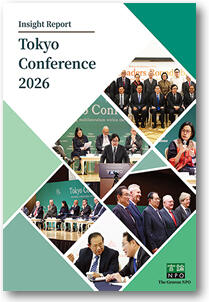
        <![CDATA[<p><a href="https://www.genron-npo.net/en/files/tokyoconference2026.pdf"><img alt="tokyoconference2026_s.jpg" src="/en/publications/images/befffa04ce2d7623f30925565ffa434582511aaa.jpg" width="180" height="260" class="mt-image-left" style="float: left; margin: 0 20px 20px 0;" /></a></p>
<p><br><br><br><br />
<a href="https://www.genron-npo.net/en/files/tokyoconference2026.pdf"><strong>Download Report </strong></a><br />
<br clear="all"></p>
<div class="ao">
<h2 class="title_type02">Foreword</h2>
<div align="right"><strong>Yasushi Kudo<br>
President, The Genron NPO</strong></div>
<p><br />
Has the world really entered an era of powerdriven politics?</p>
<p>Tokyo Conference 2026 confronted the harsh reality of this question head-on. The current clash between political ideologies was symbolized by an exchange between Keith Kellogg, a key figure in the Trump Administration, and Paolo Gentiloni, former prime minister of Italy and a leading figure in European politics, in which the US promoted the realism-based premise of "peace through power," while Europe asserted that accepting that premise will result in a collapse of the international order. The discussion went beyond simple differences in policy and highlighted the conflict between the fundamental ideologies that govern the way the world works ? namely idealism versus realism.</p>
<p>As can be seen in Ukraine, Gaza, and Iran, that conflict is not merely an academic one. The actions of the major powers are already having an increasingly potent influence on the international community, yet the participants in the Tokyo Conference shared the opinion that the world cannot turn a blind eye to the "reality of power" as doing so would result in the world tumbling into chaos. This begged the question of how to maintain order in the world within these two realities.</p>
<p>The current situation made the holding of the first Asian Leaders Roundtable during the Tokyo Conference even more significant. Until now. Discussions on how to construct the global order have primarily revolved around Europe and the United States, with Asia being a passive recipient of any decisions made. However, this Japanese platform has provided a means by which the countries of Asia can have their own say and assume their own responsibilities as key players in that process. This shift is symbolized in a</p>
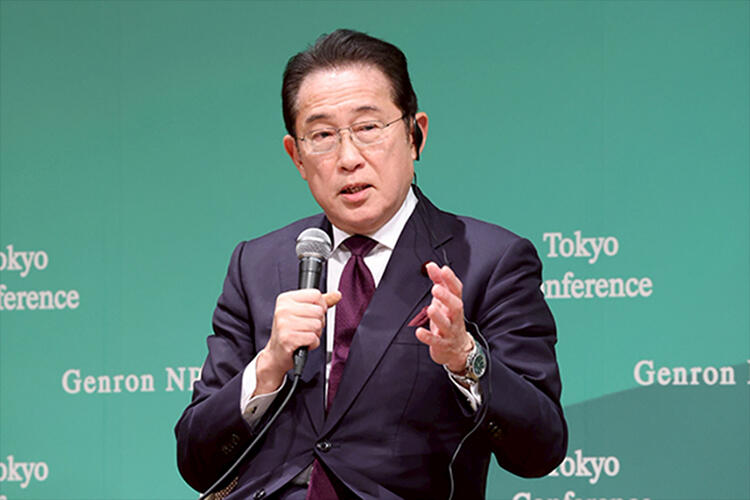
<p>A statement made by former Japanese Prime Minister Fumio Kishida, who said that "Asia should be responsible for the Asian order." Asia stands at the center of global economic growth, and has reached the stage where it too must have a hand in shaping the future of the international order.</p>
<p>Another noteworthy result of the Conference was this year's Chairman's Statement, which clearly advocated against the ready acceptance of the concept of "peace through power" and urged that the world uphold the rule of law and maintain support for multilateralism. The global order will not restore itself; it can only be maintained by those involved making the correct choices and putting their words into action.</p>
<p>But what must the world do to come up with a solution? First, we must directly confront the reality of power-driven politics and consider how to build a framework that prevents the world from slipping into chaos. Second, we must ask who will take on that role of re-building the order, as we dare not entrust that responsibility solely to the major powers. The middle powers of the world, including Japan and other Asian countries, must actively contribute to this effort or the global order will become a hollow shell of what it needs to be. Third, we must determine how to build a bridge between the idealists and the realists rather than pitting them against each other.</p>
<p>Tokyo Conference 2026 did not present clear and concrete solutions, but it does represent a major step forward towards finding such solutions as it highlighted the real issues the world is facing, and provided a direction for the world to take going forward. Cooperation is not something that comes naturally to countries in an era of growing division, and it is for that very reason that we must actively endeavor to design and support means through which cooperation can be achieved.</p>
<p>This discussion may have begun in Tokyo, but it is only the first step in what will surely be a more extensive effort in the future.</div></p>]]>
    </content>
</entry>
<entry>
    <title>Tokyo Conference 2026 Chair&apos;s Statement - Projects/Events</title>
    <link rel="alternate" type="text/html" href="https://www.genron-npo.net/en/pp/archives/5683.html" />
    <id>tag:www.genron-npo.net,2026:/en/pp//6.5683</id>
    <published>2026-03-31T07:52:50Z</published>
    <updated>2026-03-31T08:05:22Z</updated>
    <summary>Tokyo Conference 2026 was held over two days from March 10 to 12. The Conference welcomed 40 individuals to Tokyo, with participants including representatives from think tanks in twelve countries ? India, Indonesia, Singapore, Brazil, Belgium, and the member nations of the G7 ? alongside current gov...</summary>
    <author>
        <name>言論NPO</name>
    </author>
        <category term="The Tokyo Conference" scheme="http://www.sixapart.com/ns/types#category" />
        <category term="The Tokyo Conference 2026" scheme="http://www.sixapart.com/ns/types#category" />
    <content type="html" xml:lang="ja" xml:base="https://www.genron-npo.net/en/pp/">
        <![CDATA[<p>Tokyo Conference 2026 was held over two days from March 10 to 12. The Conference welcomed 40 individuals to Tokyo, with participants including representatives from think tanks in twelve countries ? India, Indonesia, Singapore, Brazil, Belgium, and the member nations of the G7 ? alongside current government ministers and other political leaders from Europe, North America, and Asia. </p>
<p>This year we commemorate the tenth anniversary of the Tokyo Conference. Over the last ten years, we have witnessed a growing instability in the premises upon which the post-Cold War international order was built, and the world is undergoing a structural transformation into a multipolar world defined by intense competition and conflict between the major powers. </p>
<p>The use of power and coercion on the part of major powers such as the United States and Russia is no longer the exception to the rule, and the logic of "might makes right" is increasingly rearing its head around the world. The Ukraine War, the Gaza conflict, and the large-scale US and Israeli military operations against Iran are all emblematic of this phenomenon. </p>
<p>The rules and foundation of international cooperation that the world once shared have weakened; we have reached a point where they are barely functioning as designed. </p>
<p>We conducted an emergency survey in cooperation with 36 think tanks around the world before the Conference began to determine how experts assess the current state of the international order and relationships between the major powers. The survey revealed that leading experts around the world share the belief that this new power-based order dominated by the major powers is no longer a temporary phenomenon.</p>
<p>The arrival of the "Age of Power" does not necessarily mean that the world is moving towards a G2-style structure with power concentrated in the hands of the United States of America and China. The world is actually moving towards a more unstable multipolar reality. In addition, the consensus among experts is that the rules-based order has not disappeared but has become merely a formality, and it will be unable to function in the future without proactive intervention on the part of the nations that shape the international order. </p>
<p>Our discussions over the last two days have been centered on the perspectives shared by the 293 experts around the world who participated in our survey. </p>
<p>With the major powers increasingly using coercion on other countries to achieve their objectives worldwide, we must ask ourselves what must be done to defend the principles of multilateralism and the rules-based order, and whether such a defense is even possible. These are the issues that the Tokyo Conference examined from various angles. Two points became clear during our discussions. </p>
<p><br />
First, we must not abandon the rule of law and multilateralism even in an era in which power politics have become the norm. Although we recognize that the actions of the major powers have an immense impact on the world, we should not underestimate the ability of the middle powers and other nations to shape the global order. </p>
<p>Second, the international order will not restore itself; it can only be shaped by deliberate choices made by the countries that form it and by cooperation between them. Although it may be difficult to restore a comprehensive form of multilateralism, there is still the possibility that we can build a more limited form of region and issue-based cooperation. Whatever difficulties we face, we must not cease our efforts to realize such a goal. </p>
<p>Armed with a shared awareness of the issues, we focused our discussions on four potential lines of action. </p>
<p><br />
<div class="ao"></p>
<p>First, we should re-affirm our support of international law and the rule of law, and ensure that they are applied in all regions and under all circumstances. While it will become difficult for the United Nations to remain at the heart of the international order, we must not lose sight of the rules and international norms agreed upon by its member nations. </p>
<p>The world should work together to end the war being waged between the United States, Israel, and Iran, and prevent the conflict from escalating and engulfing the entire region. We must not tolerate the use of force to remove the leaders of other countries when they do not align with the wishes of one's own country. The application of so-called "peace through power" undermines international law and the international order and should not be so readily accepted. We should also continue examining the legitimacy of any non-UN mechanism, however effective it may be at maintaining peace. </p>
<p><br />
Second, we must continue to work toward the restoration of comprehensive, multilateral international cooperation, even if it may be difficult.</p>
<p>We focused on the roles that can be played by middle powers such as Canada, Australia, Brazil, Japan, South Korea, and the nations of the European Union. It is difficult for the middle powers to change the overall direction of a world dominated by the power politics of the major powers. However, by working together, they can help stabilize specific sectors and regions. </p>
<p>Here the EU and the world's middle powers should proactively collaborate with civil society groups and international business to build frameworks that will allow for issue-based and regional coordination in addressing issues such as regional economic integration, crisis management, decarbonization, and pandemic response. </p>
<p><br />
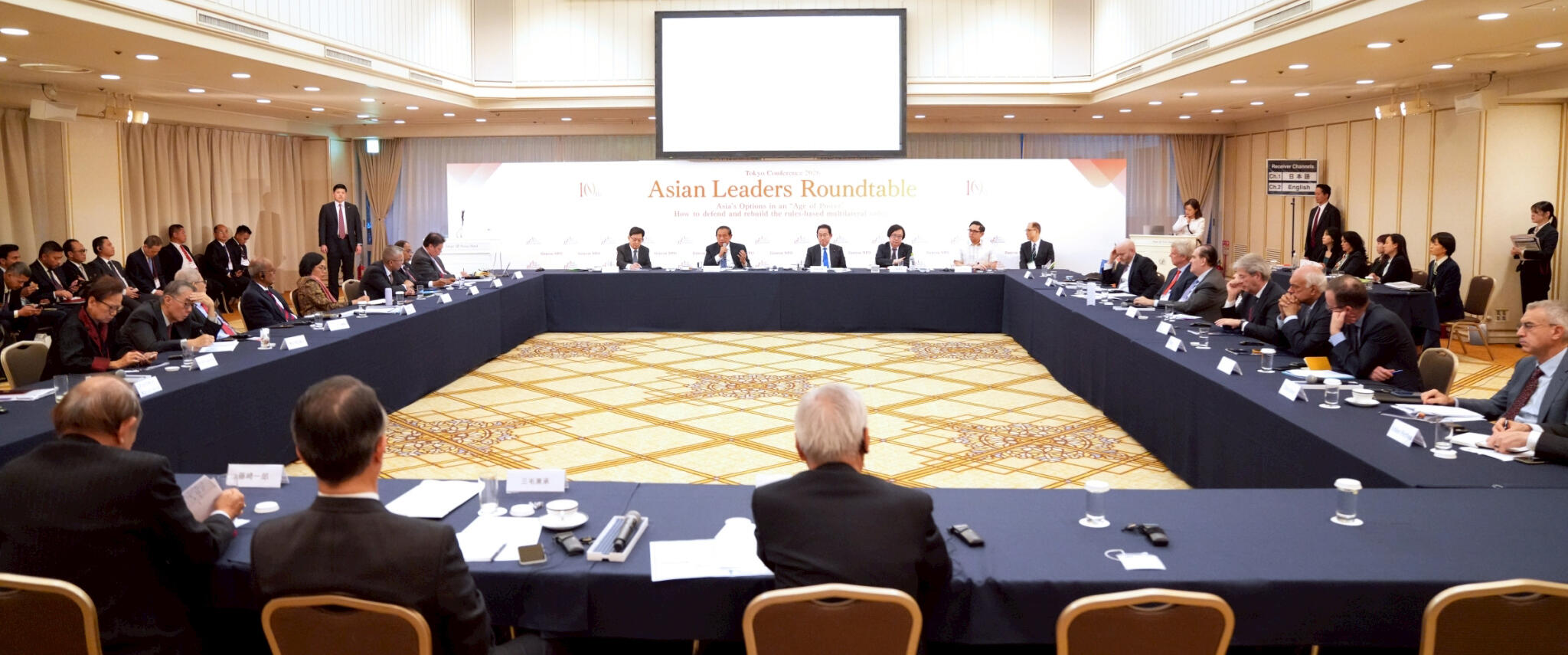
Third, this year's Tokyo Conference saw the launch of an initiative called the Asian Leaders Roundtable, which brought together political leaders from around Asia. We must fully support the countries of Asia to remain independent and to continue engaging in dialogue rather than simply remaining silent in the face of global change. </p>
<p>During the first Asian Leaders Roundtable, participants from around Asia expressed their concerns about a world in which "might makes right." Asia is key to global growth and stability, and the future of Asia and the rest of the world will depend on continued frank discussion and bridge-building with the middle powers and the rest of the world. </p>
<p><br />
Fourth, we discussed the role of experts and the academic community. When the world is dominated by power politics, the role of experts is not simply limited to explaining the situation or discussing what the world should look like. Experts have a responsibility to uncover opportunities for cooperation, to deliberate on how best to promote collaboration, and to provide practical, concrete action plans based on reality.  [GI1.1]</p>
</div>
<p><br />
This, the tenth Tokyo Conference, sees us standing at a crossroads. The world is moving towards a multipolar and unstable power-based order, and we will be unable to rebuild the rules-based order if no one takes the initiative to act. </p>
<p>We must not leave the future of the world to chance; it can only be shaped through responsible action. We, the participants of the Tokyo Conference, will continue to fulfill our role by engaging in earnest discussion here in Tokyo. </p>
<p>The future begins today. </p>
<div align="right">Tokyo Conference<br>11 March 2026</div>
]]>
    </content>
</entry>
<entry>
    <title>Tokyo Conference Public Forum 2: Reflecting on the state of multilateralism today - Projects/Events</title>
    <link rel="alternate" type="text/html" href="https://www.genron-npo.net/en/pp/archives/5680.html" />
    <id>tag:www.genron-npo.net,2026:/en/pp//6.5680</id>
    <published>2026-03-30T07:02:15Z</published>
    <updated>2026-03-31T06:33:20Z</updated>
    <summary>For the final session of the Public Forum, thinktank representatives Adam Posen, Bronwen Maddox, Carlos Ivan Simonsen Leal, Ettore Greco, James M. Lindsay, Jeromin Zettelmeyer, Paul Samson, Rizal Sukma, Volker Perthes, Sunjoy Joshi, Thomas Gomart, and Yasushi Kudo came together on stage for a discus...</summary>
    <author>
        <name>言論NPO</name>
    </author>
        <category term="The Tokyo Conference" scheme="http://www.sixapart.com/ns/types#category" />
        <category term="The Tokyo Conference 2026" scheme="http://www.sixapart.com/ns/types#category" />
    <content type="html" xml:lang="ja" xml:base="https://www.genron-npo.net/en/pp/">
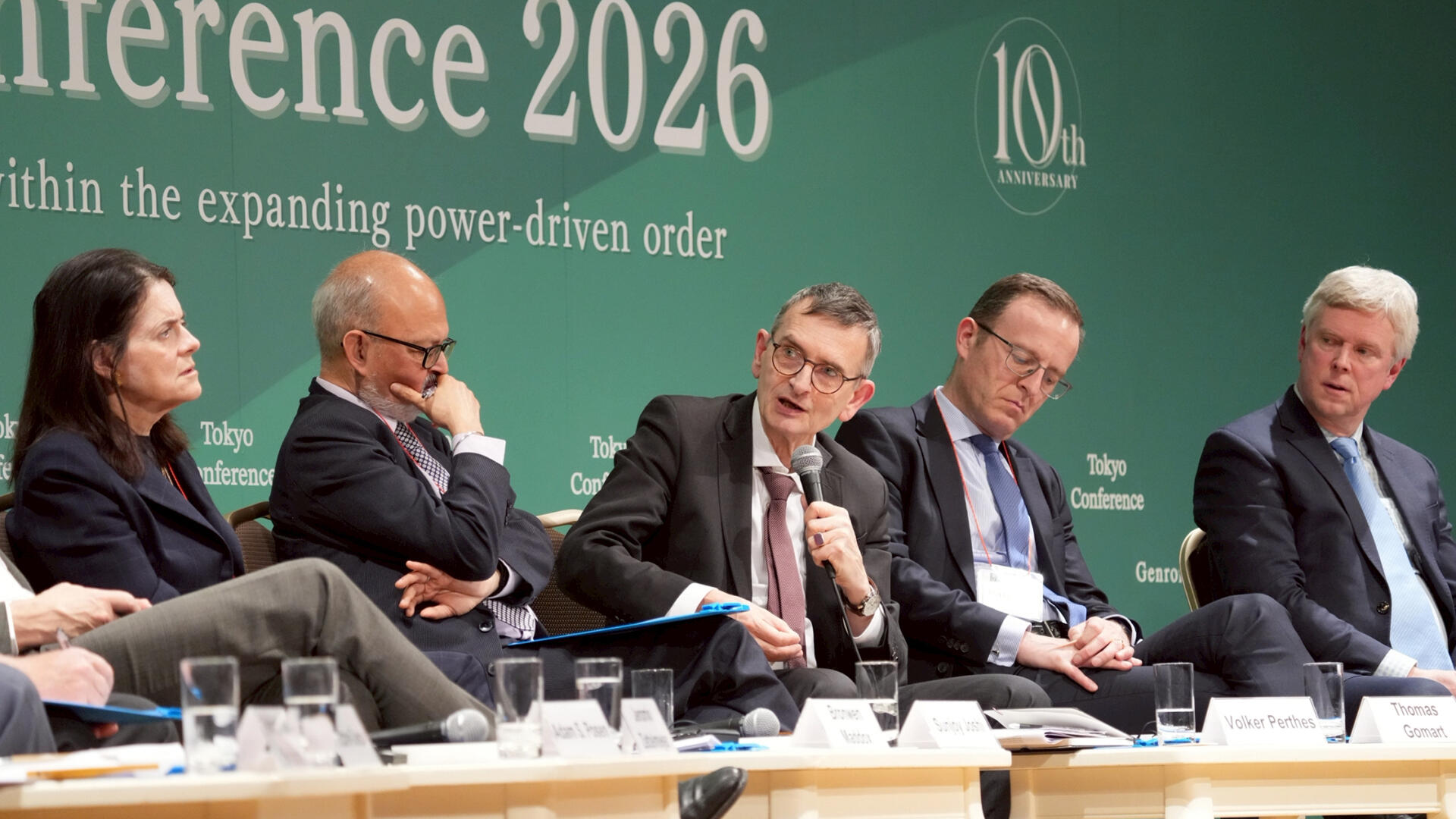
        <![CDATA[<p>For the final session of the Public Forum, thinktank representatives Adam Posen, Bronwen Maddox, Carlos Ivan Simonsen Leal, Ettore Greco, James M. Lindsay, Jeromin Zettelmeyer, Paul Samson, Rizal Sukma, Volker Perthes, Sunjoy Joshi, Thomas Gomart, and Yasushi Kudo came together on stage for a discussion moderated by Rohinton Medhora. </p>
<p><strong>Medhora began with a question to the panel of representatives. </strong></p>
<p>"No one is going to dispute that (the multilateral order) is broken in some form, whether you use that word or not, but how broken is it? How retrievable are the elements of multilateralism that have served us so well for 70, 75 years?" Medhora asked. "What is the role of both the great powers and the non-great powers in making the system more functional?"</p>
<p><strong>First to respond was Ettore Greco, who argued that the system is close to collapse, and that any effort to stop that collapse first requires reflection on the main causes. <br />
</strong></p>
<p>"For many decades, there has been discontent over the perceived lack of legitimacy of the system," Greco began. "But there is also the rise of powers that pursuing a revisionist strategy aiming at undermining the system, an increasingly aggressive Russia, and then the tension over China, coupled with this new attitude of the U.S. to question basic fundamental rules, and a tendency to use the force to solve international problems."</p>
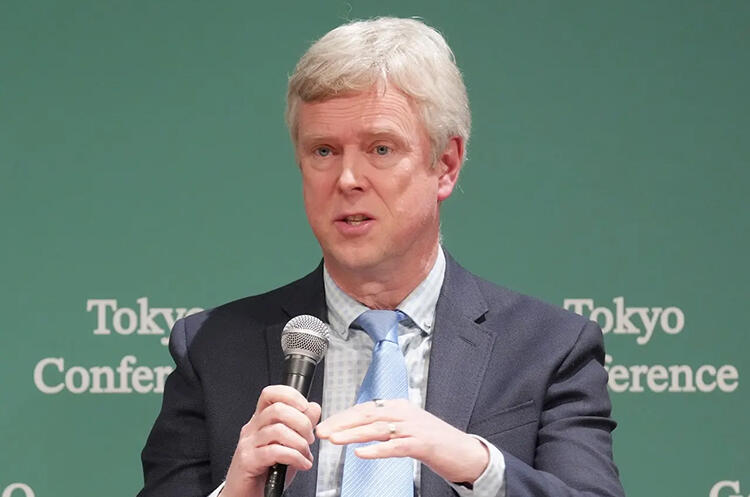
<p>Medhora asked the panelists from the US to expand upon when the current position of the Trump administration is reflective of a broader American view on multilateralism, and <strong>Adam Posen responded with his opinion that those who are committed to isolationism and unilateralism are in the minority in the US. </strong></p>
<p>"And a large number of them are acting out and accepting very self-destructive policies because of other things, not because of deep conviction that this is a better way for the US," he explained. </p>
<p>Posen also suggested that a change in administration would bring about a change in public opinion of multilateralism as well. </p>
<p>"If one could get more responsible parties in power in the US, if one could get the courts, and more importantly, Congress, to live up to their constitutional role, the population would accept it," he said. "But it also means that there isn't a deep love for the word 'multilateral' or for many of the institutions that the governments and think tanks represented here care so much about."</p>
<p><img alt="9e3810f965d42dfa92d53d1bf3e8d2af.jpg" src="/en/pp/images/9e3810f965d42dfa92d53d1bf3e8d2af.jpg" width="750" height="500" class="mt-image-center" style="text-align: center; display: block; margin: 0 auto 20px;" /></p>
<p><br />
<strong>Jim Lindsay had a somewhat different take and argued that the reality in the US is more nuanced.</strong> </p>
<p>"Many Americans have long expressed frustration over multilateralism because when people are off the record, they're willing to admit to the inefficiencies, the slowness of multilateral arrangements," he said. "I don't want to sort of suggest that somehow the Trump administration is against multilateralism and all other Americans are for it.</p>
<p>Lindsay however agreed with Posen in that Americans are generally well-disposed to working with others, and that leads to one of the complaints the US public has with the current administration.</p>
<p>"I think one of the main criticisms that many Americans have of President Trump's foreign policy is that the president is working against America's friends, partners, and allies rather than with them."</p>
<p><img alt="11f0d8fd325abd82534d65d128af6305.jpg" src="/en/pp/images/11f0d8fd325abd82534d65d128af6305.jpg" width="1920" height="1080" class="mt-image-center" style="text-align: center; display: block; margin: 0 auto 20px;" /></p>
<p><br />
<strong>Jeromin Zettelmeyer was asked to assess where multilateralism stands today and whether the situation can be fixed,</strong> and Zettelmeyer responded by asserting that multilateralism has not yet failed. </p>
<p>"Multilateralism has done very well in a normative sense, particularly in facilitating relatively free trade, which was a substantial reason for post-war growth and for lifting billions of people out of poverty."</p>
<p>He had a clear idea of where the problem lies. </p>
<p>"The reason why we have a problem now is because the creator of the post-war system has decided that this is no longer in its interest and has withdrawn at least from the trade part of it," he said. "This has to do with domestic policy failures in the United States, but also with the rise of China and the sense that the WTO was giving preferential treatment to China. This is the reason why the US has withdrawn."</p>
<p>Fixing it will require an effort be made to ensure multilateralism remains an active part of the international order. </p>
<p>"Whether you do this within the WTO or by creating something new, I'm not sure. I think probably you want to do it within the WTO, because creating something new is going to be impossibly difficult."</p>
<p><img alt="137dae3d498ced4459fcabc2221d5d31.jpg" src="/en/pp/images/137dae3d498ced4459fcabc2221d5d31.jpg" width="750" height="500" class="mt-image-center" style="text-align: center; display: block; margin: 0 auto 20px;" /></p>
<p><br />
<strong>Bronwen Maddox explained that the view of multilateralism in the UK is more positive than  at the time of Brexit, </strong>"Because countries need friends, they need alliances, and that's why the UK is edging its way back towards the European Union. But at the same time, the European Union continues to have great difficulties in agreeing on either security or competitiveness."</p>
<p>Maddox admits that multilateralism has had its issues, but she does not believe it has failed completely. </p>
<p>"Yes, the US has taken great exception to parts of it and that will continue for a while, but the US will need friends as well. It may actually have created a situation in the Middle East where it will need friends rather quickly," Maddox said.</p>
<p>The US is not the only country that needs allies she argued. </p>
<p>"China is doing a great job of pretending that it loves the rules-based order and working very hard to get its people into lots of established institutions of the rules-based order, but it doesn't follow those rules when it doesn't suit it either," she said. "But it will also need friends. It needs them to keep buying its products for a start. I think both major powers are behaving in ways that pretend as if they can act alone, but they can't."</p>
<p><img alt="239846a103ed4a44088535a81108766e.jpg" src="/en/pp/images/239846a103ed4a44088535a81108766e.jpg" width="750" height="500" class="mt-image-center" style="text-align: center; display: block; margin: 0 auto 20px;" /></p>
<p><br />
<strong>Sunjoy Joshi provided an Indian perspective of the issue at hand and argued that the premise of the discussion itself may be inappropriate. </strong></p>
<p>"I don't like using the words broken or ruptured for the international order of multilateralism. It is not broken or ruptured. The rules-based order has lost legitimacy, but that is not the fault of the institutions," he said. "Some of the institutions within their frameworks worked very well until they weren't allowed to work anymore, but the problems were structural, and structural problems needed structural solutions."</p>
<p>Joshi said that the current structure has created an issue of legitimacy arising from the structure of the multilateral order, and the fact of the P5 being "continually at each other's throats" and having veto powers.</p>
<p>"This is a crisis of legitimacy which has been created by member states," he argued, adding that all those states will have to be at the table to achieve anything.</p>
<p>"If reforms have to take place, they have to be on board, but as everyone knows, they will not be on board. Therefore, you have a structural problem for which there are no structural solutions. So, we need to discuss where we go from here."</p>
<p><img alt="d892d900d22feca5dbf8637bfef7cbb5.jpg" src="/en/pp/images/d892d900d22feca5dbf8637bfef7cbb5.jpg" width="750" height="500" class="mt-image-center" style="text-align: center; display: block; margin: 0 auto 20px;" /></p>
<p><br />
<strong>Volker Perthes agreed with Joshi's assertion that the multilateral framework is not broken,</strong> but that for multilateralism to function, it requires an order to be built upon.</p>
<p>"Legally, we still have an order. The UN Charter exists. And I think for the majority of the world, the UN system still works. Many of the UN agencies do work. Many of the multilateral cooperative structures do work. The majority of states, which are not big states, major states, not even middle powers, still see the UN Charter as the rule book for their international relations."</p>
<p>The common understanding, according to Perthes, is that the rules are "good", but their legitimacy is being challenged because the major powers are unable to accommodate change. However, he also said that people's understanding of the current order is not entirely accurate. </p>
<p>"From the perspective of a From a European power, it's fine. Everybody loves multilateralism because it has worked for us, right?" he said. "But let's be clear. It hasn't worked for everybody and legitimacy is fading. We need to rebuild it. The UN is not just some organization in a tower in New York. It's all of us."</p>
<p><strong>Thomas Gomart followed up by questioning whether people's view of the history of the multilateral order has not been to some extent embellished. </strong></p>
<p>"If we go back to the collapse of the USSR, we have a period of...a unipolar moment."</p>
<p>At that time in the 1990s, while things seemed to be working well, there were several crises that were not resolved through the multilateral order or through the intervention of the UN in particular. </p>
<p>"We had a huge genocide in Rwanda. We had a war in Balkans, which was not terminated thanks to the United Nations, but thanks to NATO, which was not following international law," he said, "And remember the war in Iraq, the war in Libya...and I could list also things done by Russia, by China, and others."</p>
<p>"I think we should not see multilateralism as being so beautiful, because to some extent, it was not ever really efficient," Gomart concluded.</p>
<p><br />
<strong>Paul Samson was asked to provide a glimpse into how multilateralism is viewed in Canada. </strong></p>
<p>"In Canada, multilateralism has pretty good support. It was seen as essential to have an open economy and open society," he said, that the current situation may be difficult to resolve. </p>
<p>"For trade, once subsidies are in place, once restrictions are in place, politically they're very difficult to roll back. So, I think this is going to be a medium-term work in progress. Maybe regional trade organizations will matter here, but it's not going to be easy to roll back to a zone that is more free."</p>
<p>However, Samson's view was not entirely pessimistic. </p>
<p>"The UN Charter and international law are taking a moment of semi-hibernation, but I don't think they're dead."</p>
<p><img alt="DSC01456.jpg" src="/en/pp/images/DSC01456.jpg" width="750" height="497" class="mt-image-center" style="text-align: center; display: block; margin: 0 auto 20px;" /></p>
<p><br />
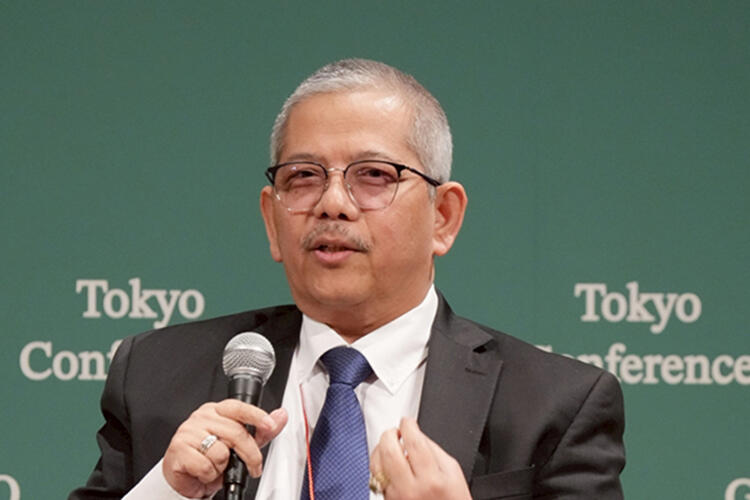
<strong>Rizal Sukma believes that multilateralism still has high levels of support in Indonesia, but stressed that the rules are important.</strong></p>
<p>"A lot of people believe that multilateralism functions only if all countries subscribe to one particular set of rules that they believe in," he said, and warned that the new challenge will be in determining how to restrain the major powers within the multilateral framework. </p>
<p>"So that's what we need to get it working: the middle powers and the small powers (working together.)"</p>
<p><br />
<img alt="1337d423c385ee0137101e1ddcc8ef00.jpg" src="/en/pp/images/1337d423c385ee0137101e1ddcc8ef00.jpg" width="750" height="500" class="mt-image-center" style="text-align: center; display: block; margin: 0 auto 20px;" /></p>
<p><br />
<strong>Carlos Ivan Simonsen Leal was asked his opinion about how much influence the middle powers,</strong> the Global South, the UN, and other international organizations and institutions actually have in the world today.</p>
<p>"At this moment, I think very little, because you have to change the structure of the economy in many regions of the world and that is going to be very painful," Leal responded. </p>
<p>Differing levels of innovation and unjustifiable trade imbalances will also make resolution of these issues more difficult, Leal explained. </p>
<p>"This will take time. I don't know if that will entail a war, and I hope not. But this will surely be painful."</p>
<p>Sukma expressed some skepticism regarding the ability of middle powers to shape the global order, but did point out  possible opportunities. </p>
<p>"I think we should work on the region-focused initiatives...and issue-based coalitions," he said. "It doesn't have to involve, big, countries."</p>
<p>He pointed out the overall agreement regarding the continued efficacy of "single purpose international organizations," and suggested that this offers some hope for multilateralism as a whole. </p>
<p>"We need to focus on those practical organizations that are doable instead of thinking about how we are going to structure the international order for the middle or smaller powers. That's beyond our pay grade, I think."</p>
<p>Lindsay offered his own perspective in reference to the major powers and the extent of their influence. </p>
<p>"I do not see a capacity for China and the United States to divvy up the world and decide how it is run, because while other countries may be smaller and less powerful, they are not powerless. And I think it would be a mistake to think otherwise."</p>
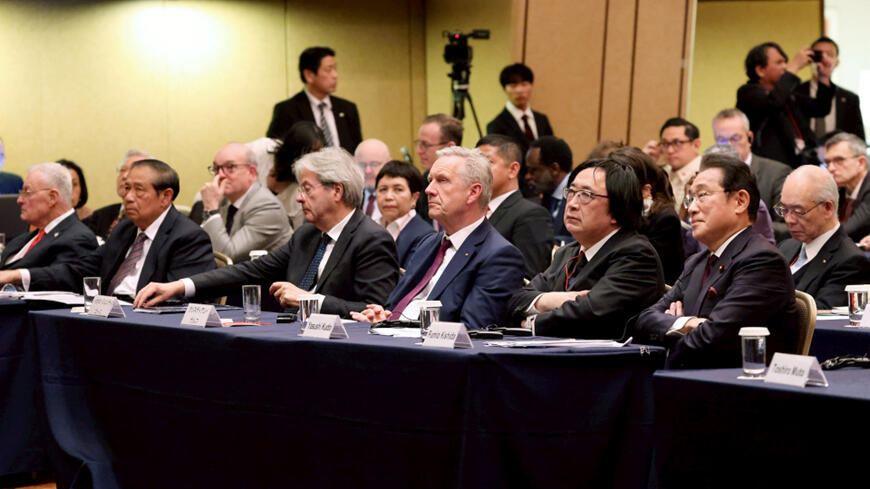
<p>The latter half of the second session saw the panelists answering questions from the audience, after which Yasushi Kudo returned to the podium to present the Chair's Statement and bring the Public Forum to a close. </p>
<p><img alt="fc40af860156de6f1be5cb059755562f.jpg" src="/en/pp/images/fc40af860156de6f1be5cb059755562f.jpg" width="1920" height="1080" class="mt-image-center" style="text-align: center; display: block; margin: 0 auto 20px;" /></p>]]>
    </content>
</entry>
<entry>
    <title>Tokyo Conference Public Forum 1: Rebuilding multilateralism for the modern world - Projects/Events</title>
    <link rel="alternate" type="text/html" href="https://www.genron-npo.net/en/pp/archives/5679.html" />
    <id>tag:www.genron-npo.net,2026:/en/pp//6.5679</id>
    <published>2026-03-30T06:44:33Z</published>
    <updated>2026-03-31T06:33:50Z</updated>
    <summary>The Tokyo Conference 2026 Public Forum was held in the afternoon of March 11, 2026. Panelists Heng Swee Keat, Airlangga Hartarto, Sri Mulyani Indrawati, Tengku Zafrul bin Tengku Abdul Aziz, Tshilidzi Marwala, Zambry Abdul Kadir, Duvvuri Subbarao, Antoinette Monsio Sayeh, Bam Aquino, and Ong Keng Yon...</summary>
    <author>
        <name>言論NPO</name>
    </author>
        <category term="The Tokyo Conference" scheme="http://www.sixapart.com/ns/types#category" />
        <category term="The Tokyo Conference 2026" scheme="http://www.sixapart.com/ns/types#category" />
    <content type="html" xml:lang="ja" xml:base="https://www.genron-npo.net/en/pp/">
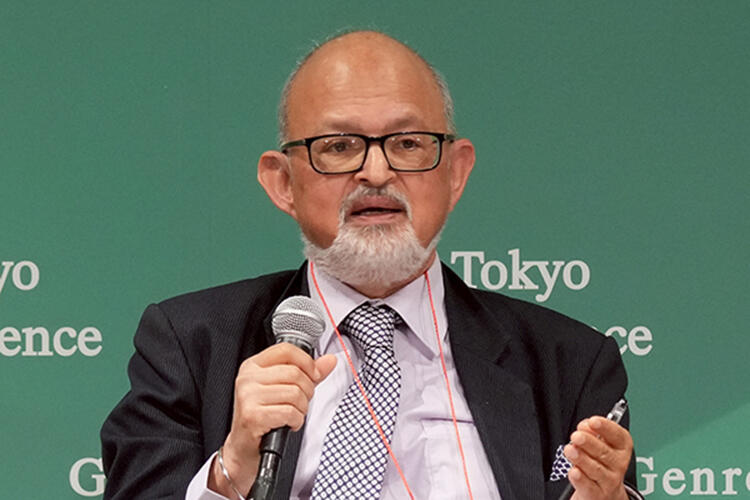
        <![CDATA[<p>The Tokyo Conference 2026 Public Forum was held in the afternoon of March 11, 2026. Panelists Heng Swee Keat, Airlangga Hartarto, Sri Mulyani Indrawati, Tengku Zafrul bin Tengku Abdul Aziz, Tshilidzi Marwala, Zambry Abdul Kadir, Duvvuri Subbarao, Antoinette Monsio Sayeh, Bam Aquino, and Ong Keng Yong were joined by The Genron NPO President Yasushi Kudo as moderator for a discussion about the future of multilateralism.</p>
<p>Kudo opened the session by asking the panelists to consider the challenges faced by multilateralism, and what needs to be done to rebuild the multilateral order such that it works within the current geopolitical environment.</p>
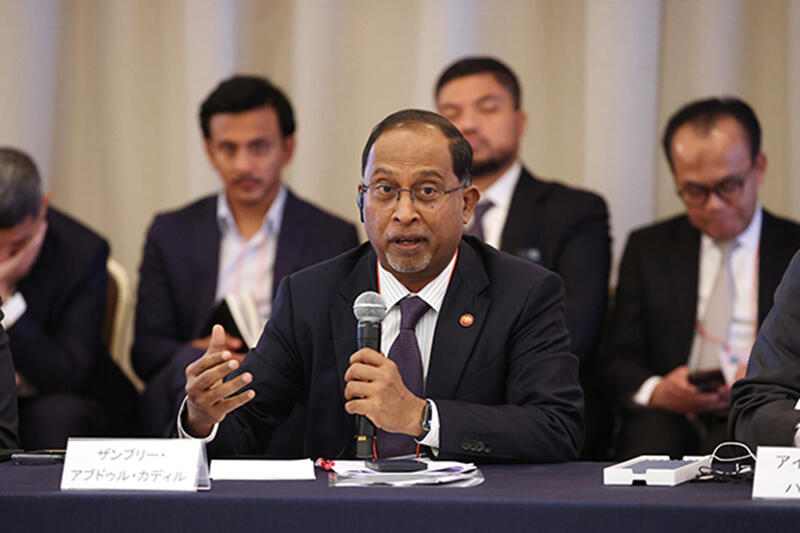
<p><strong>First to speak was Zambry Abdul Kadir, who noted that it is difficult to point to any single aspect of multilateralism as being broken,</strong> but that maintaining a hopeful outlook will help overcome the issues currently faced. </p>
<p>"On the one hand, of course, we have the dynamics of the world politics today," he explained. "But at the same time, we long for the ideal, for having an empathetic world."</p>
<p>He referred to a point raised by former Japanese Prime Minister Fumio Kishida in the previous session about maintaining a perspective based in idealism tempered with realism.</p>
<p>"Prioritizing your national interests, you also seek to balance the power, but at the same time, you must also look into how each country can work together in taking a multi-cooperative approach."</p>
<p><img alt="fd1a05acd308cfeada93af73ffb4c4c4.jpg" src="/en/pp/images/fd1a05acd308cfeada93af73ffb4c4c4.jpg" width="750" height="500" class="mt-image-center" style="text-align: center; display: block; margin: 0 auto 20px;" /></p>
<p><br />
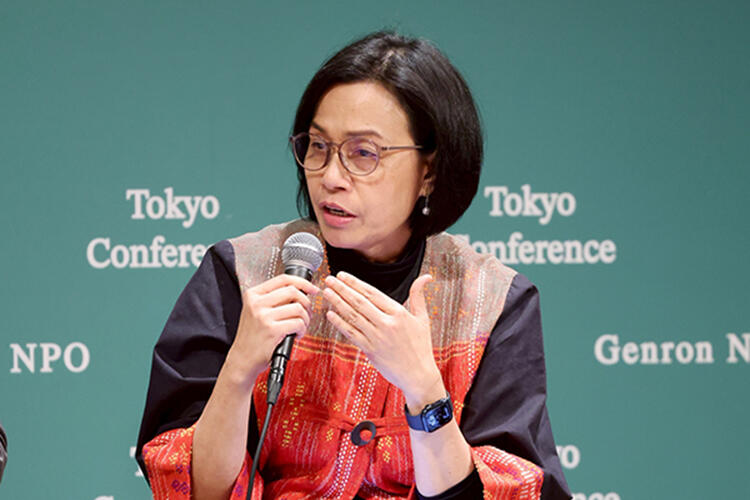
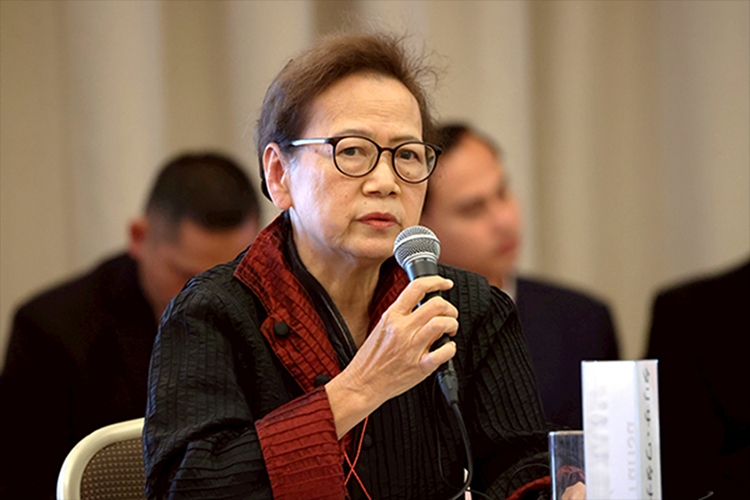
<strong>Sri Mulyani Indrawati added that multilateralism can only be defended if its mechanisms remain relevant. <br />
</strong></p>
<p>"This multilateralism, in the form of multilateral development banks or the IMF, they will continue to relevant as long as they are always useful. They have to continue to adapt, to be agile."</p>
<p>Indrawati explained that institutional reform will be difficult to implement, but it is necessary. </p>
<p>"The most difficult reform is actually with regards to governance and shareholder composition, and it is exactly this that affects legitimacy and credibility."</p>
<p>Part of what makes reform difficult is the fact that the current multilateral order is the legacy of what the world looked like in the aftermath of World War II. </p>
<p>"Governance and shareholders change very slowly. At the UN, it's even more complex because it is a global political body in which one country has one vote."</p>
<p>Indrawati believes that multilateralism will continue to have a role in the reform of business processes, centralization and decentralization efforts, and crisis response, as multilateral efforts are not always made at the global level, and that this can be helpful. </p>
<p>"Regional efforts can supplement or strengthen this lack of credibility at the global level."</p>
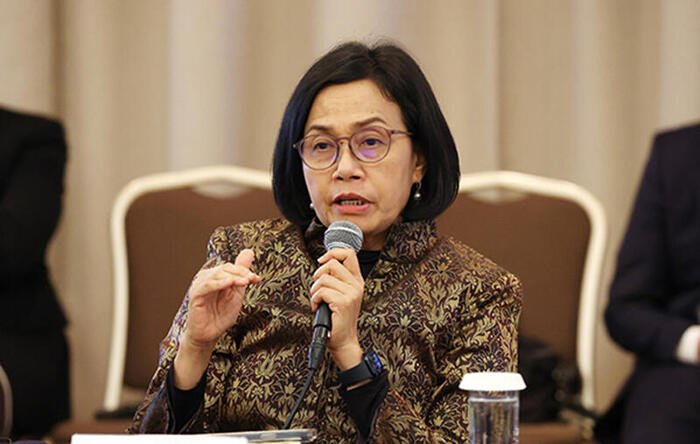
<p><img alt="9e0169a7e6c176693ff5da7763bf2954.jpg" src="/en/pp/images/9e0169a7e6c176693ff5da7763bf2954.jpg" width="750" height="500" class="mt-image-center" style="text-align: center; display: block; margin: 0 auto 20px;" /></p>
<p><br />
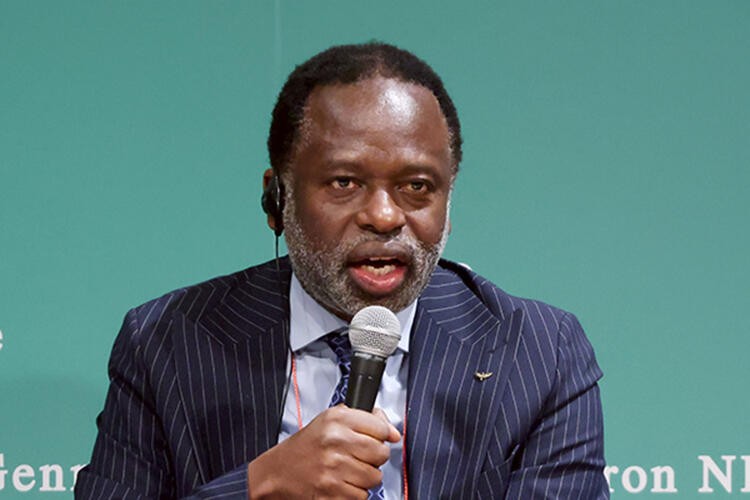
Tshilidzi Marwala spoke about the role the United Nations can play. </p>
<p>"Some aspects work, some aspects don't work. But let's just go back to the fundamentals. Let's go back to the UN Charter and the Declaration of Human Rights," he said, before explaining how the framework of the UN affects how it responds. </p>
<p>"The United Nations has three principal missions: peace and security, human rights, and development. If we just look at peace and security, the situation is not looking very good simply because of the way it is structured," he explained. "You go to the Security Council, and there's no consensus. So, when a very important aspect of the UN Charter, which is territorial integrity, is being violated, the Security Council is actually powerless because you have the P5 members with veto powers. Reform of the Security Council must happen."</p>
<p>Marwala was equally convinced that the second mission of the UN ? that of protecting human rights ? also needs attention. </p>
<p>"Human rights are being violated, and if these things are happening and we are not saying anything about it, we are all implicated."</p>
<p>Finally, regarding development, Marwala admitted that the world is unlikely to meet its targets for the Sustainable Development Goals, but there is still hope. </p>
<p>"We need to go back to the basics, the values, the values that are important, that are worth fighting for."</p>
<p>Kudo asked Marwala his opinions on the rise of non-UN bodies like the Board of Peace, and the question of what legitimacy they can have, and Marwala argued that such organizations are not a viable replacement for the United Nations. </p>
<p>"If you were to try to create something today that pulls everybody together into one room, you would not be able to do it," he said. "Let us build the United Nations, let us strengthen it, and let us deal with the weaknesses. And the biggest one is people acting outside UN authority."</p>
<p><img alt="979bbd29999d114e7e444e101a80a310.jpg" src="/en/pp/images/979bbd29999d114e7e444e101a80a310.jpg" width="750" height="500" class="mt-image-center" style="text-align: center; display: block; margin: 0 auto 20px;" /></p>
<p><br />
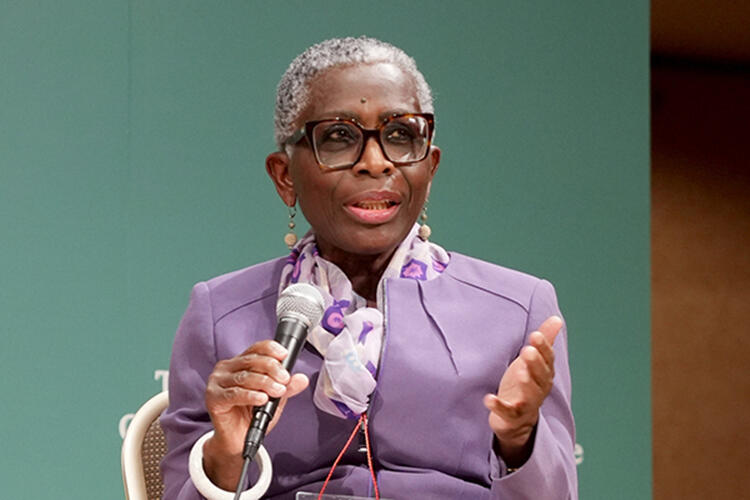
<strong>Antoinette Monsio Sayeh spoke about the role of institutions such as the IMF and their continued effectiveness. <br />
</strong></p>
<p>"The fund was established as part of the Bretton Woods Agreement back in 1945 with the objective supporting macro and financial stability around the world along with its sister institution, the World Bank," she said. "I think those two institutions have learned to be adaptable to the changing circumstances and the changing world they work in, in support of their members. They certainly can do better, as we all can."</p>
<p>Sayeh offered some suggestions regarding how the Bretton Woods institutions can uphold, support, and enhance multilateralism through greater equality between member countries.</p>
<p>"I think a key task for them is (achieving) what I would term 'unfettered even-handedness' in the analysis of member country economic policies, and in their relationships with their member countries," Sayeh said. "Even-handedness means protecting the independence of staff advice and sharing best practices across member countries, not just unilaterally from advanced economies to developing countries, but also from developing countries to advanced economies."</p>
<p><img alt="b557b6354598f804cc1d46ea100c0e0b.jpg" src="/en/pp/images/b557b6354598f804cc1d46ea100c0e0b.jpg" width="750" height="500" class="mt-image-center" style="text-align: center; display: block; margin: 0 auto 20px;" /></p>
<p><br />
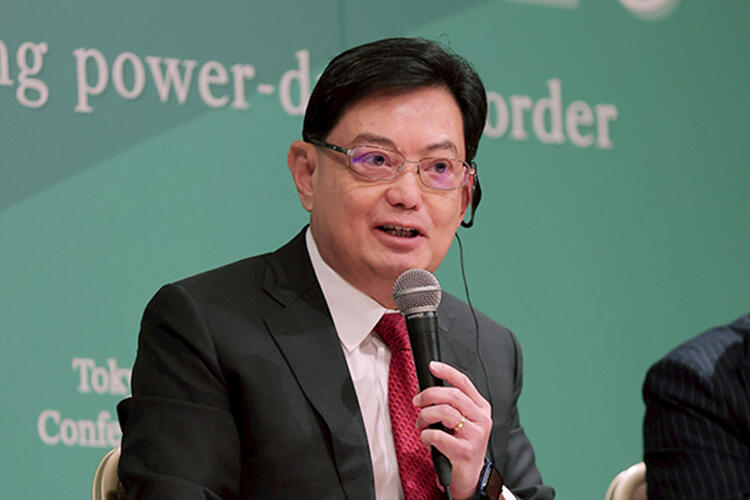
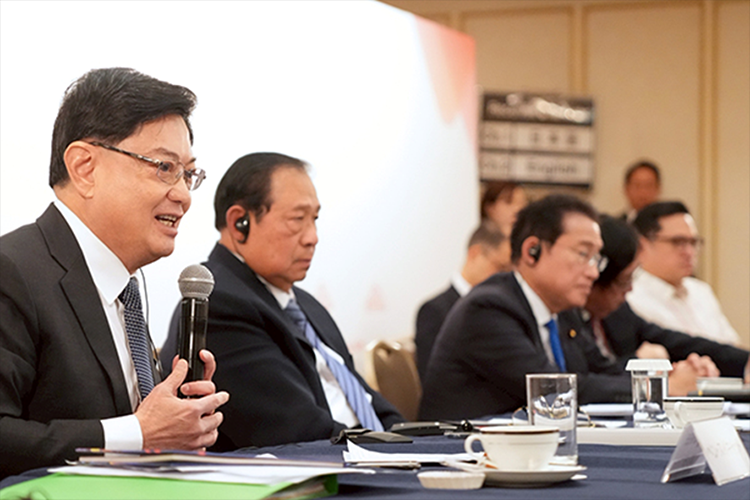
<strong>Heng Swee Kiat pointed to the continued success of multilateral institutions today, particularly those related to trade and those connected to Asia. </strong></p>
<p>"One of the things members have been able to do within the rules of the WTO is start free trade negotiations," Heng said. "Before 2001, when the Doha Round was launched, there were fewer than 100 free trade agreements. The world now has 350 to 360 free trade agreements, and Asia is the most active region in negotiating free trade agreements, with 250 to 300 agreements involving at least one Asian nation."</p>
<p>Heng believes that even smaller countries such as Singapore still have agency in the world today though finding like-minded partners with whom they can work and achieve objectives together. </p>
<p>"We can continue to pursue this in many areas," he added. "And ASEAN itself has been doing a lot of good work on this area."</p>
<p><img alt="a395c4f4a5755b4962ffc3d514b31bfd.jpg" src="/en/pp/images/a395c4f4a5755b4962ffc3d514b31bfd.jpg" width="750" height="500" class="mt-image-center" style="text-align: center; display: block; margin: 0 auto 20px;" /></p>
<p><br />
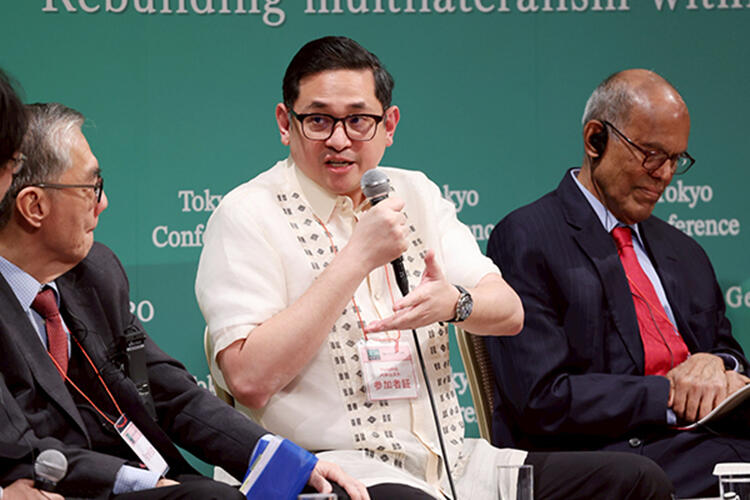
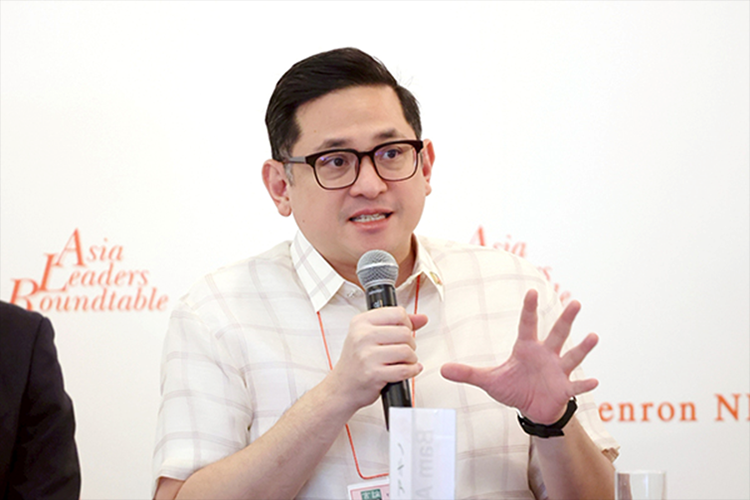
<strong>Bam Aquino spoke about the ineffectiveness of multilateral organizations in responding to war and dealing with global inequality, </strong>adding, "Maybe the old systems simply aren't working because they're really skewed towards bigger powers. In the case of the UN, it's the veto power."</p>
<p>Aquino suggested that an alternative could be to create smaller versions of the larger multilateral bodies, or as he described it, "Smaller pockets of like-minded countries."</p>
<p>"Yesterday I called it the coalition of certainty, or coalition of the certain," he explained. "Which countries will be there for you? Which countries can you really rely on?"</p>
<p>All countries have one thing in common that Aquino believes can be harnessed to build a better future.</p>
<p>"We are looking for peace. We are looking for which countries can stand up with each other and stand up for each other. I think that's the way forward, whether it's a smaller grouping of countries who are neighbors or who are similar in demographics or similar in economic structure, or even simply those with shared ideals. We're all in this together, although it seems that we're not."</p>
<p>This "coalition of certainty" could be the way forward, Aquino believes, as that could have a larger knock-on effect.</p>
<p>"(If we can) keep the peace, support each other's prosperity, be certain about each other's agreements, support each other during times of crisis, and more importantly, support each other towards shared prosperity, then I think we'll see a new world order that can benefit even countries like ours, and not just the big ones."</p>
<p><img alt="1749f11d49909cd1b117b6dea5a02720.jpg" src="/en/pp/images/1749f11d49909cd1b117b6dea5a02720.jpg" width="750" height="500" class="mt-image-center" style="text-align: center; display: block; margin: 0 auto 20px;" /></p>
<p><br />
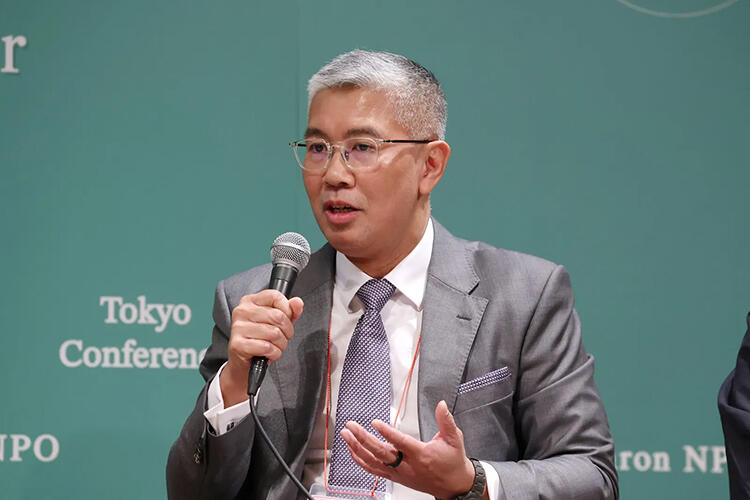
<strong>Tengku Zafrul bin Tengku Abdul Aziz </strong>turned the discussion to why multilateralism is facing challenges, as he believes understanding that can be beneficial in re-building it to meet the needs of the modern world. </p>
<p>"I think this is a question Americans also ask," Aziz said. "And I know in many other countries they're asking, 'What do we get out of these multilateral agreements' that they have signed."</p>
<p>Mindfulness is the keyword here. </p>
<p>"We talk to the multinationals, we talk to the large companies, and they say that multilateralism is good. Globalization is good. But when we talk about the principles of multilateralism, we need to measure whether the benefits translate to the micro level."</p>
<p>Sovereignty remains important, and trade agreements are a part of that, even when tensions are high. </p>
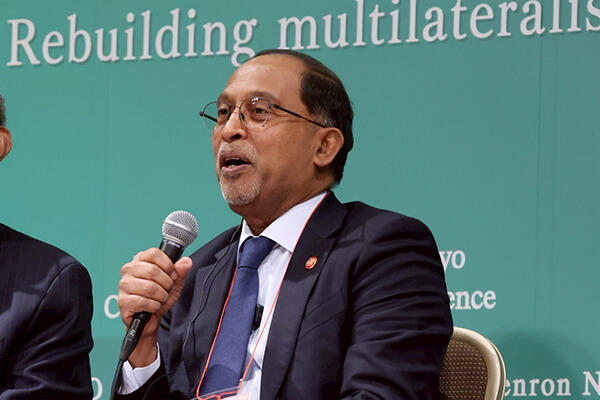
<p>"Malaysia, for example, signed an agreement on reciprocal trade with the United States. We have to. The U.S., like it or not, is our largest export market. China is our largest trading partner. Both are our two largest investors in the country and in the region as well."</p>
<p><img alt="1D2A4589.jpg" src="/en/pp/images/1D2A4589.jpg" width="750" height="500" class="mt-image-center" style="text-align: center; display: block; margin: 0 auto 20px;" /></p>
<p><br />
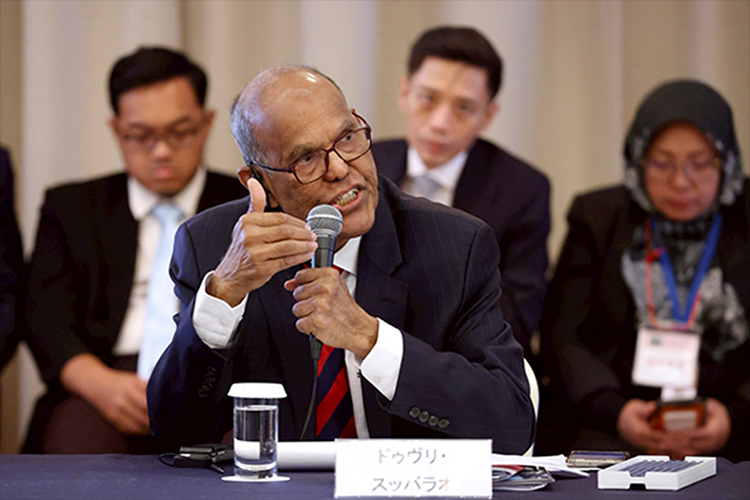
<strong>Duvvuri Subbarao brought the discussion back to why rebuilding multilateralism is important, and how it can be achieved. </strong></p>
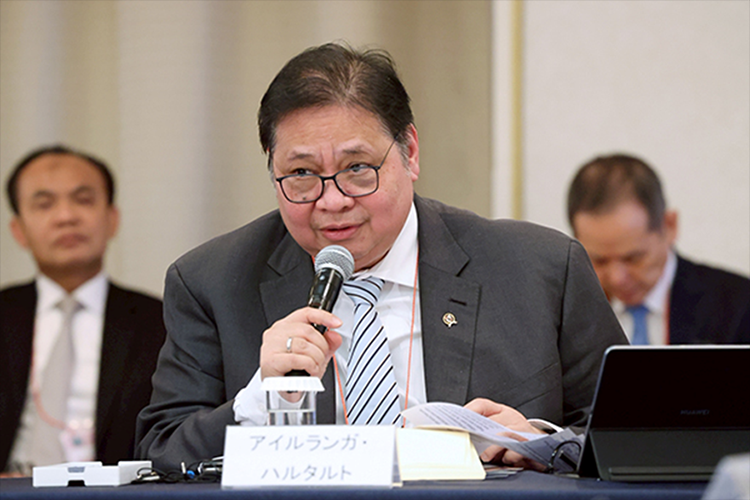
<p>"There is a rupture in the rules-based order, and that rupture hurts emerging economies more than others," Subbarao said. "What we now call the liberal international order ruled the world for the last 75 years, but that system was not ideal, not perfect, but everyone benefited. Some more than others, but everyone was better off."</p>
<p>Subbarao argued that institutions and organizations must continually "reinvent themselves" over time, but that an honest assessment of what is wrong with multilateralism today is necessary to beginning the process of rebuilding. </p>
<p>"The multilateralism that we had before was not truly democratic. Emerging markets did not have a voice. The rules were largely framed by those who had power. They enforced those rules as long as it played to their advantage, and bent them when it did not," he said. "Going forward, I believe that the objective (should not be) to restore the old order. That world is gone. The task before us is to rebuild multilateralism such that it becomes more inclusive and genuinely representative."</p>
<p>However, rebuilding multilateralism will not begin with a great declaration. </p>
<p>"It will begin with genuine cooperation, a willingness to share a voice and responsibility more fairly than in the past, and importantly, with some confidence-building measures," he said, before concluding. "The reality is this: if emerging economies and middle powers are not part of shaping the rules of the next global order, we will simply return to a system where a few write the rules and the rest live with the consequences. As Mark Carney reminded us in Davos, if you're not at the table, you're part of the menu."</p>
<p><br />
</p>]]>
    </content>
</entry>
<entry>
    <title>Tokyo Conference 2026: Keynote Lectures  - Projects/Events</title>
    <link rel="alternate" type="text/html" href="https://www.genron-npo.net/en/pp/archives/5678.html" />
    <id>tag:www.genron-npo.net,2026:/en/pp//6.5678</id>
    <published>2026-03-25T02:55:24Z</published>
    <updated>2026-03-31T06:34:13Z</updated>
    <summary>Tokyo Conference 2026 commemorated its tenth anniversary with a widely-lauded public event on March 11, 2026 titled &quot;Rebuilding multilateralism within the expanding power-driven order.&quot;  The Conference was hosted by The Genron NPO, a non-profit independent think tank dedicated to building platforms ...</summary>
    <author>
        <name>言論NPO</name>
    </author>
        <category term="The Tokyo Conference" scheme="http://www.sixapart.com/ns/types#category" />
        <category term="The Tokyo Conference 2026" scheme="http://www.sixapart.com/ns/types#category" />
    <content type="html" xml:lang="ja" xml:base="https://www.genron-npo.net/en/pp/">
        <![CDATA[<p>Tokyo Conference 2026 commemorated its tenth anniversary with a widely-lauded public event on March 11, 2026 titled "Rebuilding multilateralism within the expanding power-driven order." </p>
<p>The Conference was hosted by The Genron NPO, a non-profit independent think tank dedicated to building platforms for multilateral dialogue, in cooperation with think tanks from around the world. For this year's event, the annual two-session public forum was preceded by a series of keynote lectures and a panel discussion between leaders and diplomats from some of the world's major democracies.</p>
<p>Yasushi Kudo, president of The Genron NPO, opened the Tokyo Conference Public Forum with a brief overview of the situation the world finds itself in today; namely, that the world finds itself in an era of instability, seemingly poised at a turning point within an international order that is being subjected to major change. </p>
<p><img alt="01.jpg" src="/en/pp/images/73fc119506f9eb30336e6fa17a1e378a19c383f7.jpg" width="870" height="489" class="mt-image-center" style="text-align: center; display: block; margin: 0 auto 20px;" /></p>
<p><br />
After welcoming the gathered dignitaries to the Conference, he ceded the podium to Christian Wulff, former President of Germany.  </p>
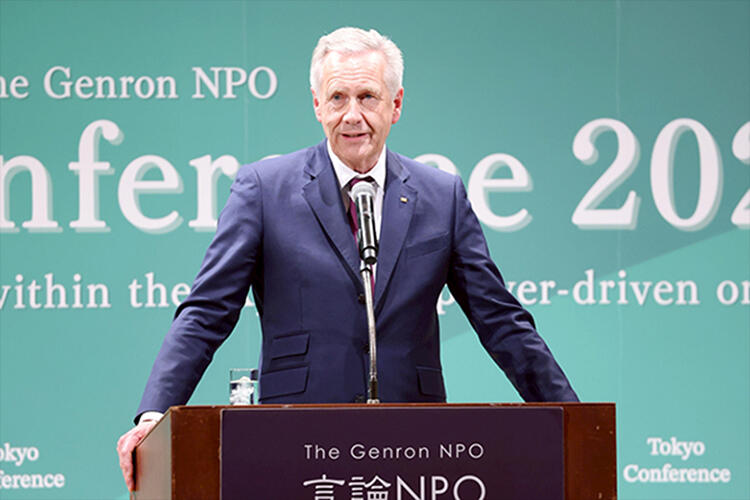
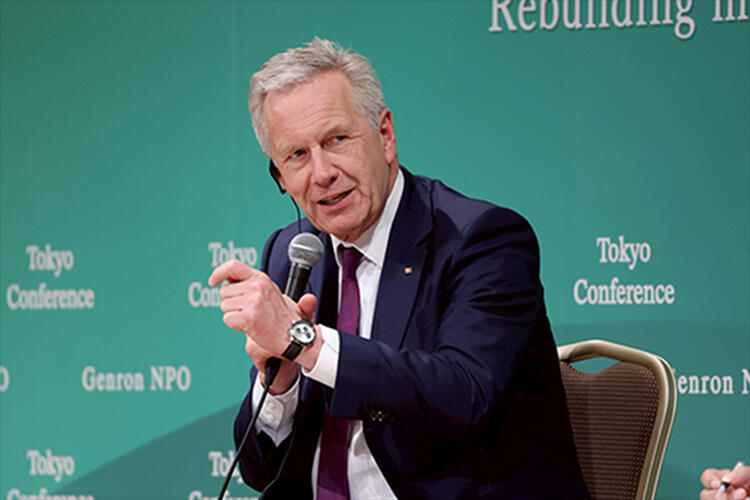
<p>Wulff began his keynote by stressing that the world is at a crossroads, in which it is being asked, "Will rule-based cooperation be able to continue, or will we fall back into unilateral national actions, transactional partnerships, and mere deal-making?" </p>
<p>Wulff believes that the answer to this question lies in making fundamental choices between "homogeneity or pluralism, uniformity or diversity, being profit-driven or values-based, arbitrariness or the rule of law, uncertainty or stability. In short, it comes down to choosing between the law of the strongest or the strength of the law." </p>
<p>He stated that his ideal future does not involve an "ethically unipolar superpower" dominating the world. To illustrate why he believes the world is in the situation it is in today, he pointed to the words of philosopher Hannah Arendt, who asserted that "the death of human empathy is one of the earliest and most telling signs of a culture about to fall into barbarism." </p>
<p>Wulff also objected to the influence that countries like the United States have on the media and far-right extremism in other countries, as that influence is being harnessed "in an effort to destroy the European Union." </p>
<p>However, Wulff also expressed hope for the future and pointed to Japan and the countries of Europe as examples of how successful multilateralism has been.</p>
<p>"Multilateralism creates a framework of good rules that enables reliable coordination of complex international flows, facilitates the global division of labor and knowledge, learns from its own mistakes, and is capable of reform," he said. "Japan and Europe know that stability is not achieved through isolation, but through cooperation; not through nationalism, but through rules-based collaboration." <br />
 <br />
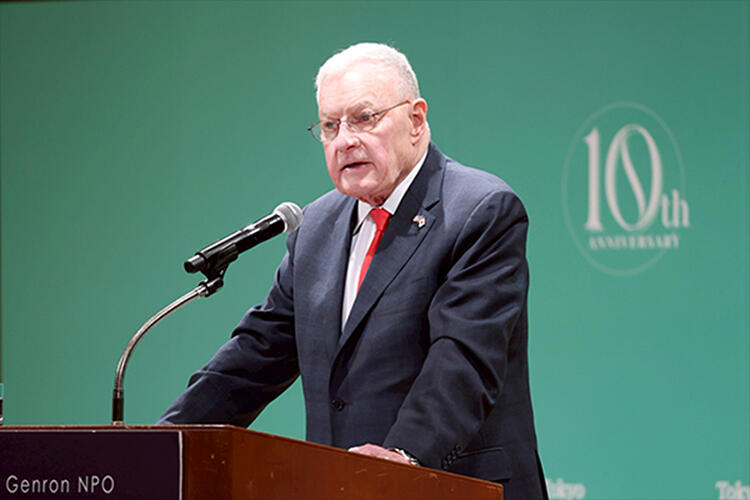
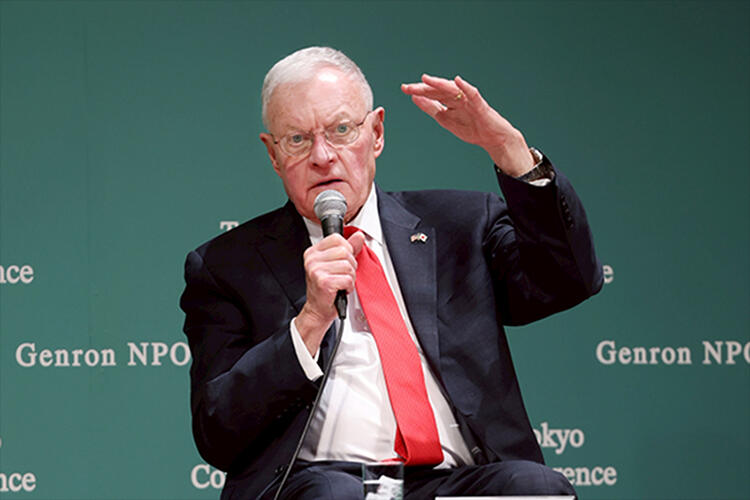
Following Wulff to the podium was Keith Kellogg, retired Lieutenant-General in the United States Army, former assistant to US President Donald Trump, and former Special Envoy to Ukraine. Kellogg began by focusing on how the Trump administration's foreign policy has shaped "America's place in the world today." </p>
<p>"It's transactional, always with 'America First' at the forefront," he said. "But Trump's foreign policy is not isolationism; it is smart power. It is prioritized power." </p>
<p><img alt="02.jpg" src="/en/pp/images/d7868ddae4f180fa21a25e6ff603d9906fca9334.jpg" width="750" height="500" class="mt-image-center" style="text-align: center; display: block; margin: 0 auto 20px;" /></p>
<p><br />
Kellogg also explained how the current administration's strategies are being used to achieve US objectives globally. </p>
<p>"The national security strategy emphasizes the restoration of American strength at home and the need to bring peace and stability to the world. The United States' number one goal is our continued survival and safety of the United States as an independent, sovereign republic," he said. "The National Defense Strategy highlights peace through strength, 'America First,' the 'warrior ethos,' and burden sharing." </p>
<p>In addition, he touched upon the wars in Iran and Ukraine, and stated that US efforts in Ukraine - especially President Trump's - have been particularly effective, before offering his own assessment of how best to end that war. </p>
<p>"The Ukrainians have been ready to agree to a full and comprehensive ceasefire along the lines of contact ever since we had negotiations in Jeddah of February 2025," he said. "We need to encourage both sides to basically claim victory and go home. President Trump has been the only leader in the free world that can bring that war to a conclusion."</p>
<p><img alt="03.jpg" src="/en/pp/images/a519621903956b89b6672dd83b4ffc3b6623d695.jpg" width="750" height="500" class="mt-image-center" style="text-align: center; display: block; margin: 0 auto 20px;" /></p>
<p><br />
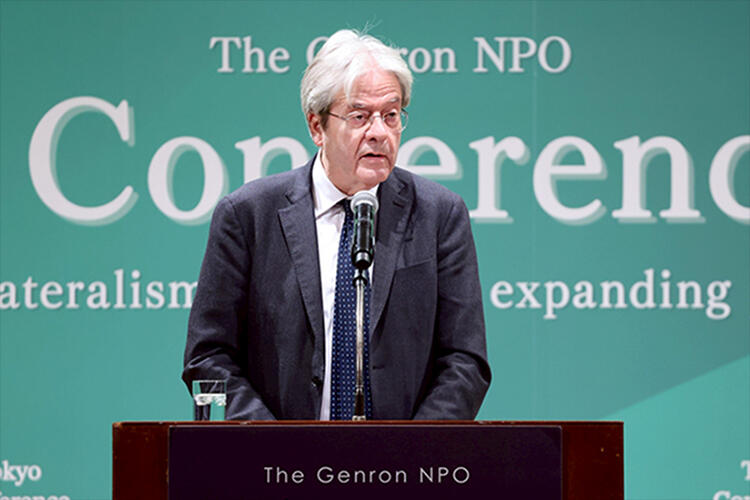
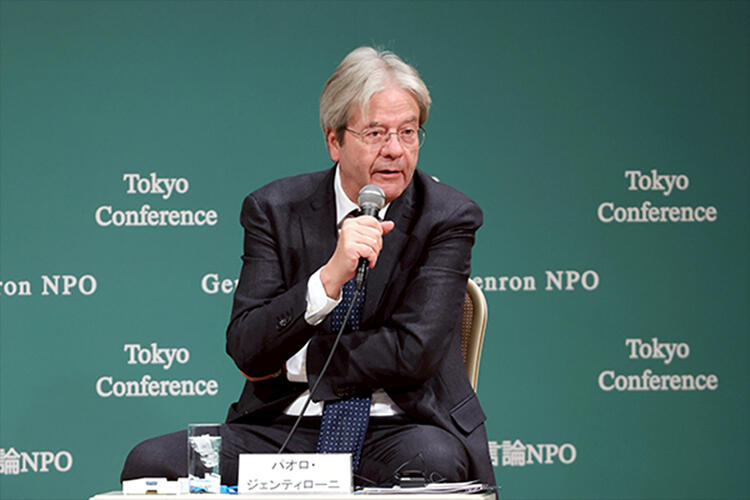
Paolo Gentiloni, former Prime Minister of Italy and former European Commissioner for the Economy, opened by observing that the rules are clearly "at risk" in today's world, and that it is heading towards an era of strained alliances. He argued that this is why Europeans must "invest in our autonomy, and the first part of this change is improving our own defense." </p>
<p>Gentiloni explained exactly what this would mean in Europe. </p>
<p>"Autonomy means diversification. This applies to energy and also to trade. Since President Trump's tariff announcements, the EU has shown it can redirect its trade flows with ease," he said. "The pragmatic reset of trade relations with China may also offer opportunities, provided reciprocity and security are guaranteed. Not protectionism, but reciprocity; not closure, but fair competition under WTO rules."</p>
<p>He went on to laud the real gains offered by trade agreements, e.g. reduced barriers and improved market access, while cautioning that they do have limits. </p>
<p>"They do not abolish strategic dependencies (we need to leave behind) by themselves," he said. "The question is not whether we should trade with China. We should and we will. It is how and when does trade become reliance, and when does reliance become vulnerability." </p>
<p>For Gentiloni however, autonomy is not limited to domestic resilience; it also requires coordination among trusted partners. </p>
<p>"Democracies must unite," he said. "Multilateral institutions are as strong as their members' willingness to respect their rules and live up to their principles, to cooperate fairly, transcend regionalism, and ensure that the rules-based order works for all. Because history will not wait, neither should we."</p>
<p><img alt="04.jpg" src="/en/pp/images/b21cdc41676bd0434cadc46684c1d991697728f7.jpg" width="750" height="500" class="mt-image-center" style="text-align: center; display: block; margin: 0 auto 20px;" /></p>
<p><br />
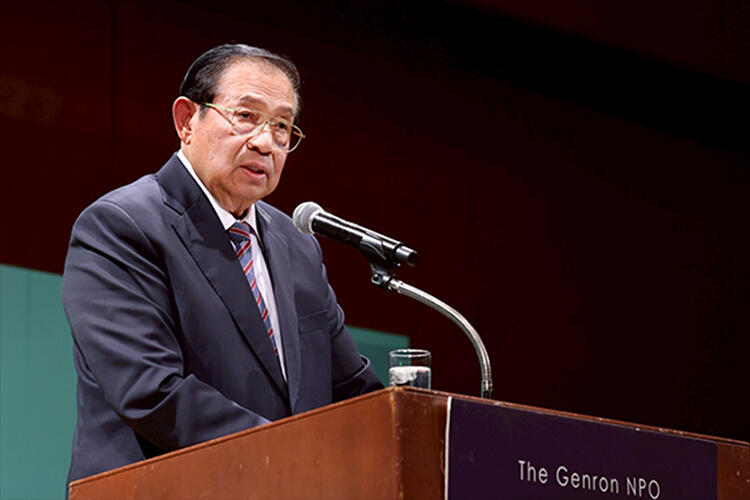
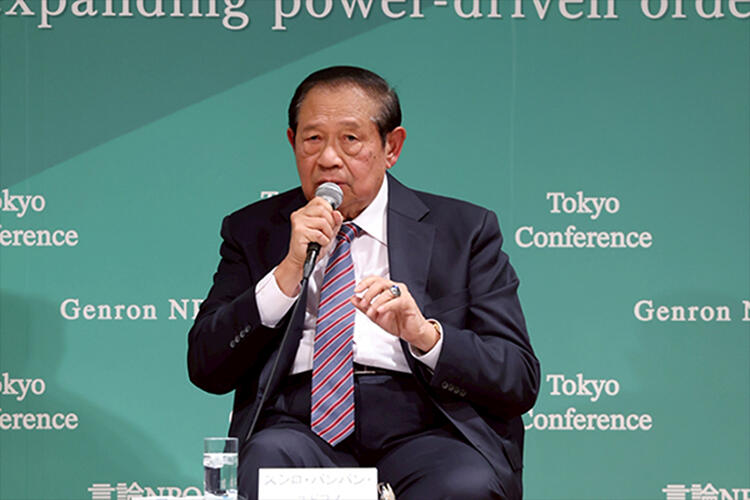
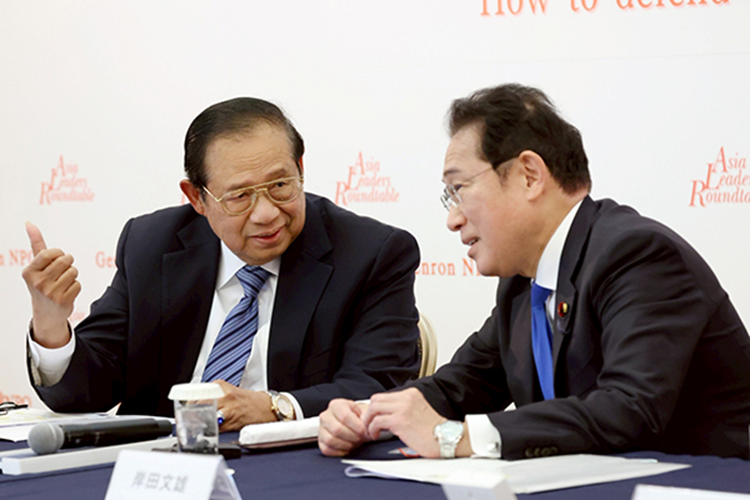
Susilo Bambang Yudhoyono served as President of Indonesia from 2004 to 2014, and he offered an Asian perspective of how the international order is changing "before our eyes," pointing out that Asia is in a unique position to help bolster it. <br />
 <br />
"Asia seeks stability without subordination. Asia seeks cooperation without coercion. Most Asian nations are middle powers," he said. "We do not deny the reality of power politics, but we believe power must operate within international norms." </p>
<p>Yudhoyono also pointed out that the status of the Global South has changed over the last few decades, and that in a "power-driven era" the question now becomes whether the Global South will be forced to choose sides, or whether its nations will be able to exercise independent judgment.</p>
<p>"In 2004, many countries of the Global South were still seen primarily as the object of policy, not authors of it," he explained. "That perception began to change (during the 2008 financial crisis with the rise of the G20.) Leaders who disagreed on many issues had to sit at one table. We did not solve everything, but we prevented systemic collapse." </p>
<p>Yudhoyono explained that G20 rose at that juncture not by design, but by necessity, and noted that the 2008 crisis highlighted that the Global South must also have a role in designing any future systems. </p>
<p>"Emerging economies were not spectators. They were at the table. That was a turning point. It showed that Global South could move from the margins to the center of global coordination," he said. "The Global South today is more diverse, more economically significant, and more politically self-aware. It no longer sees itself as an arena of rivalry. Instead, it sees itself as a stakeholder in shaping the system."</p>
<p>Yudhoyono concluded with a call for patience and caution. </p>
<p>"This age of power does not have to become an age of disorder. Diplomacy, restraint, and credible international mechanisms remain essential." </p>
<p><img alt="05.jpg" src="/en/pp/images/fbd4aa6246e7e6c393a068b7f073ec234e3ac1ba.jpg" width="750" height="500" class="mt-image-center" style="text-align: center; display: block; margin: 0 auto 20px;" /></p>
<p><br />
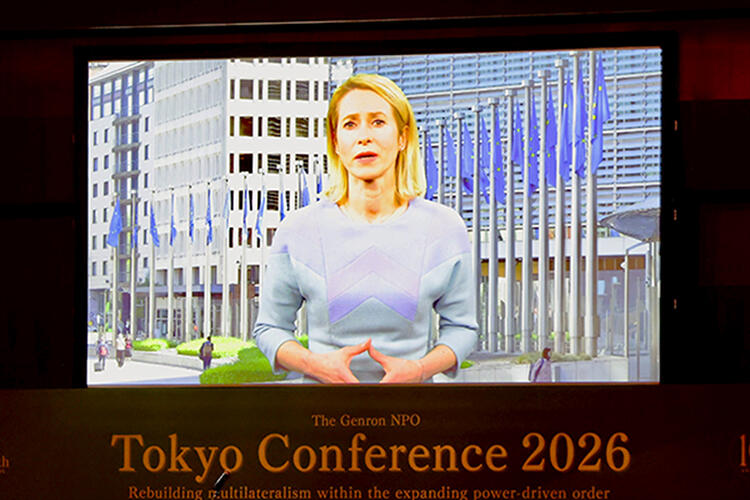
Former Estonian Prime Minister Kaja Kallas now serves as High Representative for Foreign Affairs and Security Policy and Vice President of the European Commission. Kallas provided a video message for the conference, in which she pointed out that while a new world order is in the making, there are still many unanswered questions, including what final form the new order will take. For Kallas cooperation is essential to building an effective order.</p>
<p>"Those of us who want to be the architects in rebuilding a multilateral system, rather than subjects of a system where only power counts, must pull in the same direction. For the European Union, that is why partnerships are what count." </p>
<p>Kallas pointed out the similarities between Japan and the countries of the European Union, but argued that their perspectives are not unique to them.<br />
 <br />
"We share a commitment to multilateralism, human rights, and an international order based on rules. We see them as the foundations for peace, stability, and shared prosperity," she said. "We know that the rise of unchecked aggression is a symptom of an expanding power-driven order. But the vast majority of countries want a world that is based on some kind of rules. We still believe in the sovereignty of nations. and this guides our approach to economic security and resilience." </p>
<p>Kallas asserted that "trusted and reliable partnerships are what separates the weak from the strong, and they are ultimately what will determine whether we can dissuade the world from succumbing to the will of a few," before concluding with a promise. </p>
<p>"We must remain engaged. In the quest to strengthen multilateralism, you will always find support in Europe." </p>
<p><img alt="06.jpg" src="/en/pp/images/1d71b10e9a2cfacc2fe9c3fd127457468739b8dc.jpg" width="750" height="500" class="mt-image-center" style="text-align: center; display: block; margin: 0 auto 20px;" /></p>
<p><br />
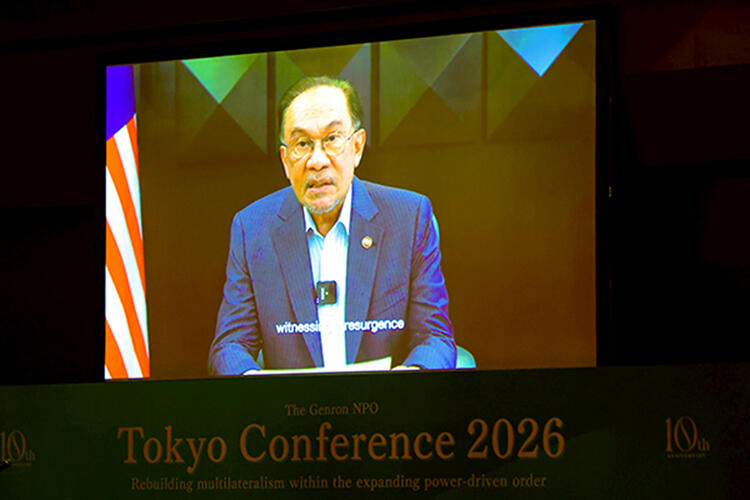
Current Malaysian Prime Minister Anwar Ibrahim also offered a video message to be played before the gathering. Before getting to the heart of his keynote speech, Prime Minister Ibrahim expressed his country's condemnation of the "recent unprovoked military strikes against Iran." He called for an immediate and unconditional ceasefire, urging all parties to "abandon the path to violence and return to the negotiating table with genuine intent." </p>
<p>Next, he turned to the topic of middle powers and the strength inherent to cooperation. </p>
<p>"The true strength of the middle powers lies within our regional collectives," he said. "At the East Asia Summit, Malaysia advocates for a vision where diversity does not divide, where we can initiate meaningful resolutions and shape norms; standing for justice, even when it is inconvenient. This is our definition of multilateralism. Not passive, but persistent; not naive, but necessary." </p>
<p>Ibrahim was clear about Malaysia's position on what must be done to bolster the international order. </p>
<p>"To restore trust, we need to return to the foundational values of the United Nations Charter. The reform of the Security Council is no longer optional. The veto power must be abolished in the long run."</p>
<p>Finally, he described Malaysia's own future path and objectives. </p>
<p>"Malaysia chooses to be a nation that drives inclusive development, not just for ourselves, but for the region and the world. Let us work together to ensure that the multilateral institutions of the future that we rely on are not mere tools of the powerful, but instruments for the pursuit of the common good of humanity by nations united in the quest for global peace and prosperity." </p>
<p><img alt="07.jpg" src="/en/pp/images/07.jpg" width="750" height="500" class="mt-image-center" style="text-align: center; display: block; margin: 0 auto 20px;" /></p>
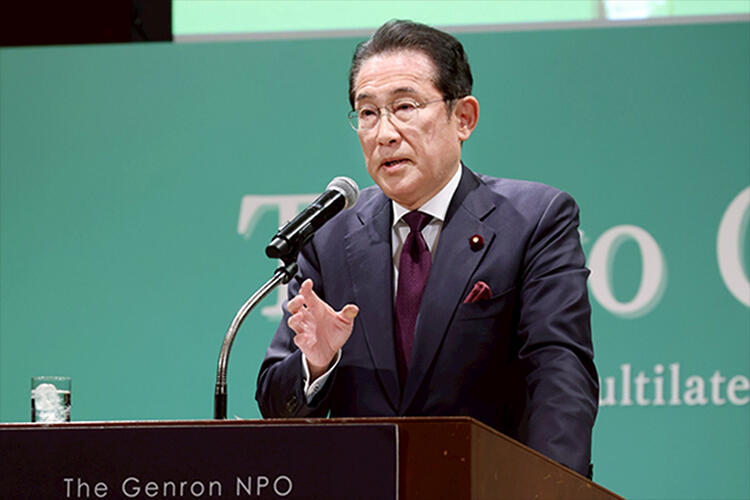
<p>The final keynote speaker was Fumio Kishida, former Prime Minister of Japan and Chief Advisor of the Tokyo Conference, who began by drawing a parallel between the diverse content of the speeches and the complexity of the current international environment. </p>
<p>"We have to face this harsh reality and respond to it, but we must also pursue the ideal. This is not a binary choice. They are compatible," he said. </p>
<p>With the security environment in East Asia becoming increasingly complicated, and that being reflected in the changes seen worldwide, Kishida believes that effective foreign policy is the way forward to improved security. But economic policy also comes into play, and he advocated that Japan follow the middle path when it comes to the major powers.  </p>
<p>"For Japan, the Japan-U.S. alliance has been and will continue to be the cornerstone of our foreign and security policy. That remains unchanged," he said. "But the Japan-China relationship is also important. China is Japan's largest trading partner, so we have to continue our dialogue with China. That position also remains unchanged."</p>
<p>Finally, Kishida turned to multilateralism and the rule of law, the latter of which he called "the very foundation of the (international) order." </p>
<p>"It's there for the sake of small and medium-sized powers who may sometimes be in vulnerable positions," he explained. "As for multilateralism, some say that its time has come. I disagree. It's become more difficult to uphold it, but that is why doing so has become more important. Multilateralism is the wisdom of humanity gathered through experiencing many wars and other catastrophes."</p>
<p>Finally, Kishida emphasized the importance of the rule of law, free trade, and multilateralism. Without these ideals, Kishida believes, and without countries like Japan continuing to pursue them, any discussion of the future will be fruitless.</p>
<p>"Japan must continue to be the flag bearer of these ideals, cooperate with countries who are in similar positions, and increase the number of our friends," he concluded. "The future of Asia is for Asian countries to decide. Japan will pursue both reality and ideal to uphold rule of law, free trade, and multilateralism. It is upon us to protect those concepts and to participate in the making of the Asian order."</p>
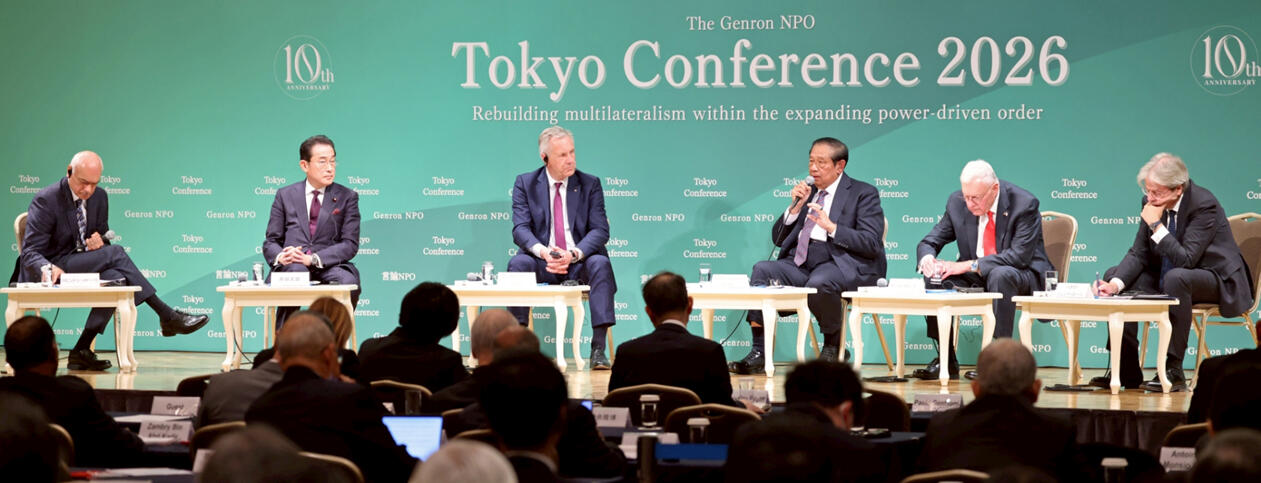
<p>After a brief intermission, the keynote speakers present at the event returned to the stage for a more explicit discussion moderated by Rohinton Medhora, Distinguished Fellow at Canada's Centre for International Governance Innovation. </p>
<p><img alt="08.jpg" src="/en/pp/images/08.jpg" width="750" height="500" class="mt-image-center" style="text-align: center; display: block; margin: 0 auto 20px;" /></p>]]>
    </content>
</entry>
<entry>
    <title>Tokyo Conference 2026 Panel Discussion: Rebuilding multilateralism within the expanding power-driven order - Projects/Events</title>
    <link rel="alternate" type="text/html" href="https://www.genron-npo.net/en/pp/archives/5677.html" />
    <id>tag:www.genron-npo.net,2026:/en/pp//6.5677</id>
    <published>2026-03-25T02:31:34Z</published>
    <updated>2026-03-31T06:34:29Z</updated>
    <summary>Medhora kicked off the discussion with a question aimed at Christian Wulff and Paolo Gentiloni, who he asked for their opinions on Europe&apos;s role in a potential future global order, and where the &quot;red lines&quot; should be drawn to prevent the current situation becoming worse.  Wulff responded first by ar...</summary>
    <author>
        <name>言論NPO</name>
    </author>
        <category term="The Tokyo Conference" scheme="http://www.sixapart.com/ns/types#category" />
        <category term="The Tokyo Conference 2026" scheme="http://www.sixapart.com/ns/types#category" />
    <content type="html" xml:lang="ja" xml:base="https://www.genron-npo.net/en/pp/">
        <![CDATA[<p>Medhora kicked off the discussion with a question aimed at Christian Wulff and Paolo Gentiloni, who he asked for their opinions on Europe's role in a potential future global order, and where the "red lines" should be drawn to prevent the current situation becoming worse. </p>
<p>Wulff responded first by arguing that building strength will prevent countries from becoming pawns, and emphasized that Europe is in a much better position than many believe ? including Europeans. </p>
<p>"Europe must not be underestimated. We have over 500 million consumers. We have lower debt than many other countries, a smaller income gap, and access to education and healthcare for all, regardless of social status. We are making progress on climate protection and are highly innovative. So, Europe will remain an important partner in the world."</p>
<p>He also noted that the European Union can serve as a model for the rest of the world to follow in moving towards a new future. </p>
<p>"In our system, every country has a commissioner in the European Commission, and every country is treated as an equal, regardless of its size. That is something Europe brings to the table ? mutual respect and appreciation ? and that can also be applied to the world."</p>
<p>Trust is another key for Wulff, and he explained why Japan and Germany enjoy a relatively high standing in other countries. </p>
<p>"They are reliable because they are trustworthy partners in development cooperation, for example," he said. "We are partners, and we must remain so. We value our partners. I believe that must be our approach, our strategy, for navigating the world."</p>
<p>Regarding the red lines, Wulff had a simple and clear response. </p>
<p>"The red lines are when someone wants to shift boundaries, when someone does not respect human dignity, when someone does not accept freedom of expression or freedom of the press. I believe we must continually discuss these red lines to ensure they do not shift, so that we do not change how we deal with others."</p>
<p><img alt="01.jpg" src="/en/pp/images/e408da311aaf5fc86bfbc83b67c57a63c8acdc6a.jpg" width="750" height="500" class="mt-image-center" style="text-align: center; display: block; margin: 0 auto 20px;" /></p>
<p><br />
Gentiloni echoed many of Wulff's comments regarding the strengths of the European Union, but pointed out that even the EU is facing new challenges. </p>
<p>"Europeans had three optimistic ideas that proved to be illusions. First, the fact that we could have cheap gas from Russia. Second, that we could have an enormous Chinese market open to our manufacture without any problems. And third, that our American allies will continue to provide, themselves, the burden of European security. In these last 20 years, these three strong ideas proved to be three illusions." </p>
<p>Europe must now address those illusions, Gentiloni explained, and key to this is the concept of strategic autonomy</p>
<p>"How (do we) build our autonomy in terms of trade, of technological innovation and competitiveness, and of defense?" he asked. </p>
<p>While such a goal is easy to explain, he explained, it is made more difficult in the case of Europe because it is not a single state but a union of member states.</p>
<p>"It is predictable and safe, but very slow. And the world is changing very fast. These advantages of Europe risk becoming a liability if we are too slow." </p>
<p>He concluded that the current situation has had at least one silver lining. </p>
<p>"Paradoxically, we should thank President Trump because he has been a wake-up call for Europe. Europe (must work towards) stronger autonomy. We can't be the only herbivores in the world of carnivores." </p>
<p><img alt="02.jpg" src="/en/pp/images/2f855dda53362b63a876e7902802868fa87f7020.jpg" width="750" height="500" class="mt-image-center" style="text-align: center; display: block; margin: 0 auto 20px;" /></p>
<p><br />
Medhora turned next to Keith Kellogg for some insight on where the relationship between the United States and China may be going. </p>
<p>"In the first Trump administration, we kept (those countries) we considered adversaries apart. You kept the Chinese over in this corner, the North Koreans in this corner, the Iranians in this corner, and the Russians in this corner. You got that separation between them all," Kellogg said. </p>
<p>He argued that it was the Biden administration, which turned away from this strategy, that caused the current situation in which "they actually joined together," and stated that the current dilemma is how to break those relationships apart again. </p>
<p>"Because you can attack each pretty well," he said. "When I say attack, I don't mean a kinetic attack; it's economic features first. How do you break them apart so you can actually approach them in detail?" </p>
<p>Kellogg then explained where the drive towards an "America First" policy came from. </p>
<p>"In the past we've said that America was gonna be sort of like the shield that was out there. Well, we've realized that by doing that, it was really incumbent upon the American people. So, (we knew that) we have to rely on our alliances. Buying time and building insulation. We have to make sure we can build up our own structures, primarily in the economic field, so we can compete well against the Chinese into the future."</p>
<p>The ultimate goal, Kellogg said, is to separate China and Russia and reduce the strength of the partnership they have entered into. </p>
<p>"If we do that, we figure we can work with the Chinese. We can work with the Russians. You can see what's happening in Iran right now in the Middle East, and we hope that there's some type of accommodation we can develop with China and well in the future. But again, it's not a military race, even though they are building militaries. We realize it's economic." </p>
<p>Medhora followed up on Kellogg's keynote, asking if there is "room for a deal" if both the United States and China are following a "Our Nation First" policy, and Kellogg stated that any deal between Russia and the US will need to include China. He also pointed out that Trump's relationships with both Russian President Vladimir Putin and Chinese President Xi Jinping will make dialogue easier. </p>
<p><img alt="03.jpg" src="/en/pp/images/89184748565c48f6d70cefdb7bc3fbb154a0db8a.jpg" width="750" height="500" class="mt-image-center" style="text-align: center; display: block; margin: 0 auto 20px;" /></p>
<p><br />
Next, Medhora asked Susilo Bambang Yudhoyono to expand on what he sees as Asia's role in the future. </p>
<p>"I think countries in Asia have the opportunity to play more roles in the future. It's not only how we could maintain our stability and security in this region, or how we could continue growing our economies. We could do many things to accomplish the global agenda in saving our planet and reducing poverty across the globe."</p>
<p>Yudhoyono pointed to regional architecture such as ASEAN as an example of how Asia could contribute.</p>
<p>"If we could empower these regional architectures, I think there will be many options. There will be many solutions to existing problems that we are facing together."</p>
<p>Yudhoyono also stated that Asia has a limited ability to intervene directly in moderating the friction between China and the United States, but it may be possible to guide them in a positive direction. </p>
<p>"I don't think that any country can stop the rivalry between the two great powers, but we could appeal to both sides," he explained. "There must be another agenda on which two countries can cooperate and serve as an example to this region for a better Asia: economically, politically, and in terms of security." </p>
<p><img alt="04.jpg" src="/en/pp/images/04.jpg" width="750" height="500" class="mt-image-center" style="text-align: center; display: block; margin: 0 auto 20px;" /></p>
<p><br />
Medhora praised Fumio Kishida's support of multilateralism and asked what role he sees Japan playing in a reconstructed world order. </p>
<p>"That is why we started the Asian Leaders Roundtable, so that Asian stakeholders can think together multilateralism and its future," Kishida answered. "The objective is to engage in dialogue, and our first roundtable (held March 10) went well."</p>
<p>He suggested that the Asian focus on economic multilateralism in the past could be adjusted in the future to account for other issues, including decarbonization and security, but ultimately, Asia has to think about its own future, and this is where Japan has a role to play. </p>
<p>"We feel that it is our responsibility. The direction we take going forward should be determined precisely through a multilateral approach by steadily engaging in dialogue with many countries across Asia. The first step was taken yesterday, and we hope to continue engaging in dialogue with other countries around Asia, with Japan stepping up to offer a venue for us to gather and think about our mutual future." </p>
<p>Medhora returned to Wulff at this point and asked him to describe why empathy is so important and what governments can do to promote it. Wulff began by reminding attendees how the current global order had been built in the first place. </p>
<p>"After the two world wars of the 20th century, together we founded the United Nations. And everyone said: no more war, no more fighting against minorities, no more persecution of minorities, no more backroom diplomacy.  But now forgetting is winning out over remembering. We must clearly remember why we founded the United Nations."</p>
<p>However, he also pointed out that the United Nations does not reflect the world as it is today. </p>
<p>"The veto countries have held veto rights since World War II, but India has 1.4 billion people and Indonesia has 300 million people. They are not permanently represented on the Security Council, and certainly haven't got veto power."</p>
<p>Wulff then shifted the spotlight to Africa. </p>
<p>"Africa as a continent has a huge number of young people, a great deal of innovation, significant growth, a lot of spirit, and a great deal of initiative, none of which is reflected in the United Nations. As representatives of different continents here, we must work together to listen more and be more responsive to one another," he said. </p>
<p>This, to Wulff, is both where empathy comes from and why it is so important to have.  </p>
<p>"That is empathy. Not just seeing with your own two eyes, but also through the eyes of the other person. That is why I am so focused on Indonesia, because there we see a vast country, a democracy with diverse religions enshrined in its constitution as 'unity in diversity.' In Jakarta, there's a tunnel between the Muslim mosque and the Catholic cathedral, the Tunnel of Friendship. Young Muslims and young Christians who are interested in one another can spend a whole weekend learning about the other religion," Wulff said. "To me, these are the heroes, not the people who only see their own interests."</p>
<p>Wrapping up his point, Wulff pointed a finger at another issue he sees as vital: the lack of representation. </p>
<p>"Most problems are caused by old men who are afraid of no longer being taken seriously. We need to put more women and more young people in positions of responsibility and approach everything with more empathy. Then we'd have fewer problems." </p>
<p><img alt="05.jpg" src="/en/pp/images/05.jpg" width="1261" height="483" class="mt-image-center" style="text-align: center; display: block; margin: 0 auto 20px;" /></p>
<p><br />
Finally, Medhora asked the panelists about how the rule of law has been handled thus far, and what is in store for the future. </p>
<p>"The 'Rule of law' is not only international rules themselves, but the respect for the rule of law as part of a democratic system," Gentiloni said, before acceding a point made by Kellogg that disregard for the rule of law is not recent. However, Gentiloni believes that what is happening now differs from what was experienced in the past, and that it is very dangerous. </p>
<p>"The second war of the Gulf was when the US made an enormous effort to try to convince (the United Nations that the invasion of) Iraq was justified on the basis of international rules," he said. "We can say that the rules were forgotten at the time, but the effort was enormous. If we compare that effort to the situation now, nothing similar is happening."</p>
<p>Gentiloni then predicted that the next decade will see the start of a new nuclear arms race, "Because non-proliferation treaties will be considered insignificant. Many countries will try to build their own nuclear capacity. I don't think that we can accept a world of this kind." </p>
<p>"We all know the weaknesses of the UN, WTO, you name it," he concluded. "But if we don't work to strengthen them, we are working against peace and prosperity."</p>
<p>In contrast, Kellogg criticized the way rule of law has been handled thus far as being the result of "cowardice." </p>
<p>"Why do countries vote against UN resolutions that condemn the war in Ukraine?" he asked. "They talk about the rule of law. People hide behind the rule of law when you have to aggressively stop what happened."</p>
<p>Kellogg pointed to Neville Chamberlain's appeasement policy regarding German expansionism in 1938 as an example of when aggression was needed.</p>
<p>"You have to draw a line, and sometimes that line is hard. I prefer my sons and their sons and daughters don't go to war next time. It sounds harsh, but too many times nations have hidden behind the term 'rule of law.'" </p>
<p>Yudhoyono added his thoughts regarding rule of law, calling it the "child of justice." </p>
<p>"Rule of law is an important element of democracy," he continued. "We fight for democracy by using rule of law to say no to authoritarianism."</p>
<p>Yudhoyono stressed that rule of law is useful in constraining the powers of leaders and countries that violate the norms of international relations. </p>
<p>"Power must be checked by other powers, because as everybody knows, power tends to corrupt, and absolute power tends to corrupt absolutely." </p>
<p>Yudhoyono believes a safe first step would be for the world to return to the fundamental principle underlying the rule of law; namely, that of respecting international laws regarding warfare and humanitarian conventions. </p>
<p>Wulff added to this, paraphrasing Aristotle by stressing that improving the world is simple. </p>
<p>"When many people work toward a better world, it gets better. And if many people don't work toward it, or if they hold back, or if they work toward something bad, then it gets worse," he said.  </p>
<p>Wulff also believes that advocating for rules and ensuring everyone follows them is an inherently positive thing, but admitted that this is a qualified statement.</p>
<p>"How to deal with the dilemma in which people are refusing to abide by law and order, in which people murdering and tyrannizing their own people as in Iran, well, that is another question. In cases where there is such disregard for the law, I can understand why people would resort to violence. But the fundamental principle must be that people create rules and follow them." </p>
<p><img alt="06.jpg" src="/en/pp/images/06.jpg" width="750" height="500" class="mt-image-center" style="text-align: center; display: block; margin: 0 auto 20px;" /></p>
<p>Last to speak was Fumio Kishida, who expressed concern that attempts to change the status quo by force or coercion will continue to be an issue in the future, but added that discussing those rules and how to follow them remains essential. </p>
<p>"I fully recognize that there have been times in the past when (the rule of law) was not thoroughly implemented, but believe that continuing to discuss this ideal of rule of law will send a valuable message to many countries. Russia's invasion of Ukraine began when I was Prime Minister, and I attended the NATO Summit to argue that today's Ukraine could be tomorrow's East Asia, and that such attempts to change the status quo by force must not be tolerated," Kishida explained. </p>
<p>"If the rule of law is not upheld on a sustained basis, there is a risk that other governments will come to believe that they too can change the status quo by force, which will lead to further instability. The international community must continue to make every effort to uphold the principle of the rule of law."</p>
<p>This brought the panel discussion to an end, and after a brief intermission the first session of the Public Forum began. (See other article for details.)</p>]]>
    </content>
</entry>
<entry>
    <title>Archive Video Now Available:  What sort of world are the major powers attempting to create? ーTokyo Conference2026 Panel Discussion - Projects/Events</title>
    <link rel="alternate" type="text/html" href="https://www.genron-npo.net/en/pp/archives/5676.html" />
    <id>tag:www.genron-npo.net,2026:/en/pp//6.5676</id>
    <published>2026-03-23T23:33:37Z</published>
    <updated>2026-03-31T06:34:45Z</updated>
    <summary>Leaders from Japan, the United States, Germany, Italy, and Indonesia come together to discuss some of the most pressing questions facing the world today: How should Asia and the EU respond in an era defined by power politics? Where is the U.S.-China relationship headed? And what is the future of the...</summary>
    <author>
        <name>言論NPO</name>
    </author>
        <category term="The Tokyo Conference" scheme="http://www.sixapart.com/ns/types#category" />
        <category term="The Tokyo Conference 2026" scheme="http://www.sixapart.com/ns/types#category" />
    <content type="html" xml:lang="ja" xml:base="https://www.genron-npo.net/en/pp/">
        <![CDATA[<p>Leaders from Japan, the United States, Germany, Italy, and Indonesia come together to discuss some of the most pressing questions facing the world today: How should Asia and the EU respond in an era defined by power politics? Where is the U.S.-China relationship headed? And what is the future of the rule of law and multilateralism?</p>
<p>Five leaders who have stood at the forefront of global affairs engage in an uncompromising exchange of views on the future of the world order. We are now releasing the full video of that discussion.</p>
<div class="youtube">
<iframe src="https://player.vimeo.com/video/1176393723?badge=0&amp;autopause=0&amp;player_id=0&amp;app_id=58479" frameborder="0" allow="autoplay; fullscreen; picture-in-picture; clipboard-write; encrypted-media; web-share" referrerpolicy="strict-origin-when-cross-origin" style="position:absolute;top:0;left:0;width:100%;height:100%;" title="Archive Video Now Available:  What sort of world are the major powers attempting to create? ーTokyo Conference2026 Panel Discussi"></iframe>
</div>
<div class="ao"><h2 class="title_type02">Tokyo Conference 2026 Day 2: Wednesday, March 11</h2>
<h6>Panel discussion</h6>
<p>"What sort of world are the major powers attempting to create? The international order in an era of power and unilateral negotiation"</p>
<h6>Panelists：</h6>
<p>Kishida Fumio（Former Prime Minister, Chief Advisor to the Tokyo Conference）<br />
Paolo Gentiloni（Former Italian Prime Minister and European Commissioner for Economy）<br />
Keith Kellogg（Former Assistant to the President and Special Presidential Envoy for Ukraine）<br />
Christian Wulff（The 10th President of the Federal Republic of Germany）<br />
Susilo Bambang Yudhoyono（Former President of the Republic of Indonesia）</p>
<h6>Moderator：</h6>
Rohinton Medhora（Distinguished Fellow, Centre for International Governance Innovation, Canada）
</div>]]>
    </content>
</entry>
<entry>
    <title>Asian Leaders Roundtable 3: Envisioning Asia&apos;s Future - Projects/Events</title>
    <link rel="alternate" type="text/html" href="https://www.genron-npo.net/en/pp/archives/5675.html" />
    <id>tag:www.genron-npo.net,2026:/en/pp//6.5675</id>
    <published>2026-03-19T10:36:54Z</published>
    <updated>2026-03-31T06:35:07Z</updated>
    <summary>The inaugural Asian Leaders Roundtable was held in Tokyo on March 10, 2026, and welcomed leaders from around Asia for three discussions about the future of the region.  This is the third of three main articles covering the Roundtable, and it provides a summary of the final question discussed: What k...</summary>
    <author>
        <name>言論NPO</name>
    </author>
        <category term="The Tokyo Conference" scheme="http://www.sixapart.com/ns/types#category" />
        <category term="The Tokyo Conference 2026" scheme="http://www.sixapart.com/ns/types#category" />
    <content type="html" xml:lang="ja" xml:base="https://www.genron-npo.net/en/pp/">
        <![CDATA[<p>The inaugural Asian Leaders Roundtable was held in Tokyo on March 10, 2026, and welcomed leaders from around Asia for three discussions about the future of the region. </p>
<p>This is the third of three main articles covering the Roundtable, and it provides a summary of the final question discussed: What kind of global role should Asia aspire to play in the run-up to 2050?</p>
<p>For this question, two attendees were invited to present their thoughts, after which the forum was brought to a close with remarks from former Japanese Prime Minister Fumio Kishida, former Indonesian President Susilo Bambang Yudhoyono, and former Singaporean Deputy Prime Minister Heng Swee Keat. </p>
<p>Paolo "Bam" Aquino currently serves as a senator in the government of the Philippines, and he called on Asia to lead the charge in restoring faith in collaborative governance that can address the complex global issues faced today. </p>
<p>"As we look ahead to 2050, Asia can become a leading global force that champions innovation, operation, and sustainability. We along with other regional partners have the potential to set the standard for a new form of multilateralism that prioritizes regional partnerships over traditional power dynamics," he said. </p>
<p>Aquino stated that in order to achieve such a goal, Asia must "enhance its role as a driver of global economic growth by continuing to innovate and collaborate in technology and industry. By leveraging the diverse strengths of its mature and emerging economies, the region can foster advancements in crucial sectors such as digital technology, manufacturing, healthcare, and even sustainability."</p>
<p>A collaborative spirit is essential to success in this endeavor, according to Aquino. The nations of Asia ? along with their regional partners ? should not view each other as competitors, but should rather recognize the value of mutual support and open trade to enhance collective prosperity. His hope is that ASEAN and its partners can take the lead in this. Additionally, Asia must contribute to improving the security environment. </p>
<p>"Asia must lead in establishing a shared security framework within our region that values cooperation and respect for sovereignty. We must move away from reliance on might as a means of resolution and instead return to a rules-based order. And through this, we can cultivate an environment of stability and peace that benefits not just each country, but also the global community."</p>
<p>Over the years leading up to 2050, Aquino asserted that Asia's vision should emphasize technological innovation, mutual respect and prosperity, and sustainability. </p>
<p>"By embracing these principles and being open to new coalitions and partnerships, even maybe beyond the traditional ones," he said. "We can showcase a model of multilateralism that delivers collective economic growth, international cooperation, and a rules-based order that ensures shared security."</p>
<p>In conclusion, he warned that 2050 may be too long a time frame for the situation as it stands today. </p>
<p>"We need to act now to form these new coalitions and new multilaterals, or even bolster old multilaterals that we've been a part of," he said. "Because the world simply won't wait for us."</p>
<p><img alt="01.png" src="/en/pp/images/df8a6fd2090e62d9b91df24831dccd325d664672.png" width="750" height="500" class="mt-image-center" style="text-align: center; display: block; margin: 0 auto 20px;" /></p>
<p><br />
Indonesian Coordinating Minister for Economic Affairs Airlangga Hartarto began his comment by arguing that the multipolar global order is not a recent phenomenon. What makes the situation different today is that the interaction between the poles is clouded by transactional and power-driven politics that are affecting the systems in place.</p>
<p>"With rising protectionism and eroding trust in multilateral systems, the WTO, for instance, has struggled to deliver progress in critical and emerging issues such as digital trade and ensuring resilient supply chains during the global shocks," he said. "The United Nations is struggling to uphold effective multilateralism in the face of deep pure political division, nationalist trends, and complex global crises."</p>
<p>Airlangga believes that a candid understanding of the global situation is essential, as is taking a pragmatic approach to navigating it, and he offered a suggestion about where the first efforts should be made. </p>
<p>"In the short-term, what needs to be saved is the next ministerial conference at the WTO at the end of this month," he explained. "I think this is the key for the long-term regarding the role of multilateralism; if we aren't able to save the WTO, multilateralism is truly at the crossroads. How can we expect to have (stronger multilateralism) in 2050, if we cannot resolve (the issues surrounding) the next WTO meeting?"</p>
<p>Airlangga followed with a prediction about the economic environment in 2050. </p>
<p>"Asia will account for 52% of global GDP in 2050," he said. "China is expected to be the largest with GDP of around 58 trillion (PPP), and then India with 44, Indonesia at about 10 or 11, and Japan and South Korea at around 9 to 10. Asian countries have to commit to promoting connectivity instead of fragmentation. Instead of protectionism, we must strengthen open and rules-based trade, and we have to act together to save the WTO. We must encourage strategic cooperation and complementary growth."</p>
<p>Airlangga also endorsed harnessing ASEAN as a driver for change. </p>
<p>"ASEAN is one of the largest economic blocs, and through RCEP and CPTPP, I think we have to deepen the networks we have," he said. "Even if there is uncertainty in Middle East, if all Asian countries can work together like we did today, we can be sure that by 2050, it will be indeed the century of Asia."</p>
<p>After a brief discussion about the final question of the Roundtable, former Japanese Prime Minister Fumio Kishida offered an overall summary of the gathering. </p>
<p><img alt="02.png" src="/en/pp/images/84ec7cdbb97162f33321178d955210b299d61dbf.png" width="750" height="500" class="mt-image-center" style="text-align: center; display: block; margin: 0 auto 20px;" /></p>
<p><br />
"Today's discussion was not about asking whether multilateralism has come to an end," he said. "The question asked was: 'In what form would multilateralism function in the midst of the current reality?' In this phase, Asia's role is crucial. Asia cannot sit on the sidelines simply observing the changes occurring around the world. Whether we are speaking about demographics, economic growth, technology, or the geopolitical situation, the choices made by Asia will define the future of the world. They will determine whether we move towards stability or division."</p>
<p>Kishida recognized the unique conditions existing in Asia, and noted that they were reflected in how attendees approached the Roundtable as well. </p>
<p>"Asia is not monolithic. There are different histories, values, and political regimes," he said. "We saw explicit differences in views during today's discussions, but we were also able to find commonalities."</p>
<p>Kishida stated that "No one is seeking a world that is divided. No one wants to leave to our children and grandchildren a world where order is formed only by force and power."</p>
<p>However, he also believes that Asia's role is not to replace the major powers and thereby be able to determine the form the order should take. It should instead help determine what should be protected. By raising its voices, Asia can demonstrate to the world that this is the minimum that countries should be doing. </p>
<p>Kishida closed by stating his belief that Japan has a role to play as a venue for dialogue and in supporting the differing positions of others, and he expressed his hope that the Asian Leaders Roundtable will become a permanent fixture that enables wider dialogue in the international community. </p>
<p><img alt="03.png" src="/en/pp/images/6aad71c93ce42d21757b02ccc7885f059e198aaf.png" width="750" height="500" class="mt-image-center" style="text-align: center; display: block; margin: 0 auto 20px;" /></p>
<p><br />
Former Indonesian President Susilo Bambang Yudhoyono provided his own summary of the dialogue by first describing how he came about his own values. </p>
<p>"I am a realist," he said. "But I love value-based realism. Before becoming a politician and then leading my beloved country, I was a military man. I served for three decades. My approach ...is very much influenced by my background and the journey of my life. But I think we can say that we basically agree on many things." </p>
<p>The first example Yudhoyono gave was that multilateralism must overcome unilateralism. </p>
<p>"We also agree that we have to respect international law, international order. Not the law of the jungle," he added, before quoting the Athenian historian Thucydides, who wrote, "the strong do what they can and the weak suffer what they must." </p>
<p>In Yudhoyono's word, this philosophy is, "For us, unacceptable." </p>
<p>Next, he highlighted the general agreement about empowering the United Nations and its organizations, and about respecting the Geneva Conventions and other laws of war to prevent human suffering, before turning to where the world can cooperate. </p>
<p>"We have go to back to global cooperation in dealing with the more important items on the global agenda: saving our planet and reducing poverty around the globe."</p>
<p>Finally, Yudhoyono summed up his opinion with an observation of where the world stands now in its understanding of the path forward. </p>
<p>"We know the 'what' and the 'why' regarding the improper direction our world is currently heading in, and we probably agree that we have to fix this broken world," he said. "If we could build real power collectively, then our world will likely improve, and we could prevent a real nightmare from occurring in our lifetime. Of course, there are many other important things that we may discuss together, but in essence we know the 'what' and the 'why.' Our task is to find the 'how': how to fix the bad things happening now in our world." </p>
<p>Former Singaporean Deputy Prime Minister Heng Swee Keat provided the closing remarks for the Asian Leaders Roundtable. </p>
<p>"We must continue to ask questions about what form multilateralism should take, the importance of values-based approach and the adherence to international law, and how we can do better," he began.</p>
<p>Heng expressed his appreciation for how Indonesia approaches its interactions with other ASEAN countries, particularly considered its size and influence, and implied that it could serve as a template for future broader multilateral frameworks as well.</p>
<p>"From the start, Indonesia did not use its weight and say that 'might is right,' but instead constructed a very positive relationship with Singapore, with all of us in ASEAN, and was a major builder of the ASEAN community, so much so that today the ASEAN Secretariat sits in Jakarta," he explained. "I think the Indonesian motto "Unity in Diversity" fits our discussion well. The key question is how do we turn this unity and diversity into unity and strength?"</p>
<p>Heng reminded the Roundtable that numerous attendees had referred to the importance of trust and credibility when it comes to cooperation, and noted that it is not enough to simply discuss these concepts, as for Heng, trust and credibility are about action.</p>
<p>"Asia can be a coalition builder ? a bridge builder ? to uphold the rule of law," he said. "We must continue to drive economic growth into the new age, when digital technology will be so critical. I'm very glad that ASEAN is doing the Digital Economy Partnership Agreement. We are pioneering the use of it in trade, which will be very positive."</p>
<p>Many speakers addressed the importance of ASEAN as a centralizing framework during the Roundtable, and Heng agreed. </p>
<p>"ASEAN centrality and neutrality are very important. ASEAN should reach out to everyone: build internal strength within ASEAN, and at the same time reach out to all those outside ASEAN in Asia and around the world, to build a stronger community of like-minded countries that emphasize multilateralism, free trade, and investment."</p>
<p>He also explained that while some believe ASEAN is resistant to change, in fact, it simply moves slowly. </p>
<p>"If you look at ASEAN from year to year, you think that it is a snail. It's really just crawling along," he said. "But if you look at ASEAN over 50 years, well, you are quite amazed at the progress that it has made. So, let's be patient. Let's continue to work hard. Let's continue to push at it."</p>
<p>Finally, Heng asked attendees to "look at the bright side" when it comes to the current global situation. </p>
<p>"Global trade and investment, despite all the negative remarks and all the negative developments, have not been too damaged yet. So, let us continue to do what we can and maintain that momentum."</p>
<p>In conclusion, Heng echoed the remarks of the co-chairs and Genron NPO President Kudo in expressing his hope that this forum for discussion between Asian leaders be encouraged to continue, and with that, the Asian Leaders Roundtable was brought to a close.</p>
<p><img alt="04.png" src="/en/pp/images/c790176ffd445922a35e406c4df4f1b7f98b5f1b.png" width="750" height="500" class="mt-image-center" style="text-align: center; display: block; margin: 0 auto 20px;" /></p>]]>
    </content>
</entry>
<entry>
    <title>Asian Leaders Roundtable 2:What Role for Asia in an &quot;Asia of Power&quot;? - Projects/Events</title>
    <link rel="alternate" type="text/html" href="https://www.genron-npo.net/en/pp/archives/5674.html" />
    <id>tag:www.genron-npo.net,2026:/en/pp//6.5674</id>
    <published>2026-03-19T10:22:19Z</published>
    <updated>2026-03-31T06:35:26Z</updated>
    <summary>The inaugural Asian Leaders Roundtable was held in Tokyo on March 10, 2026, and welcomed leaders from around Asia for three discussions about the future of Asia.  This is the second of three articles covering the Roundtable, and it provides a summary of the second question posed to the gathering: Am...</summary>
    <author>
        <name>言論NPO</name>
    </author>
        <category term="The Tokyo Conference" scheme="http://www.sixapart.com/ns/types#category" />
        <category term="The Tokyo Conference 2026" scheme="http://www.sixapart.com/ns/types#category" />
    <content type="html" xml:lang="ja" xml:base="https://www.genron-npo.net/en/pp/">
        <![CDATA[<p>The inaugural Asian Leaders Roundtable was held in Tokyo on March 10, 2026, and welcomed leaders from around Asia for three discussions about the future of Asia. </p>
<p>This is the second of three articles covering the Roundtable, and it provides a summary of the second question posed to the gathering: Amid the current global challenges, what roles and actions should Asia assume at the national and regional levels, and through cooperation with the wider international community, to reshape the rule-based global order, revitalize multilateral cooperation, and achieve sustainable economic growth?</p>
<p>As with the first discussion, four attendees were invited to present their thoughts, after which Asian Leaders Roundtable invitees and observers from Tokyo Conference 2026 held a short discussion under the Chatham House Rule.</p>
<p>Economist Duvvuri Subbarao, former Governor of the Reserve Bank of India, opened with an assessment of the current state of the world ? describing it as fragmenting into two trade, currency, and financial blocs ? and explained how this affects Asia in particular. </p>
<p>"Major powers, especially the United States, are acting unilaterally. Economic nationalism is replacing economic efficiency. Technology is fragmenting and trust is thinning," he said. "Every country in the world is affected by this, but Asia has the most to worry about because while the earlier international liberal order wasn't ideal, Asia benefited the most and Asia has the most to lose."</p>
<p>Subbarao explained that participants were asked to provide plausible solutions to the questions being asked, and in response, he offered four ways Asia can respond to the current situation. First, he explained that the work must begin domestically, starting with strengthening institutions, protecting central bank credibility, ensuring regulatory transparency, and maintaining open and predictable economic frameworks.</p>
<p>"Asia can respond by reshaping the global order at home. If Asia wants to defend our rules-based system internationally, it must reinforce a rules-based system domestically," he said. "Credibility is cumulative and Asia's growing economic weight gives it not only influence but responsibility."</p>
<p>Subbarao's second point addressed what Asia can do at the regional level.</p>
<p>"Asia must move beyond integration towards norm creation," he said. "Initiatives such as ASEAN show that Asia can deliver economic cooperation even when global trade negotiations stall. Asia should aim for interoperable digital standards, sustainable infrastructure financing, climate cooperation frameworks, and payment connectivity without financial decoupling."</p>
<p>Thirdly, Subbarao pointed out that Asia can also play a role as a builder of coalitions, particularly from the perspective of the middle powers. </p>
<p>"Asia's diversity can be a strength. Japan, Korea, India, Indonesia, Philippines, Singapore, Australia: these countries may differ in politics and geography, but they share an interest in stability, open trade, and predictable rules. So, Asia can pioneer issue-based coalitions on climate finance, semiconductor supply chain cooperation, digital governance standards, and resilient health systems."</p>
<p>Finally, Subbarao called on Japan to play a leading rule. </p>
<p>"Japan must take the lead in Asia's response to the current international system because Japan is a US Ally, a major Asian economy, a technology leader, and a champion of rules-based trade." he said. "Japan has already demonstrated leadership ? from rescuing the TPP after US withdrawal to advancing high quality infrastructure standards and supply chain resilience. In a world of sharpened rivalries, I think Japan can serve as a stabilizer between major powers, a convener of middle powers, a defender of institutional norms, and a bridge between the global north and the global south. Not through confrontation, but through consistency."</p>
<p><img alt="01.png" src="/en/pp/images/01782ba2a41e6c9217e94c82b4c27a660b596318.png" width="750" height="500" class="mt-image-center" style="text-align: center; display: block; margin: 0 auto 20px;" /></p>
<p><br />
Former Bank of Thailand Governor Tarisa Watanagase was next to speak, and she described how the previous international status quo was responsible for the remarkable growth, development, and stability seen over the past several decades. However, she also lamented the current drift towards an order built upon unilateralism, self-interest, and leveraging of power.</p>
<p>"The driving factors behind these changes are nationalism ? as we see in the US "America First" policy ? superpower rivalry, weaponization of sanctions, tariffs, control of critical minerals, and also the ineffectiveness of global institutions. There's a Thai saying that when mighty elephants fight, the grass underneath is crushed. I think that's what we are seeing now. The conflicts of superpowers have crushed the rules and laws in geopolitics and global security and relevant global institutions."</p>
<p>Watanagase's assessment of the current situation is not entirely pessimistic, however. </p>
<p>"The consolation is that other areas of multilateralism have remained more or less intact," she said. "Middle powers and smaller economies are cooperating in a broad range of economic activities with their peers, and pursuing avenues to form relations with like-minded parties for bigger alliances for cooperation."</p>
<p>It is in these areas that Watanagase believes Asia has a role to play. </p>
<p>"In Asia, we have a number of influential middle powers and ASEAN, so Asia is the most relevant region to contribute to upholding this system. We are also used to putting our efforts into influencing financial services. For example, ASEAN successfully voiced our concern over the use of macroprudential measures, the balance of payments safeguards, and capital flow management. These are evidence that Asia has helped shape the architecture of the financial order."</p>
<p>Watanagase continued by explaining that the current order is a continuation of what the countries of Asia have already been doing through engagement and collaboration for common prosperity and stability, except that now the primary actors are middle powers and smaller economies. In addition, she believes that Asia has little choice regarding what it must do.</p>
<p>"We must accept that the world has changed. Cooperation was relatively easier before, but now we face higher nationalism and protectionism around the globe, and other new challenges: changing supply chains and aging populations, AI, and other technological disruptions, digital economy and finance, and the green transition," she said. </p>
<p>To Watanagase, it is imperative that Asia be united and maintain the spirit of rules-based cooperation, even in the face of the various challenges and different priorities held by the countries of the region. To better respond to this reality, she offered a potential tactical strategy.</p>
<p>"I think Asia can launch a critically important agenda to deliver outcomes highly relevant to the region and the world. (Achieving a) clean transition is a pressing issue for all, and I think if we can launch such an agenda, we will be able to get a consensus to launch and pursue it. It's important that middle powers engage us and (nations that) lag behind. I believe that a strong ASEAN is an asset to Asia, and it is in the interest of Asian middle powers to ensure that this remains the case."</p>
<p>To conclude, she highlighted the importance of a unified region, especially in relation to ASEAN.</p>
<p>"It's likely that after the conflicts in Latin America and the Middle East, superpowers may heighten their focus and intensify pressure on ASEAN to choose a side. Only a strong ASEAN can resist such pressure."</p>
<p><img alt="02.png" src="/en/pp/images/fe8ba6d96e1def7b8579e3c36bb69fdf79540b5d.png" width="750" height="500" class="mt-image-center" style="text-align: center; display: block; margin: 0 auto 20px;" /></p>
<p><br />
Tengku Zafrul bin Tengku Abdul Aziz is a Malaysian politician, banker, and investor who holds senior advisory roles in the Malaysian government and the Malaysian Investment Development Authority. He began by immediately describing what he believes lies at the root of the lag in improving the systems currently in place. </p>
<p>"We meet at the moment when power is moving faster than process. We are seeing fresh tariff uncertainty, tighter export controls, and conflict risks that affect energy, shipping, and business confidence. For Asia, these are not distant shocks. They show up quickly in freight costs, input prices, and investment decisions, as well as growth prospects. So, the question before us is not whether Asia will be affected; we already are."</p>
<p>It is Tengku Zafrul's view that Asia must choose to be "a builder," i.e., by increasing regional resilience and trust, and by engaging in practical cooperation with the wider world. To achieve this, he provided three potential courses of action. </p>
<p>"First at the national level, Asia has to strengthen resilience. We (must distrust) turning inward. That means credible institutions, clear policy signals, strong human capital, and the ability to absorb shocks without falling into panic or protectionism. Resilience should not mean retreat. It should mean having enough capability, enough diversification, and enough confidence to stay open."</p>
<p>Tengku Zafrul provided concrete numbers to back up his suggestion, noting that Malaysia's GDP grew by 5.2% in 2025, and the country approved record-high levels of investment and trade, with more than half of the approved investments coming from domestic sources. He believes that this proves that investors "still respond to clarity, credibility, and execution."</p>
<p>For his second proposal, Tengku Zafrul suggested that Asia put more effort into achieving real ? rather than "rhetorical" ? regional integration. </p>
<p>"In times like this, regions matter more, not less," he said. "If global rules are under stress, then regional cooperation becomes a stabilizer. It reduces friction, widens options, and helps countries avoid being trapped by binary choices. So, for ASEAN, this means focusing on practical outcomes: lower trade frictions, better customs and logistics coordination, stronger digital trust, more connected energy systems, and clearer pathways for sustainable investments. The chairmanship of ASEAN last year showed that ASEAN adopted many practical visions ? for example, Asian Community Vision 2045 ? reaffirming ASEAN's role in shaping rules-based regional architecture. ASEAN also advanced economic and digital initiatives like DEFA."</p>
<p>Tengku Zafrul's third proposal addressed the issue of how Asia should interact with the rest of the world. </p>
<p>"Asia should act not as a passive arena for rivalry, but as an active coalition builder. We should be realistic that all multilateralism is under strain, but the answer is not to give up on cooperation. The answer is to rebuild it where it can still deliver. That means defending some basic principles: sovereignty, rule of law, peaceful dispute resolution, and freedom of choice for smaller and middle-sized states. It means supporting WTO reform and other rules-based mechanisms that preserve predictability, and it means building practical coalitions around the issues where cooperation is still possible: climate, health, security, digital governance, supply chain resilience, and transition finance."</p>
<p>The issues addressed here are not abstract ones for countries like Malaysia, according to Tengku Zafrul. </p>
<p>"In 2025, Malaysia's total trade reached a record close to 800 billion U.S. dollars. A trading nation cannot thrive in a world where rules are arbitrary. When we speak about a rules-based order, we are really speaking about the conditions that allow growth, jobs, and stability to continue. This is why I believe Asia's role is not to replace the existing order, nor to pretend the whole system can simply be restored. Our role is to help modernize cooperation for the world as it is now. If Asia does this well, we will do more than protect ourselves from disruption; we will help shape a system that is more credible, more balanced, and more sustainable. And that, I believe, is the role Asia should now assume."</p>
<p><img alt="03.png" src="/en/pp/images/3d98034e51be17cb852b3ffacfe6f8db0750cbcb.png" width="750" height="500" class="mt-image-center" style="text-align: center; display: block; margin: 0 auto 20px;" /></p>
<p><br />
The final commenter for the second question of the Roundtable was Noriyuki Hara, Chair for the Committee on Asia and Oceania at the Japan Business Federation, and Chairman and Director of MS & AD Insurance Group Holdings. </p>
<p>Hara began by recognizing the difficulties multilateralism is facing due to drastic changes in the global environment. However, he pointed out that Asia ? a region home to a broad range of religious and ethnic cultures ? has been able to achieve growth through mutual respect of that diversity and through mutual trust. That latter point is one he believes particularly important when it comes to cooperation. </p>
<p>"In 1977, then Japanese Prime Minister Takeo Fukuda visited the countries of Southeast Asia, and in Manila, his final stop, he expressed a new foreign policy regarding affairs with Southeast Asia, the so-called Fukuda Doctrine," Hara explained. "The Fukuda Doctrine states that Japan will focus on 'heart-to-heart' cooperation with ASEAN as an equal partner."</p>
<p>Hara stated that the doctrine was applied not only to ASEAN, but to Asia as a whole, and that it is still being followed today. </p>
<p>"Japanese companies attempt to build trusting relationships local companies in order to grow together. This relationship of trust is a very valuable asset," Hara asserted, adding that economic security and autonomy are also important. </p>
<p>"Asian countries have different cultures, traditions, resources, and industries. These strengths must be harnessed such that our countries become indispensable to the global economy and capable of independent growth. Capacity building will be an important part of achieving that."</p>
<p>Hara noted that there are multiple sectors in which cooperation should be improved. </p>
<p>"First is free trade. Development and free trade are essential for economic security and supply chain resilience. It is also necessary to have not only bilateral FTAs, but agreements like the CPTPP. Multilateral trade frameworks are necessary to helping and complementing each other, and should include cooperation with countries outside Asia. Economic resilience comes not from protectionism but from open, connected relationships based on fair competition."</p>
<p>The second sector where collaboration will be useful is carbon neutrality initiatives tailored to Asia. With Asian economies continuing to grow, the demand for energy and fossil fuels will increase. However, as few renewables are in wide use yet, Hara did wonder how carbon neutrality can be achieved.</p>
<p>Hara believes that human resources development and exchange is another area ripe for cooperative efforts. </p>
<p>"The most important industrial resource is personnel, and labor exchange is vital. In addition, by exchanging knowledge and technologies, we can deepen our mutual understanding and contribute more to the connectivity of Asian economy."  </p>
<p>Finally, collaboration is required to resolve the social and demographic issues that many countries in Asia are facing now or will face in the near future. </p>
<p>"I think that's important that we work together to resolve all of these challenges," Hara explained. "There are many areas in which Asian countries can still cooperate and mutually increase our opportunities."</p>
<p>Following the opening commentary, participants focused on two main threads of discussion. </p>
<p>The first touched upon how Asia can coordinate to address environmental issues, with one attendee asking why there seems to be no wider environmental agreement on carbon pricing. The same attendee added that the digital economy could be another area where Asia could take the lead, saying, "DEPA (Digital Economy Partnership Agreement) strikes me as a very good example of Asia being innovative in global governance and setting the stage for others to follow."</p>
<p>In response, it was noted that numerous Asian middle powers are doing "good work in green transition technological innovation," adding that, "If we can put those middle powers with the rest of Asia, and then we can work together and produce some data about standards and produce some very meaningful outcome for the world to move forward. That could be the first step." </p>
<p>This was soon followed by another comment about how ASEAN adopted its Strategy for Carbon Neutrality in 2023 as a part of its official regional road map, and also launched the Common Carbon Framework two years ago during COP. This commentor was positive about the future initiatives in this area, noting that current bilateral agreements between some member states suggest that a regional carbon market system is in the process of forming, though it may not yet be a single cohesive framework. </p>
<p>Also addressed was the increase in oil prices in the wake of the war in Iran. Attendees were asked what contingency plans are in place in Asia to deal with more extreme price increases, and one participant pointed out that this is not the first time the world has had to deal with high oil prices.</p>
<p>"With higher prices, there is a scramble to try to find a substitute like biofuels. The whole world is going to suffer from the economic adjustments that come with that kind of pressure, but it will compensate."</p>
<p>This ended the discussion, and the Roundtable turned to the third and final question. </p>
<p><img alt="04.png" src="/en/pp/images/9426a35cb17ec51c330fd6cce5061f8b49f6fb80.png" width="750" height="499" class="mt-image-center" style="text-align: center; display: block; margin: 0 auto 20px;" /></p>]]>
    </content>
</entry>
<entry>
    <title>Asian Leaders Roundtable 1: How does Asia perceive the current global order? - Projects/Events</title>
    <link rel="alternate" type="text/html" href="https://www.genron-npo.net/en/pp/archives/5673.html" />
    <id>tag:www.genron-npo.net,2026:/en/pp//6.5673</id>
    <published>2026-03-18T02:35:27Z</published>
    <updated>2026-03-31T06:35:46Z</updated>
    <summary>The inaugural Asian Leaders Roundtable was held in Tokyo on March 10, 2026, and welcomed leaders from around Asia for three discussions about the future of Asia.  The first question posed to the gathering was as follows: As power-driven politics and transactional approaches by great powers continue ...</summary>
    <author>
        <name>言論NPO</name>
    </author>
        <category term="The Tokyo Conference" scheme="http://www.sixapart.com/ns/types#category" />
        <category term="The Tokyo Conference 2026" scheme="http://www.sixapart.com/ns/types#category" />
    <content type="html" xml:lang="ja" xml:base="https://www.genron-npo.net/en/pp/">
        <![CDATA[<p>The inaugural Asian Leaders Roundtable was held in Tokyo on March 10, 2026, and welcomed leaders from around Asia for three discussions about the future of Asia. </p>
<p>The first question posed to the gathering was as follows: As power-driven politics and transactional approaches by great powers continue to expand, how does Asia perceive the current global order? Within this reality, what principles or values must be protected?</p>
<p>Four attendees were invited to present their thoughts on the above question, after which Asian Leaders Roundtable invitees and observers from Tokyo Conference 2026 held a short discussion under the Chatham House Rule. </p>
<p>First to speak was former Deputy Prime Minister of Singapore Heng Swee Keat, who described the current era in which we live as one of "great uncertainty." He followed by praising the United Nations and other institutions of the current global order for what they have achieved thus far. </p>
<p>"The global order established after World War II, with significant contributions from the United States, has brought relative peace and stability," Heng said. "While conflict persists, the Cold War ended without escalating into another World War. Institutions like the United Nations have upheld the sovereignty of nations, resolved disputes, and fostered global agreements such as the law of the sea."</p>
<p>According to Heng, maintaining the peace was not the only achievement of the international order; it also succeeded in expanding how labor is deployed. </p>
<p><br />
"Global trade and investment underpinned by rules forged at the WTO have expanded the global division of labor. Developed nations have benefited from cheaper and more diverse goods, while developing nations have seen rising standards of living. Asia in particular has been a major beneficiary."</p>
<p><br />
His third observation about the current order was regarding financial institutions. <br />
 </p>
<p>"The surge in capital flows to foreign direct investments and portfolio investments have enabled more efficient deployment of resources. Institutions like the IMF, World Bank, and Bank for International Settlements have played critical roles in supporting this system." </p>
<p>Heng described these "three pillars" as having collectively raised living standards worldwide, but also offered a warning. </p>
<p><br />
"The global order is shifting towards power-driven politics and transactional approaches by the major powers, how Asia perceives and responds to these changes will shape our future."</p>
<p><br />
He offered three potential principles that could guide Asia in moving forward. </p>
<p><br />
"First, while Asia is diverse, we share common interests and values. We have all benefited from the principles of sovereignty, the rules-based global order, free trade, and multilateralism. Global institutions like the UN, WTO, IMF, World Bank, and ICJ are not perfect, but they remain essential. So instead of abandoning them, we must reform and strengthen them to serve all nations better.</p>
<p><br />
"Second, Asia must continue to develop our economies. Many parts of ASEAN still have low per capita GDP and even in China, which has lifted hundreds of millions of people out of poverty, there are still hundreds of millions living on less than 1,000 U.S. dollars a year. Regional cooperation is key to this...but we must observe the principles of open regionalism, by engaging partners from Australia, Europe, and any other part of the world.</p>
<p><br />
Heng's third point referenced the economic policies of the late Shinzo Abe, former Prime Minister of Japan. </p>
<p><br />
"We must draw lessons from Abenomics, particularly its three arrows: monetary, fiscal, and structural policies. Monetary policy must ensure price stability and financial soundness. Fiscal policy should invest in public goods like education, healthcare, and infrastructure. Structural reforms, though challenging, are critical for adapting to technological advances like AI and quantum computing and biotech."</p>
<p><br />
Heng pointed out how globalization can be best harnessed.</p>
<p><br />
"Globalization thrives when economies restructure and innovate, creating new competitive advantages. Blocking progress or resorting to protectionism will only lead to conflict."</p>
<p><br />
Heng believes that Asia has already learned a lesson about confrontation in that it "does not lead to development." Instead, the countries of Asia should accelerate engagement, find complementary relationships, and embrace restructuring. This is particularly true in the era of "big power politics." At times like these, ASEAN centrality and neutrality are vital.<br />
 </p>
<p>Heng concluded, "Together we can address common challenges like climate change and pandemics, support UN sustainable development, and work together to harness the future that technology can offer us be in tackling climate change, pandemics, using AI, quantum computing, and more." </p>
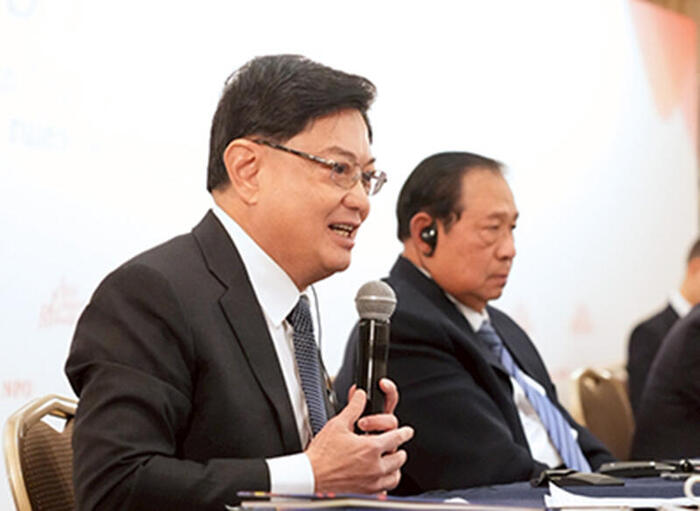
<p><img alt="058c2197d03bd792341cb3527554b277.jpg" src="/en/pp/assets_c/2026/03/5f43fa4fd3fba459cea9c5de1064888eaa1fd544-thumb-700xauto-3686.jpg" width="700" height="511" class="mt-image-center" style="text-align: center; display: block; margin: 0 auto 20px;" /></p>
<p><br />
Next to speak was Sri Mulyani Indrawati, who served as the Minister of Finance of Indonesia and Managing Director of the World Bank Group. Sri Mulyani believes that ASEAN has an indispensable role to play in the global economy and in maintaining geopolitical stability</p>
<p><br />
"Asia accounts for more than half of global economic growth, hosts the largest manufacturing hubs, the fastest growing middle class, and major financial and technological centers," she began. "Asia plays a decisive rule in critical supply chains and also in global trade and investment."</p>
<p><br />
Sri Mulyani presented her ideas on how Asia can use these strengths to help stabilize the global system. </p>
<p><br />
"I think we can pragmatically use the existing platforms that Asia benefited enormously from in the rule-based order through the transformation of the economy post-World War II by adopting open trade and investment, investing in human capital, building infrastructure, building good sound and clean governance of public and private institutions, and adopting sound macroeconomic fiscal and monetary policies as well as structural reform." </p>
<p><br />
Sri Mulyani believes that the region must use the existing platform of collaboration to reduce fragmentation and broaden cooperation. Through that, ASEAN can keep the major powers engaged in structural dialogue. </p>
<p><br />
"ASEAN and Asia can also maintain and strengthen the rules-based economic order. It is not perfect...but we could actively play a role in reforming the new world order through working together and collectively."</p>
<p><br />
She went on to point out that recent conflicts and geopolitical tension have also introduced new instruments of economic warfare through sanctions, payment system fragmentation, and polarization of reserve currencies.</p>
<p><br />
"These are no longer isolated tools," Sri Mulyani explained. "They are becoming structural features that threaten financial stability and generate negative spillover across economies."</p>
<p><br />
"We need to continue working hard within regional forums, including strengthening our own cooperation," she continued. "Liquidity coordination, enhanced payment system connectivity, and expanded local currency settlement must be strengthened. Beyond (the creation of a) financial safety net, ASEAN and all its partners can play unifying roles </p>
<p>by diluting rivalry through practical cooperation. We could build cross-border infrastructure, including facilitating energy and energy transition, digital payment interoperability, disaster response coordination, and stronger food security collaboration."</p>
<p><br />
Sri Mulyani concluded by asserting that Asia and ASEAN are very important players in the G20 and other global fora. </p>
<p><br />
"ASEAN countries can contribute constructively by advancing key global initiatives, debt restructuring, climate change and transition finance, pandemic preparedness, and digital public infrastructure. These will not only serve the interests of Asia, but also many other low- and middle-income countries, especially in Africa."</p>
<p><img alt="2530ce5409c655790ba08e3f0aedf382.jpg" src="/en/pp/assets_c/2026/03/e58aa2175b0e3a97d649e79a0c684b7319235c71-thumb-700xauto-3688.jpg" width="700" height="444" class="mt-image-center" style="text-align: center; display: block; margin: 0 auto 20px;" /></p>
<p><br />
Former Malaysian Minister of Foreign Affairs Zambry Abdul Kadir spoke next, and began with a simple observation. </p>
<p><br />
"Every generation believes it lives in a transformative era, but some eras truly reshape the trajectory of history," he said. "We are witnessing the rapid unraveling of the predictable rules-based multilateral order that facilitated decades of global growth. In its place, we see a system increasingly defined by zero-sum competition, unilateral deal making, and outright economic coercion."</p>
<p><br />
Zambry noted that the current international landscape is increasingly characterized as an "age of power" by many analysts. Influence during such an era is often measured in military strength, technological dominance, and economic leverage. However, he pointed out that a lasting order cannot be sustained by power alone. From the Asian perspective, the world is not now simply a battlefield for great powers. Instead, it is suffering from a "growing deficit of trust ?trust in international institutions, trust in international law, and trust in the idea that rules apply equally to all." He then described some of the elements of the current global situation that are shaping perceptions in Asia, beginning with the weaponization of global interdependence. </p>
<p><br />
"For decades, we were told that economy interdependence would prevent conflict," Zambry explained. "Trade was meant to be the great equalizer. Technology was meant to unite humanity through progress. Yet today we see supply chains being reorganized not for efficiency, but for geopolitical competition. For many countries across Asia, the trends (we see today) threaten the development pathway that lifted millions out of poverty."</p>
<p><br />
The second element affecting Asian perceptions can be found in the "credibility crisis of the rules-based order," which is heavily affected by what Zambry called "contradictions." </p>
<p><br />
"Major powers frequently call for the defense of the rules-based international order, yet we also observe instances where those rules appear to be selectively applied, creatively interpreted, and entirely bypassed when it becomes inconvenient to the powerful.</p>
<p>A system that operates on the basis of rules for others, with exceptions for ourselves, cannot sustain legitimacy. They become instruments of hierarchy."</p>
<p><br />
Zambry's final element lies in the "the pressures of geopolitical binaries" resulting from the formation of exclusive strategic blocks and minilateral arrangements throughout the region. </p>
<p><br />
"More concerning is the increasing pressure placed upon Asian nations to choose a side; to align with one power against another," he said. "Let me say this clearly, Malaysia refuses to view its future through the lens of a new Cold War. We will not be reduced to pieces on someone else's political chess board."</p>
<p><br />
However, Zambry also offered some criticism of the previous multilateral order and asserted that Asian countries must not simply attempt to defend it.</p>
<p><br />
"The old order was imperfect and often marginalized the voices of the Global South. Instead, we must work together to build a more balanced and equitable multilateral system."</p>
<p><br />
Zambry outlined three essential principles for Asia to follow, with the first being "strategic autonomy through active non-alignment."</p>
<p><br />
"It is not neutrality. It is not passivity. It is the freedom to engage with all partners without external coercion and is based strictly on mutual respect and our own sovereign national interests and policies. We (should) maintain strong relations with traditional Western partners, while also expanding engagement with the Global South. Our participation in emerging platforms such as BRICS demonstrates that nations can maintain diverse and overlapping partnerships. Strategic autonomy must remain the sovereign right of every nation."</p>
<p><br />
Next, Zambry believes that Asian countries must protect sovereign equality and international law. </p>
<p><br />
"In an age of power, smaller and middle-sized nations (will) rely heavily on international law as their primary safeguard. The sovereignty of a small nation must carry the same legal weight as that of a major power. We must consistently apply these principles together, whether we are discussing territorial integrity in Europe, freedom of navigation in Asia, or humanitarian law in Gaza, Ukraine, and the Middle East."</p>
<p><br />
Ultimately, Zambry believes that the same standards must be applied to all countries, and this brought him to his final point, that international diplomacy requires shared values. </p>
<p><br />
"In Malaysia, our government philosophy is guided by a modern framework which emphasizes sustainability, compassion, respect, innovation, prosperity, and trust. Some may dismiss this value as idealistic in a world driven by Realpolitik, but in truth, values are the foundation of sustainable international cooperation."</p>
<p><img alt="e609b8d03cd32399560bff6f3364160c.jpg" src="/en/pp/images/1b66b472c860b3e4511fea27f5ea485fadc487d5.jpg" width="800" height="533" class="mt-image-center" style="text-align: center; display: block; margin: 0 auto 20px;" /></p>
<p><br />
Kanetsugu Mike is Chairman of the Mitsubishi UFJ Financial Group, and he provided the perspective of someone involved in the banking industry as the final commentary on the guiding question for this discussion.</p>
<p><br />
"Some people see the world facing fragmentation and, from certain perspectives, they may have a point. But speaking from the viewpoint of having tremendous confidence in Asia's future, I think a better word is 'reconfiguration'," Mike began. "Power and the transactional behavior of major states have always shaped geopolitics, economics, security, and finance to some degree. And today these forces are more interconnected than ever. This can redirect and even amplify their impact, but that doesn't mean the world order that is built around globalization is coming to an end." </p>
<p><br />
Mike provided some concrete numbers that illustrated how much global trade has grown over the last twenty years even in the face of increased tariffs, de-coupling, de-risking, and rising tensions between China and the United States. </p>
<p><br />
"Economic interdependence did not recede," Mike asserted. "The global economy is not fragmented. It is reorganizing and reallocating based on the current realities. What we cannot afford to lose is the commitment to sustain cooperation based on differences."</p>
<p><br />
Furthermore, annual economic growth was equally positive, according to Mike. </p>
<p><br />
"Over the past two decades, the global economy grew at an average rate of around 3%. At the same time, the Asia-Pacific grew around 5%, and Southeast Asia more than 6%. This is not a coincidence. Structural drivers like demographic advantages, rapid urbanization, strong manufacturing bases, and expanding interregional markets have all supported Asia's growth."</p>
<p><br />
Mike also believes that it would be inappropriate to overlook how Asia achieved this in light of the significant political, developmental, and historical differences that exist in the region. He praised the region's strength in being able to maintain a pragmatic balance with "respective flexibility, not rigid uniformity," and noted how its large share of global trade requires a predictable framework that provides a foundation that supports investment and cooperation.</p>
<p><br />
"This is vital because sustained growth needs stable rules, market connectivity, and trust. We also need to remove impediments to growth, including regulatory friction.</p>
<p>Finance is a driver ...but fragmented international financial regulations increase compliance costs across jurisdictions. Instead of broad comprehensive efficiency, this leads to isolated compartments of optimization, sluggish capital allocation, and constrained global growth. Harmonization and standardization of international financial regulations is the remedy."</p>
<p><br />
However, Mike warned that the way forward must take into account the negative externalities that come with growth. </p>
<p><br />
"Growth generates distortions like climate change and the chasms of economic inequality," he said. "These will undermine sustainability if they are not addressed." </p>
<p><br />
Mike concluded with a cautiously optimistic observation. </p>
<p><br />
"Asia will continue to be an engine of global growth, but it won't be automatic. It requires effort. Even in an 'era of reconfiguration,' we have to nurture connections, help institutions function effectively, reduce friction, and convert the perceived burden of the transition into opportunity. Instead of passively accepting the evolving order, Asia will maintain a spirit of cooperation that reflects and respects differences, strengthens the framework for growth, and removes factors that impede it. This is Asia's choice and I believe it will meet the challenge."</p>
<p><img alt="e6cf7830ed0fe56790750c42b9583726.jpg" src="/en/pp/assets_c/2026/03/abbb1a3706a750dbbefc4f62c675d06648b6ff7e-thumb-700xauto-3691.jpg" width="700" height="466" class="mt-image-center" style="text-align: center; display: block; margin: 0 auto 20px;" /></p>
<p><br />
Participants next embarked on a bracing discussion that expanded on many of the points raised by the initial speakers. As previously mentioned, the Chatham House Rule was invoked to ensure a frank exchange of views, and the discussion revolved around what sort of concrete measures and policies the countries of Asia can implement to address issues related to multilateralism, economic integration, and sovereignty. </p>
<p><br />
One participant recognized that the ASEAN platform may not be perfect, but went on to argue that "This is one of the most peaceful regions we know." Another followed up on this by asserting that the multilateral setup of the Asian "still needs to evolve."</p>
<p><br />
"No, it's not perfect. It works for us, but it does still need to evolve, in particular with regard to security and the conduct of the seas. But I'm still hopeful that ASEAN can eventually come up with an agreement of conduct regarding how each of our countries can respect each other, respect our exclusive economic zones, and still continue to do trade and support each other's economic prosperity."</p>
<p><br />
Roles that Asia's middle powers can play were also addressed when one participant said, "I think Japan, for example, and many other countries like India, can play this middle power role. We hope they will act as bridge builders."</p>
<p><br />
Finally, one of the participants lauded ASEAN's strengths. </p>
<p><br />
"One of the most important goals of ASEAN is to strengthen multilateralism throughout. Over the years, (ASEAN has) faced different difficulties between member states, but the whole idea is to increase economic integration. To cooperate. To strengthen our respective societies in our different countries. And most importantly, to promote multilateralism to keep the region open and to strengthen our cohesiveness."<br />
</p>]]>
    </content>
</entry>
<entry>
    <title>Launch of the Asian Leaders Roundtable: Asia&apos;s Options in an &quot;Age of Power&quot;      How to defend and rebuild the rules-based multilateral order   - Projects/Events</title>
    <link rel="alternate" type="text/html" href="https://www.genron-npo.net/en/pp/archives/5672.html" />
    <id>tag:www.genron-npo.net,2026:/en/pp//6.5672</id>
    <published>2026-03-12T01:09:13Z</published>
    <updated>2026-03-31T06:36:04Z</updated>
    <summary>On March 10, 2026, The Genron NPO welcomed leaders from around Asia to the Asian Leaders Roundtable, a new initiative launched to coincide with the tenth anniversary of Tokyo Conference 2026, an annual gathering of experts and leaders from around the world.  As Genron president Yasushi Kudo explaine...</summary>
    <author>
        <name>言論NPO</name>
    </author>
        <category term="The Tokyo Conference" scheme="http://www.sixapart.com/ns/types#category" />
        <category term="The Tokyo Conference 2026" scheme="http://www.sixapart.com/ns/types#category" />
    <content type="html" xml:lang="ja" xml:base="https://www.genron-npo.net/en/pp/">
        <![CDATA[<p>On March 10, 2026, The Genron NPO welcomed leaders from around Asia to the Asian Leaders Roundtable, a new initiative launched to coincide with the tenth anniversary of Tokyo Conference 2026, an annual gathering of experts and leaders from around the world. </p>
<p>As Genron president Yasushi Kudo explained in his remarks opening the forum, the aim of the Asian Leaders Roundtable is not to gather opinions, but to bring together the leaders of many of the most important countries in Asia - Japan, Indonesia, Singapore, the Philippines, Malaysia, India, and more - to discuss what needs to be done to protect the rules-based multilateral order currently threatened by the actions of the major powers, and to discuss what needs to be done to update it for the modern day. <br />
Serving as co-chairs were former Japanese Prime Minister Fumio Kishida and former Indonesian President Susilo Bambang Yudhoyono. Former Prime Minister Kishida kicked off the discussions by explaining why holding the Asian Leaders Roundtable is particularly important today. </p>
<p>"The world is becoming more uncertain," he began. "The very foundation of the international order is quietly but steadily changing." </p>
<p>"Over the years that have passed since the end of the Cold War, we presumed that the world order is underpinned by consensus based on rules, institutions, and multilateral cooperation. However, more recently, the major powers have used force and coercion to achieve their aims rather than engaging in coordination within the existing institutional frameworks, and they are unapologetic about their behavior." </p>
<p>Kishida went on to describe this transformation as being multifaceted, spanning the realms of politics, security, economy, and technology, and also expressed his concern that this change is not a temporary one. He then turned to the effect on Asia. </p>
<p>"In the midst of such a reality," he continued. "One of the regions most heavily impacted is Asia. Asia stands at the heart of global economic growth and stability, and is simultaneously the region is most directly impacted by the behavior of and confrontation between the major powers."</p>
<p>Kishida asked those gathered to consider how the countries of Asia should interpret the changes being seen, and to discuss where the "red line" should be drawn regarding what is and what is not acceptable. He also explained that coordinating an approach to the current situation requires a forum like the Asian Leaders Roundtable. </p>
<p>"Asia is diverse. There are political differences between the countries of Asia, and differences in level of development, history, culture, religion, and national interest. <br />
The objective of this round table is neither to align our positions nor to release a joint statement: what is important is for us to observe what is occurring around the world from an Asian perspective and identify the principles we can never afford to lose."</p>
<p><img alt="en2.jpg" src="/en/pp/images/fea9cbcf0876f3634e4b64f22b3a6ec2e73c75d8.jpg" width="1181" height="735" class="mt-image-center" style="text-align: center; display: block; margin: 0 auto 20px;" /></p>
<p>Kishida closed by encouraging the countries of Asia to take a stand. </p>
<p>"Reticence is not neutrality," he said. "Silence will result in acceptance of a world run solely by the decisions of the major powers. This roundtable is not a place to deliver conclusions. It is a place to demonstrate to the world what Asia is beginning to contemplate." </p>
<p>Next to take the podium was the Roundtable's second co-chair, former Indonesian President Sushiro Bambang Yudhoyono, who lent his own voice to the importance of the gathering. </p>
<p>"Allow me to begin with a simple statement: This forum truly matters. It matters because we are living in a time when the international order is undergoing a profound transformation. The world we knew based on rules, institutions, and multilateral cooperation is increasingly challenged by a new reality served by power politics, geopolitical rivalry, and transactional diplomacy."</p>
<p>Yudhoyono pointed to the rising tensions in the Middle East between Israel, the United States, and Iran, describing the conflict as having become "a regional war," and using it as an example of how quickly the effects of a regional crisis can propagate outwards to "resonate across the global system."</p>
<p>"In times like these, dialogue across nations and societies becomes not just useful, but essential," Yudhoyono said. "This is why I believe that this forum is very valuable. It offers us a space to reflect, to exchange ideas, and to consider what role Asia should play in shaping the future international order. Ladies and gentlemen, in facing global change, humanity always has a choice, and the choice before us is simple: we either care and contribute, or we do nothing. I believe that everyone gathered here today has made the first choice: we care and we are ready to contribute. As the saying goes, if you are not at the table, you will be on the menu."</p>
<p>Yudhoyono explained that history has an important lesson to teach those of us in the modern day about how power must never go unchecked.</p>
<p>"Checks and balances are not only necessary in domestic governance; they are equally important in international relations. Yet we are witnessing a situation where great powers driven by rivalry and national interests sometimes act unilaterally, sometimes competitively, and sometimes unpredictably."</p>
<p>He also described how existing institutions are finding it difficult to address the current situation, but that a potential solution exists. </p>
<p>"International institutions, including the United Nations, often struggle to respond effectively to these dynamics. As a result, many global challenges, from conflicts to economic disruptions, remain unresolved or inadequately addressed. This reality calls for new thinking. Perhaps this very dialogue can be the beginning of what we might call an alliance of global middle powers. These are countries that may not dominate global politics individually, but collectively possess significant economic weight, diplomatic influence, and moral authority. They can defend multilateralism. They can encourage restraint among major powers and they can help prevent the international system from sliding into this order."</p>
<p>Yudhoyono went on to echo Kishida's assertion that Asia is "the central engine of global economic growth" and warned that, if a situation similar to that occurring now in the Middle East arose in Asia, it could have a profound impact on the world.</p>
<p>"Asia is...home to some of the most sensitive geopolitical (hotspots) in the world. If instability were to erupt in this region, especially in the form of military conflict, the consequences would be severe not only for Asia, but also for the entire global economy. Supply chains would be disrupted, economic growth would slow dramatically, and millions of people could suffer. Therefore, Asia has both a strong interest and strong responsibility to preserve sustainability, maintain peace, and sustainable economic growth."</p>
<p><br />
Yudhoyono closed his remarks by reminding the forum how the Asian Leaders Roundtable can contribute to finding answers to the question of what Asia can and should do to safeguard the rules-based international order, and to maintain stability, security, and economic prosperity for the many peoples of Asia. </p>
<p>"The future of our order will not be determined by one country alone, nor by one region alone. It will be saved by the collective wisdom, responsibility, and leadership of many," he concluded. "I believe that Asia, working together with partners across the world, can help ensure that this new era remains one of stability, cooperation, and shared prosperity." </p>
<p><img alt="60314_1.jpg" src="/en/pp/images/163c5e4117f920da7ab68f52544b9d2afe4bd44f.jpg" width="2048" height="855" class="mt-image-center" style="text-align: center; display: block; margin: 0 auto 20px;" /></p>
<p>Upon completion of the opening addresses by the co-chairs, Genron president Yasushi Kudo moderated the subsequent discussions, which revolved around three guiding questions. </p>
<p>First, with the continued expansion of power-driven politics and transactional approaches by the major powers, how does Asia perceive the current global order? What principles or values must be protected?</p>
<p>Second, participants were asked to consider what actions should Asia take at the national level, at the regional level, and in cooperation with the rest of the world in light of the current global situation. </p>
<p>Finally, what global role should Asia aspire to realize by 2050, and how should it position itself within the global community?<br />
 <br />
The Asian Leaders Roundtable holds that Asia should not stand idly by, passively accepting the impact of changes occurring around the world. The region is an integral part of global growth and stability, and it is becoming increasingly important for the countries of Asia to demonstrate to the world the sort of international order they aim to support and defend. </p>
<p>The Asian Leaders Roundtable will serve as a platform through which the countries of Asia can share their visions for the future, discuss the options available, and present those ideas to the world. The plan is for the Asian Leaders Roundtable to become a regular event and to invite representatives from more countries and regions in the years to come. More articles will be posted in the coming days.</p>]]>
    </content>
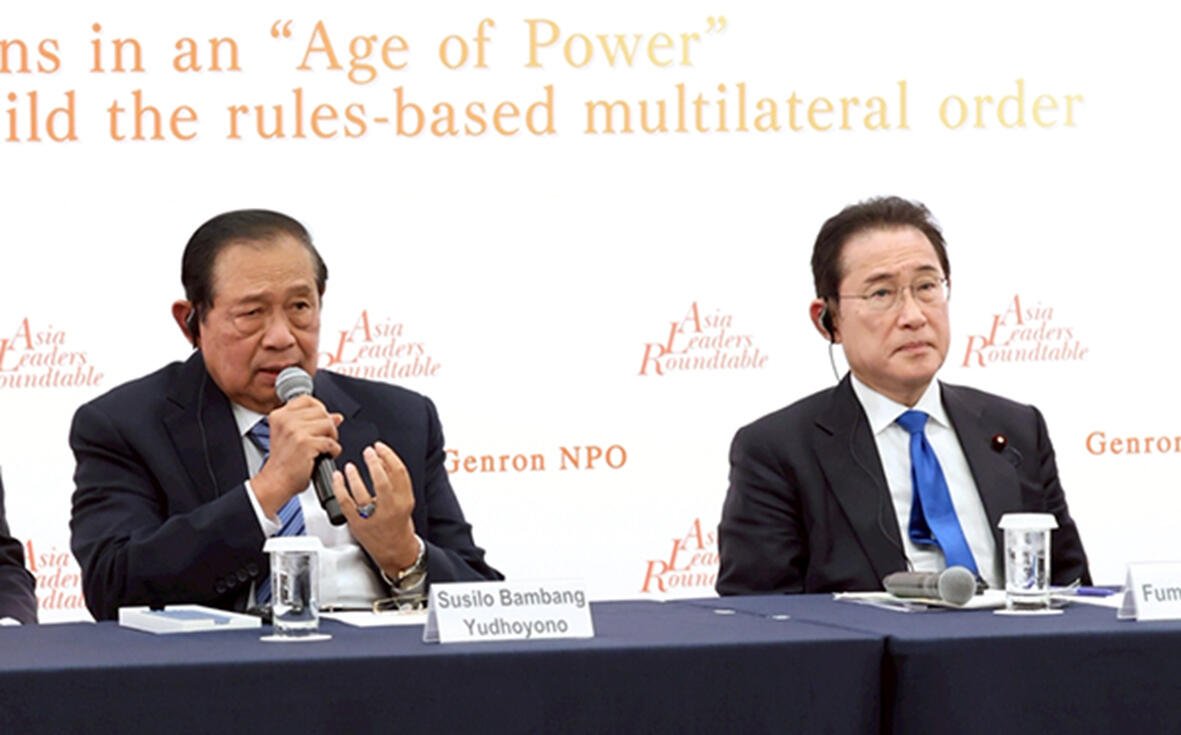
</entry>
<entry>
    <title>Tokyo Conference 2026 Chairman&apos;s Statement - Projects/Events</title>
    <link rel="alternate" type="text/html" href="https://www.genron-npo.net/en/pp/archives/5671.html" />
    <id>tag:www.genron-npo.net,2026:/en/pp//6.5671</id>
    <published>2026-03-11T08:54:04Z</published>
    <updated>2026-03-31T06:36:25Z</updated>
    <summary>Tokyo Conference 2026 was held over two days from March 10 to 12. The Conference welcomed 40 individuals to Tokyo, with participants including representatives from think tanks in twelve countries ? India, Indonesia, Singapore, Brazil, Belgium, and the member nations of the G7 ? alongside current gov...</summary>
    <author>
        <name>言論NPO</name>
    </author>
        <category term="The Tokyo Conference" scheme="http://www.sixapart.com/ns/types#category" />
        <category term="The Tokyo Conference 2026" scheme="http://www.sixapart.com/ns/types#category" />
    <content type="html" xml:lang="ja" xml:base="https://www.genron-npo.net/en/pp/">
        <![CDATA[<p>Tokyo Conference 2026 was held over two days from March 10 to 12. The Conference welcomed 40 individuals to Tokyo, with participants including representatives from think tanks in twelve countries ? India, Indonesia, Singapore, Brazil, Belgium, and the member nations of the G7 ? alongside current government ministers and other political leaders from Europe, North America, and Asia. </p>
<p>This year we commemorate the tenth anniversary of the Tokyo Conference. Over the last ten years, we have witnessed a growing instability in the premises upon which the post-Cold War international order was built, and the world is undergoing a structural transformation into a multipolar world defined by intense competition and conflict between the major powers. </p>
<p>The use of power and coercion on the part of major powers such as the United States and Russia is no longer the exception to the rule, and the logic of "might makes right" is increasingly rearing its head around the world. The Ukraine War, the Gaza conflict, and the large-scale US and Israeli military operations against Iran are all emblematic of this phenomenon. </p>
<p>The rules and foundation of international cooperation that the world once shared have weakened; we have reached a point where they are barely functioning as designed. </p>
<p>We conducted an emergency survey in cooperation with 36 think tanks around the world before the Conference began to determine how experts assess the current state of the international order and relationships between the major powers. The survey revealed that leading experts around the world share the belief that this new power-based order dominated by the major powers is no longer a temporary phenomenon.</p>
<p>The arrival of the "Age of Power" does not necessarily mean that the world is moving towards a G2-style structure with power concentrated in the hands of the United States of America and China. The world is actually moving towards a more unstable multipolar reality. In addition, the consensus among experts is that the rules-based order has not disappeared but has become merely a formality, and it will be unable to function in the future without proactive intervention on the part of the nations that shape the international order. </p>
<p>Our discussions over the last two days have been centered on the perspectives shared by the 293 experts around the world who participated in our survey. </p>
<p>With the major powers increasingly using coercion on other countries to achieve their objectives worldwide, we must ask ourselves what must be done to defend the principles of multilateralism and the rules-based order, and whether such a defense is even possible. These are the issues that the Tokyo Conference examined from various angles. Two points became clear during our discussions. </p>
<p><br />
First, we must not abandon the rule of law and multilateralism even in an era in which power politics have become the norm. Although we recognize that the actions of the major powers have an immense impact on the world, we should not underestimate the ability of the middle powers and other nations to shape the global order. </p>
<p>Second, the international order will not restore itself; it can only be shaped by deliberate choices made by the countries that form it and by cooperation between them. Although it may be difficult to restore a comprehensive form of multilateralism, there is still the possibility that we can build a more limited form of region and issue-based cooperation. Whatever difficulties we face, we must not cease our efforts to realize such a goal. </p>
<p>Armed with a shared awareness of the issues, we focused our discussions on four potential lines of action. </p>
<p><br />
First, we should re-affirm our support of international law and the rule of law, and ensure that they are applied in all regions and under all circumstances. While it will become difficult for the United Nations to remain at the heart of the international order, we must not lose sight of the rules and international norms agreed upon by its member nations. </p>
<p>The world should work together to end the war being waged between the United States, Israel, and Iran, and prevent the conflict from escalating and engulfing the entire region. We must not tolerate the use of force to remove the leaders of other countries when they do not align with the wishes of one's own country. The application of so-called "peace through power" undermines international law and the international order and should not be so readily accepted. We should also continue examining the legitimacy of any non-UN mechanism, however effective it may be at maintaining peace. </p>
<p><br />
Second, we must continue to work toward the restoration of comprehensive, multilateral international cooperation, even if it may be difficult.</p>
<p>We focused on the roles that can be played by middle powers such as Canada, Australia, Brazil, Japan, South Korea, and the nations of the European Union. It is difficult for the middle powers to change the overall direction of a world dominated by the power politics of the major powers. However, by working together, they can help stabilize specific sectors and regions. </p>
<p>Here the EU and the world's middle powers should proactively collaborate with civil society groups and international business to build frameworks that will allow for issue-based and regional coordination in addressing issues such as regional economic integration, crisis management, decarbonization, and pandemic response. </p>
<p><br />
Third, this year's Tokyo Conference saw the launch of an initiative called the Asian Leaders Roundtable, which brought together political leaders from around Asia. We must fully support the countries of Asia to remain independent and to continue engaging in dialogue rather than simply remaining silent in the face of global change. </p>
<p>During the first Asian Leaders Roundtable, participants from around Asia expressed their concerns about a world in which "might makes right." Asia is key to global growth and stability, and the future of Asia and the rest of the world will depend on continued frank discussion and bridge-building with the middle powers and the rest of the world. </p>
<p><br />
Fourth, we discussed the role of experts and the academic community. When the world is dominated by power politics, the role of experts is not simply limited to explaining the situation or discussing what the world should look like. Experts have a responsibility to uncover opportunities for cooperation, to deliberate on how best to promote collaboration, and to provide practical, concrete action plans based on reality.  </p>
<p><br />
This, the tenth Tokyo Conference, sees us standing at a crossroads. The world is moving towards a multipolar and unstable power-based order, and we will be unable to rebuild the rules-based order if no one takes the initiative to act. </p>
<p>We must not leave the future of the world to chance; it can only be shaped through responsible action. We, the participants of the Tokyo Conference, will continue to fulfill our role by engaging in earnest discussion here in Tokyo. </p>
<p>The future begins today. <br />
　<br />
<div align="right">Tokyo Conference</p>
<p>11 March 2026</div><br />
</p>]]>
    </content>
</entry>
<entry>
    <title>Tokyo Conference 2026 |  A new stage for track II diplomacy opens in Tokyo on March 10 - Projects/Events</title>
    <link rel="alternate" type="text/html" href="https://www.genron-npo.net/en/pp/archives/5670.html" />
    <id>tag:www.genron-npo.net,2026:/en/pp//6.5670</id>
    <published>2026-03-05T07:28:40Z</published>
    <updated>2026-03-31T06:37:32Z</updated>
    <summary> Tokyo Conference 2026 Date:March 10 - 12, 2026 Venue:Tokyo Prince Hotel, Tokyo JAPAN Languages: Japanese, English (Simultaneous interpretation) Host:The Genron NPO ...</summary>
    <author>
        <name>言論NPO</name>
    </author>
        <category term="The Tokyo Conference" scheme="http://www.sixapart.com/ns/types#category" />
        <category term="The Tokyo Conference 2026" scheme="http://www.sixapart.com/ns/types#category" />
    <content type="html" xml:lang="ja" xml:base="https://www.genron-npo.net/en/pp/">
        <![CDATA[<div style="padding:56.25% 0 0 0;position:relative;"><iframe src="https://player.vimeo.com/video/1170603239?badge=0&amp;autopause=0&amp;player_id=0&amp;app_id=58479" frameborder="0" allow="autoplay; fullscreen; picture-in-picture; clipboard-write; encrypted-media; web-share" referrerpolicy="strict-origin-when-cross-origin" style="position:absolute;top:0;left:0;width:100%;height:100%;" title="Tokyo Conference 2026 | A new stage for citizen-led diplomacy opens in Tokyo on March 10"></iframe></div><script src="https://player.vimeo.com/api/player.js"></script>
<p><br />
Tokyo Conference 2026</p>
<p>Date:March 10 - 12, 2026<br />
Venue:Tokyo Prince Hotel, Tokyo JAPAN<br />
Languages: Japanese, English (Simultaneous interpretation)<br />
Host:The Genron NPO<br />
</p>]]>
    </content>
</entry>
<entry>
    <title> The Global Expert Survey on the International Order and Relations between the Major Powers - Publications</title>
    <link rel="alternate" type="text/html" href="https://www.genron-npo.net/en/publications/archives/5669.html" />
    <id>tag:www.genron-npo.net,2026:/en/publications//5.5669</id>
    <published>2026-03-04T05:23:21Z</published>
    <updated>2026-03-05T06:44:02Z</updated>
    <summary>　Amid rapid changes in the international environment and the expanding power-based approaches by major states, the Genron NPO conducted the Global Expert Survey on international order and relations between the major powers. 　The objective of this survey was to clarify the opinions of researchers and...</summary>
    <author>
        <name>言論NPO</name>
    </author>
        <category term="Reports" scheme="http://www.sixapart.com/ns/types#category" />
    <content type="html" xml:lang="ja" xml:base="https://www.genron-npo.net/en/publications/">
        <![CDATA[<p>　Amid rapid changes in the international environment and the expanding power-based approaches by major states, the Genron NPO conducted the Global Expert Survey on international order and relations between the major powers.</p>
<p>　The objective of this survey was to clarify the opinions of researchers and other experts affiliated with the world's leading think tanks about the future of the international order and the relationships between the major powers in preparation for Tokyo Conference 2026. </p>
<p>　The survey was conducted between 23 January and 23 February, 2026, and in cooperation with 36 think tanks representing countries and regions in the Americas, Europe, and Asia, with a central role being played by the 12 think tanks involved in the running of the Tokyo Conference 2026. A total of 293 experts from 26 countries took part, allowing us to tap into a wealth of knowledge and expertise in the fields of international politics, security, and global economics. Responses are grouped by nationality rather than organizational affiliation in order to clarify any regional differences in opinion.</p>
<div align="right"><a href="/en/publications/docs/0304_ENG.pdf"><img alt="pdf.png" src="/en/publications/assets_c/2026/03/pdf-thumb-autox190-3661.png" width="150" height="190" class="mt-image-right" style="float: right; margin: 0 0 20px 20px;" />Read More</a></div><br clear="all">
<p></p>
<p>　This survey was implemented with the cooperation of the twelve think tanks participating in the Tokyo Conference, as well as a number of other institutions, including Pacific Forum, Centro Studi di Politica Internazionale (CeSPI), Centre for European Policy Studies (CEPS), Stratbase, Merdeka Center, Institute of Strategic & International Studies (ISIS), Universiti Malaya, and Institute for Economics and Peace (IEP).</p>]]>
    </content>
</entry>
<entry>
    <title>The Tokyo Conference 2025 Report - Projects/Events</title>
    <link rel="alternate" type="text/html" href="https://www.genron-npo.net/en/pp/archives/5668.html" />
    <id>tag:www.genron-npo.net,2025:/en/pp//6.5668</id>
    <published>2025-06-19T04:51:09Z</published>
    <updated>2025-06-19T08:37:27Z</updated>
    <summary>International cooperation and restoration of peace on the 80th anniversary of the founding of the United Nations   Download Report  ...</summary>
    <author>
        <name>言論NPO</name>
    </author>
        <category term="The Tokyo Conference 2025" scheme="http://www.sixapart.com/ns/types#category" />
    <content type="html" xml:lang="ja" xml:base="https://www.genron-npo.net/en/pp/">
        <![CDATA[<p>International cooperation and restoration of peace<br />
on the 80th anniversary of the founding of the United Nations</p>
<p><br />
<a href="https://www.genron-npo.net/en/pp/docs/Tokyo_Conference2025_Report_EN.pdf"><img alt="genron2018_s.png" src="/en/pp/images/Asia-Peace-Conference-2022_s.jpg" width="200" height="286" class="mt-image-left" style="float: left; margin: 0 20px 20px 0;" /></a> </p>
<p><br />
<a href="https://www.genron-npo.net/en/pp/docs/Tokyo_Conference2025_Report_EN.pdf"><strong>Download Report </strong></a><br />
<br clear="all"></p>
<p><br />
</p>]]>
    </content>
</entry>
</feed>