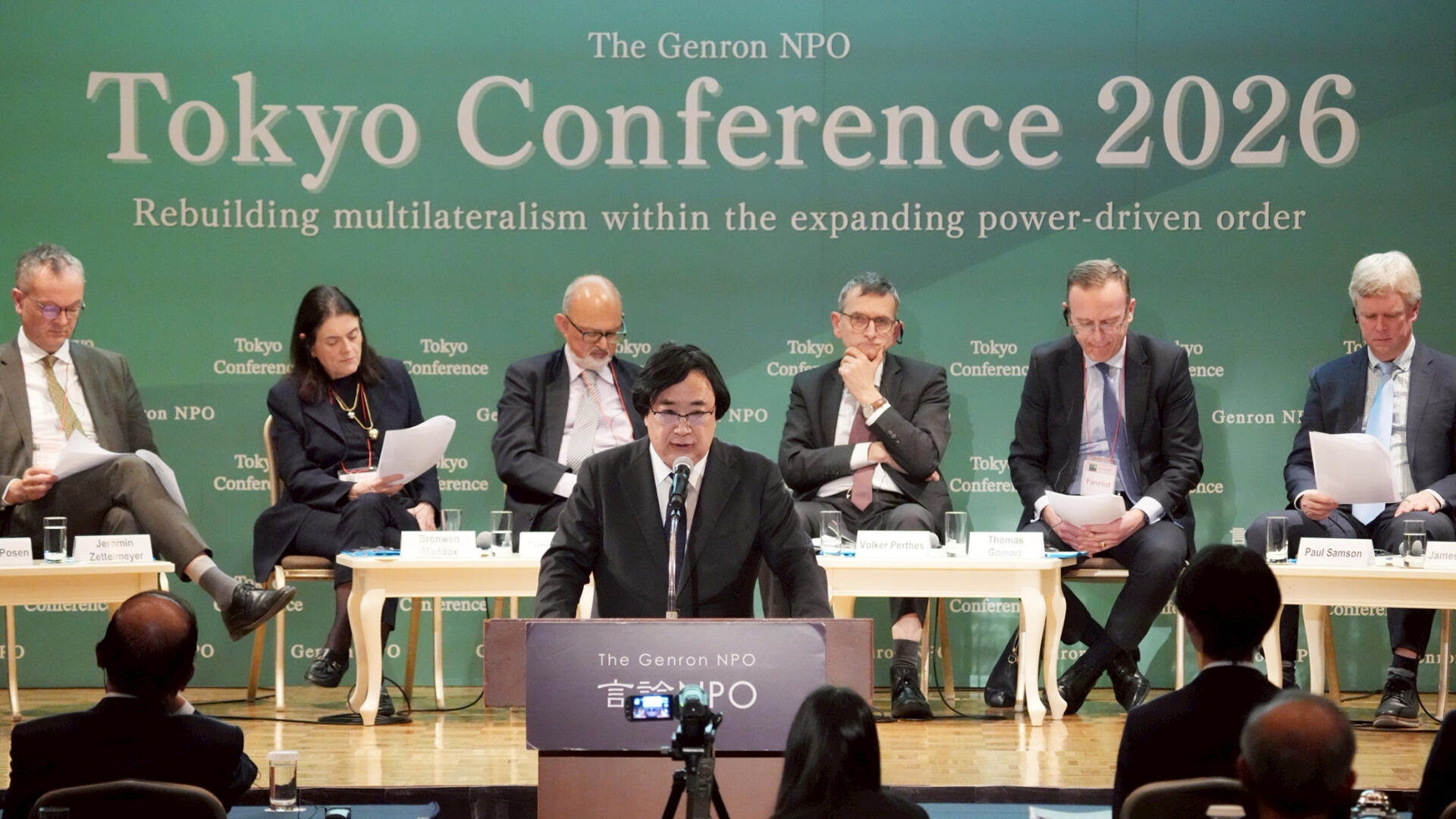
Tokyo Conference 2026 was held over two days from March 10 to 12. The Conference welcomed 40 individuals to Tokyo, with participants including representatives from think tanks in twelve countries ? India, Indonesia, Singapore, Brazil, Belgium, and the member nations of the G7 ? alongside current government ministers and other political leaders from Europe, North America, and Asia.
This year we commemorate the tenth anniversary of the Tokyo Conference. Over the last ten years, we have witnessed a growing instability in the premises upon which the post-Cold War international order was built, and the world is undergoing a structural transformation into a multipolar world defined by intense competition and conflict between the major powers.
The use of power and coercion on the part of major powers such as the United States and Russia is no longer the exception to the rule, and the logic of "might makes right" is increasingly rearing its head around the world. The Ukraine War, the Gaza conflict, and the large-scale US and Israeli military operations against Iran are all emblematic of this phenomenon.
The rules and foundation of international cooperation that the world once shared have weakened; we have reached a point where they are barely functioning as designed.
We conducted an emergency survey in cooperation with 36 think tanks around the world before the Conference began to determine how experts assess the current state of the international order and relationships between the major powers. The survey revealed that leading experts around the world share the belief that this new power-based order dominated by the major powers is no longer a temporary phenomenon.
The arrival of the "Age of Power" does not necessarily mean that the world is moving towards a G2-style structure with power concentrated in the hands of the United States of America and China. The world is actually moving towards a more unstable multipolar reality. In addition, the consensus among experts is that the rules-based order has not disappeared but has become merely a formality, and it will be unable to function in the future without proactive intervention on the part of the nations that shape the international order.
Our discussions over the last two days have been centered on the perspectives shared by the 293 experts around the world who participated in our survey.
With the major powers increasingly using coercion on other countries to achieve their objectives worldwide, we must ask ourselves what must be done to defend the principles of multilateralism and the rules-based order, and whether such a defense is even possible. These are the issues that the Tokyo Conference examined from various angles. Two points became clear during our discussions.
First, we must not abandon the rule of law and multilateralism even in an era in which power politics have become the norm. Although we recognize that the actions of the major powers have an immense impact on the world, we should not underestimate the ability of the middle powers and other nations to shape the global order.
Second, the international order will not restore itself; it can only be shaped by deliberate choices made by the countries that form it and by cooperation between them. Although it may be difficult to restore a comprehensive form of multilateralism, there is still the possibility that we can build a more limited form of region and issue-based cooperation. Whatever difficulties we face, we must not cease our efforts to realize such a goal.
Armed with a shared awareness of the issues, we focused our discussions on four potential lines of action.
First, we should re-affirm our support of international law and the rule of law, and ensure that they are applied in all regions and under all circumstances. While it will become difficult for the United Nations to remain at the heart of the international order, we must not lose sight of the rules and international norms agreed upon by its member nations.
The world should work together to end the war being waged between the United States, Israel, and Iran, and prevent the conflict from escalating and engulfing the entire region. We must not tolerate the use of force to remove the leaders of other countries when they do not align with the wishes of one's own country. The application of so-called "peace through power" undermines international law and the international order and should not be so readily accepted. We should also continue examining the legitimacy of any non-UN mechanism, however effective it may be at maintaining peace.
Second, we must continue to work toward the restoration of comprehensive, multilateral international cooperation, even if it may be difficult.
We focused on the roles that can be played by middle powers such as Canada, Australia, Brazil, Japan, South Korea, and the nations of the European Union. It is difficult for the middle powers to change the overall direction of a world dominated by the power politics of the major powers. However, by working together, they can help stabilize specific sectors and regions.
Here the EU and the world's middle powers should proactively collaborate with civil society groups and international business to build frameworks that will allow for issue-based and regional coordination in addressing issues such as regional economic integration, crisis management, decarbonization, and pandemic response.
Third, this year's Tokyo Conference saw the launch of an initiative called the Asian Leaders Roundtable, which brought together political leaders from around Asia. We must fully support the countries of Asia to remain independent and to continue engaging in dialogue rather than simply remaining silent in the face of global change.
During the first Asian Leaders Roundtable, participants from around Asia expressed their concerns about a world in which "might makes right." Asia is key to global growth and stability, and the future of Asia and the rest of the world will depend on continued frank discussion and bridge-building with the middle powers and the rest of the world.
Fourth, we discussed the role of experts and the academic community. When the world is dominated by power politics, the role of experts is not simply limited to explaining the situation or discussing what the world should look like. Experts have a responsibility to uncover opportunities for cooperation, to deliberate on how best to promote collaboration, and to provide practical, concrete action plans based on reality.
This, the tenth Tokyo Conference, sees us standing at a crossroads. The world is moving towards a multipolar and unstable power-based order, and we will be unable to rebuild the rules-based order if no one takes the initiative to act.
We must not leave the future of the world to chance; it can only be shaped through responsible action. We, the participants of the Tokyo Conference, will continue to fulfill our role by engaging in earnest discussion here in Tokyo.
The future begins today.
11 March 2026
Post a comment