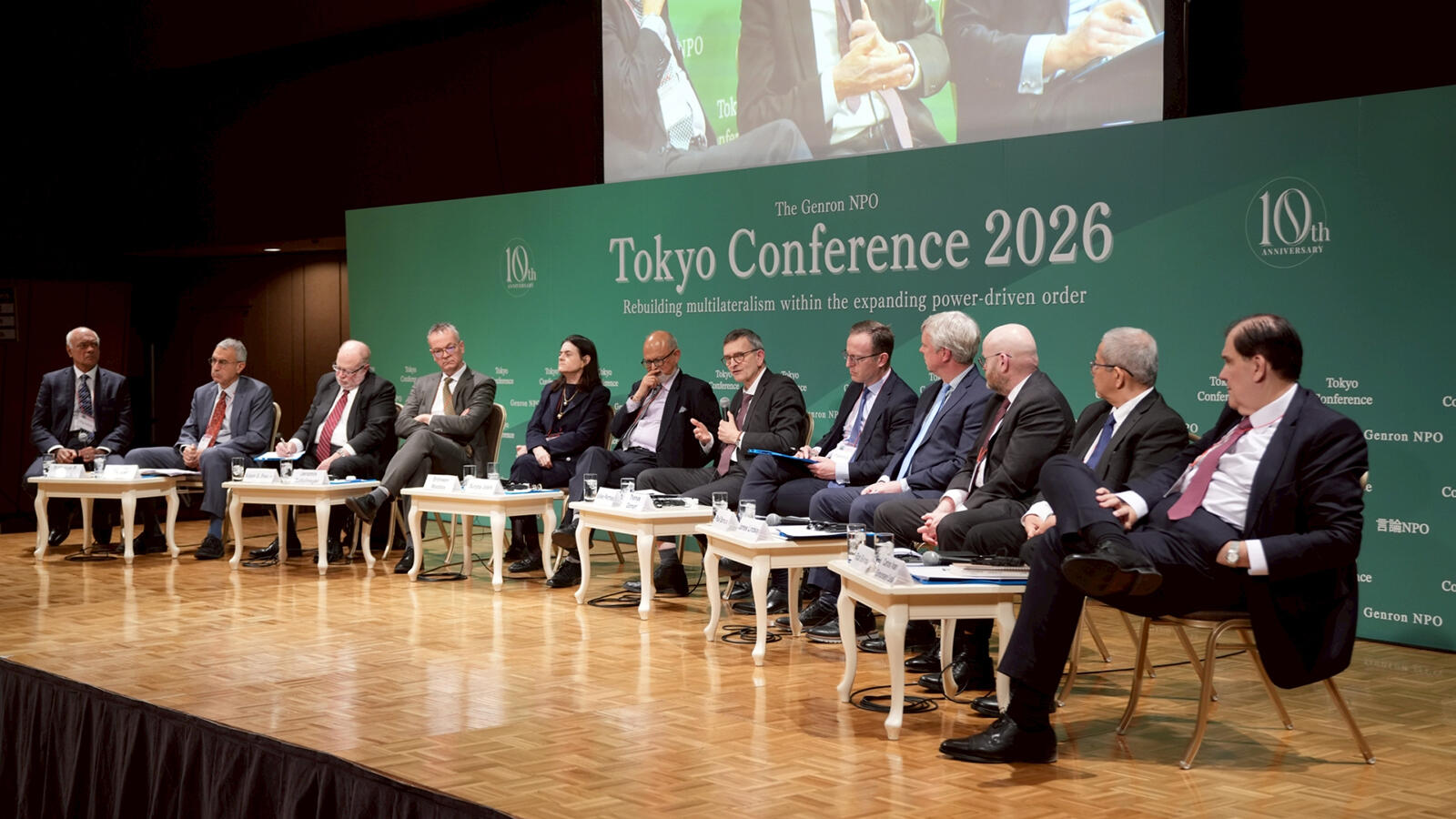
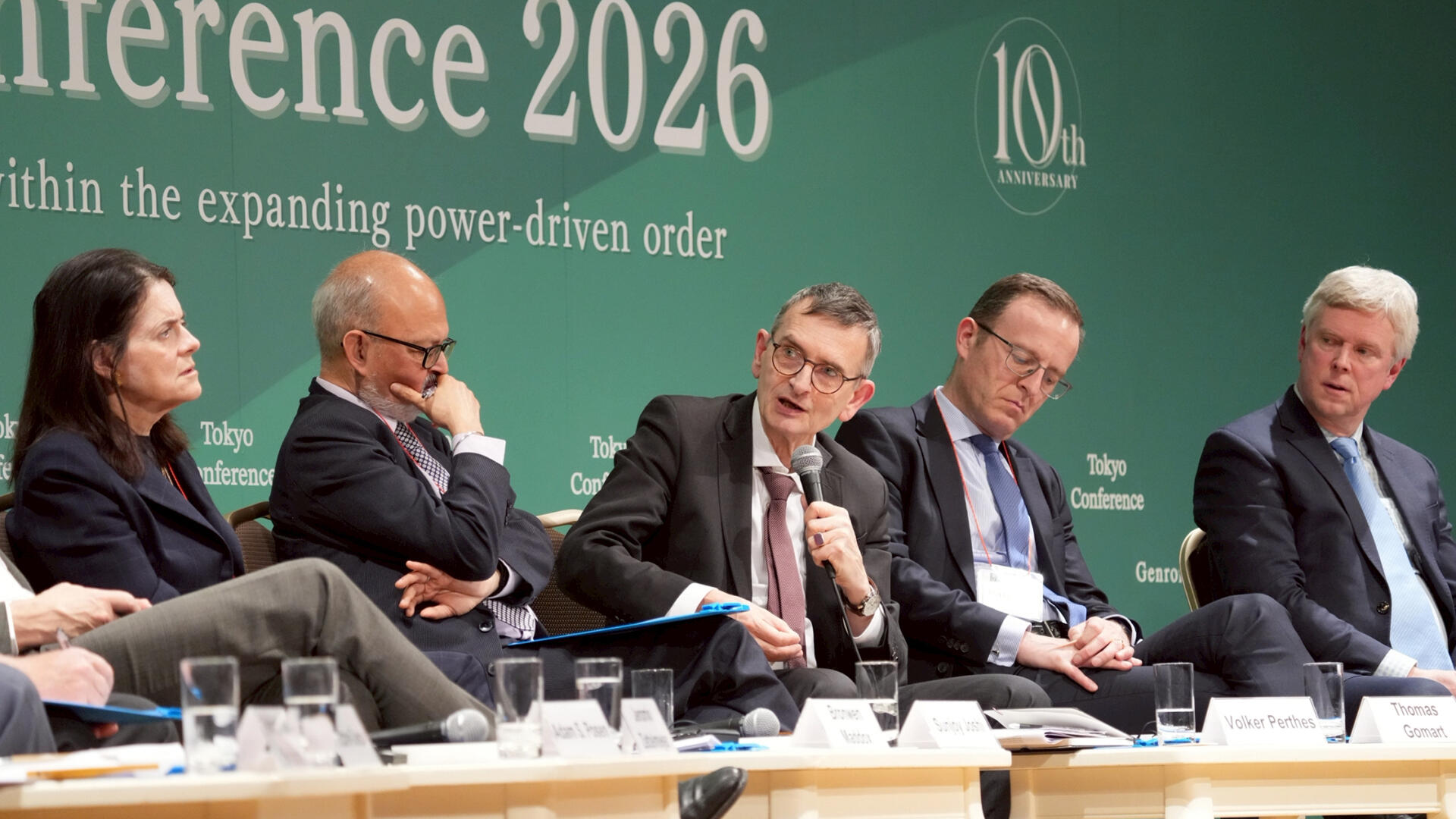
For the final session of the Public Forum, thinktank representatives Adam Posen, Bronwen Maddox, Carlos Ivan Simonsen Leal, Ettore Greco, James M. Lindsay, Jeromin Zettelmeyer, Paul Samson, Rizal Sukma, Volker Perthes, Sunjoy Joshi, Thomas Gomart, and Yasushi Kudo came together on stage for a discussion moderated by Rohinton Medhora.
Medhora began with a question to the panel of representatives.
"No one is going to dispute that (the multilateral order) is broken in some form, whether you use that word or not, but how broken is it? How retrievable are the elements of multilateralism that have served us so well for 70, 75 years?" Medhora asked. "What is the role of both the great powers and the non-great powers in making the system more functional?"
First to respond was Ettore Greco, who argued that the system is close to collapse, and that any effort to stop that collapse first requires reflection on the main causes.
"For many decades, there has been discontent over the perceived lack of legitimacy of the system," Greco began. "But there is also the rise of powers that pursuing a revisionist strategy aiming at undermining the system, an increasingly aggressive Russia, and then the tension over China, coupled with this new attitude of the U.S. to question basic fundamental rules, and a tendency to use the force to solve international problems."
Medhora asked the panelists from the US to expand upon when the current position of the Trump administration is reflective of a broader American view on multilateralism, and Adam Posen responded with his opinion that those who are committed to isolationism and unilateralism are in the minority in the US.
"And a large number of them are acting out and accepting very self-destructive policies because of other things, not because of deep conviction that this is a better way for the US," he explained.
Posen also suggested that a change in administration would bring about a change in public opinion of multilateralism as well.
"If one could get more responsible parties in power in the US, if one could get the courts, and more importantly, Congress, to live up to their constitutional role, the population would accept it," he said. "But it also means that there isn't a deep love for the word 'multilateral' or for many of the institutions that the governments and think tanks represented here care so much about."
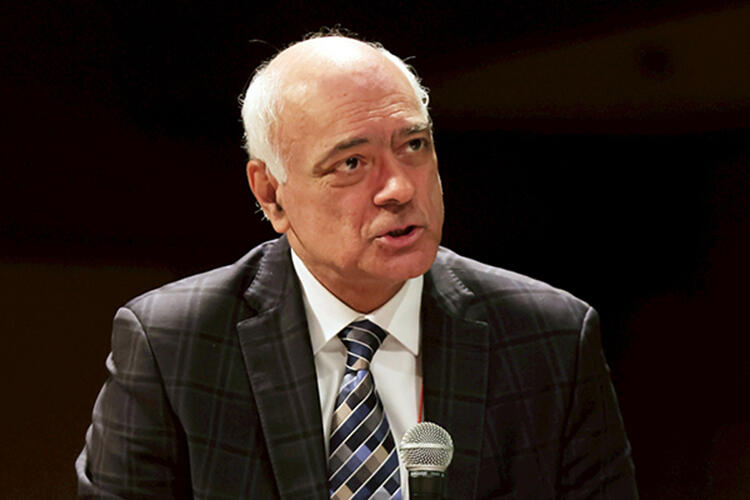
Jim Lindsay had a somewhat different take and argued that the reality in the US is more nuanced.
"Many Americans have long expressed frustration over multilateralism because when people are off the record, they're willing to admit to the inefficiencies, the slowness of multilateral arrangements," he said. "I don't want to sort of suggest that somehow the Trump administration is against multilateralism and all other Americans are for it.
Lindsay however agreed with Posen in that Americans are generally well-disposed to working with others, and that leads to one of the complaints the US public has with the current administration.
"I think one of the main criticisms that many Americans have of President Trump's foreign policy is that the president is working against America's friends, partners, and allies rather than with them."
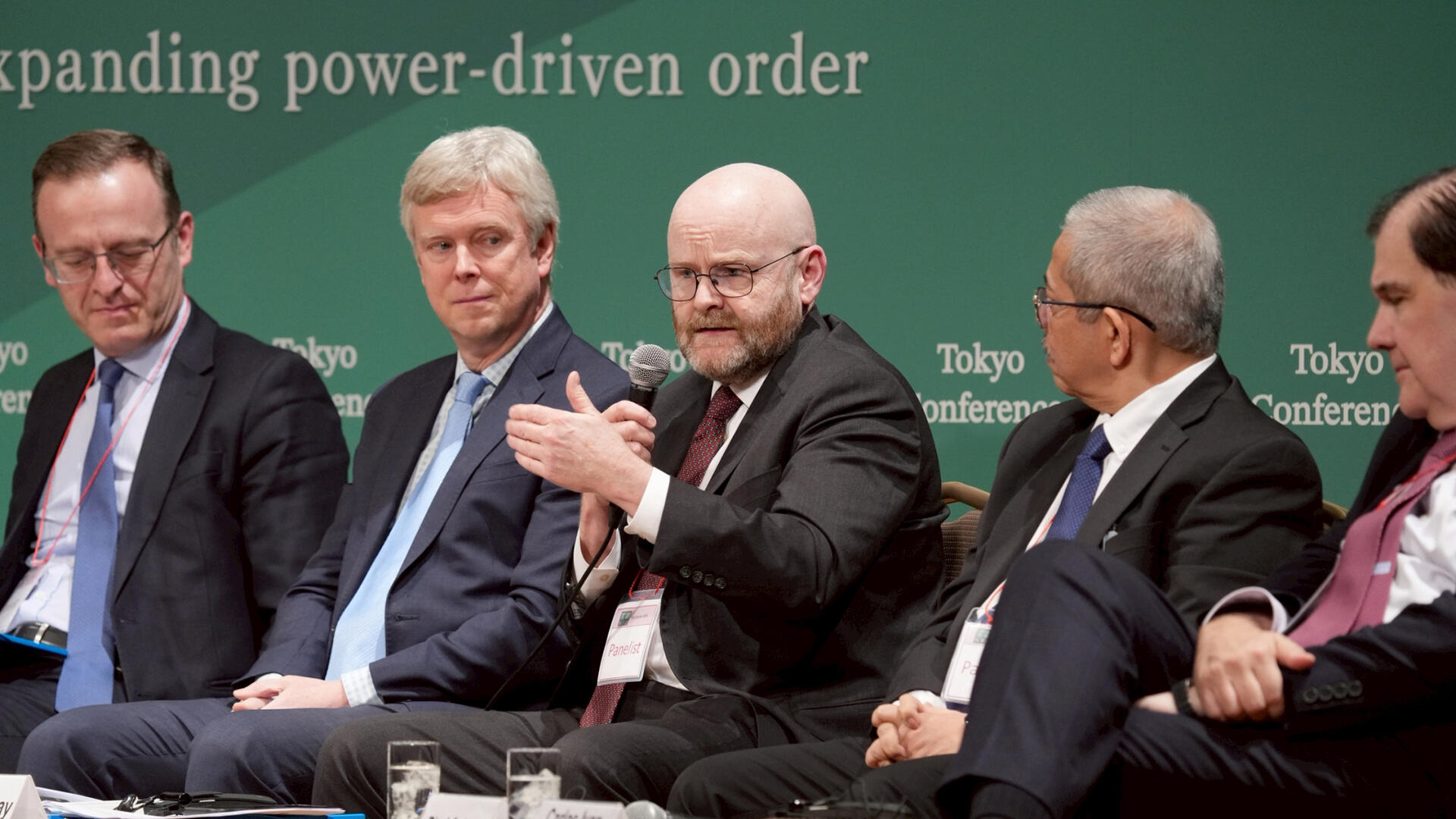
Jeromin Zettelmeyer was asked to assess where multilateralism stands today and whether the situation can be fixed, and Zettelmeyer responded by asserting that multilateralism has not yet failed.
"Multilateralism has done very well in a normative sense, particularly in facilitating relatively free trade, which was a substantial reason for post-war growth and for lifting billions of people out of poverty."
He had a clear idea of where the problem lies.
"The reason why we have a problem now is because the creator of the post-war system has decided that this is no longer in its interest and has withdrawn at least from the trade part of it," he said. "This has to do with domestic policy failures in the United States, but also with the rise of China and the sense that the WTO was giving preferential treatment to China. This is the reason why the US has withdrawn."
Fixing it will require an effort be made to ensure multilateralism remains an active part of the international order.
"Whether you do this within the WTO or by creating something new, I'm not sure. I think probably you want to do it within the WTO, because creating something new is going to be impossibly difficult."
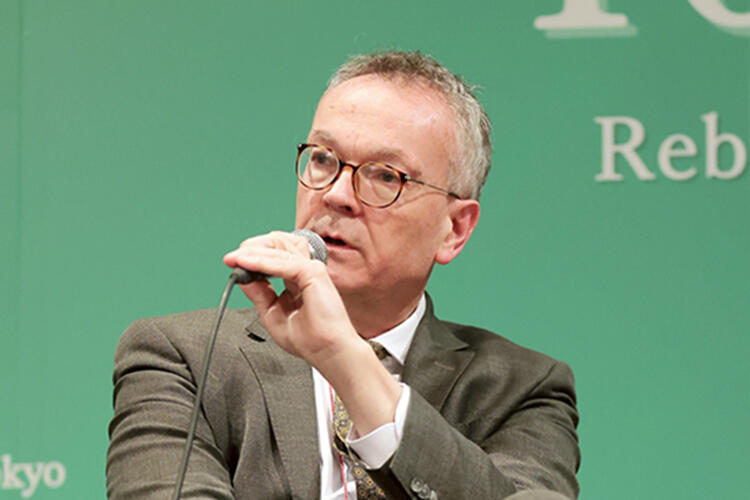
Bronwen Maddox explained that the view of multilateralism in the UK is more positive than at the time of Brexit, "Because countries need friends, they need alliances, and that's why the UK is edging its way back towards the European Union. But at the same time, the European Union continues to have great difficulties in agreeing on either security or competitiveness."
Maddox admits that multilateralism has had its issues, but she does not believe it has failed completely.
"Yes, the US has taken great exception to parts of it and that will continue for a while, but the US will need friends as well. It may actually have created a situation in the Middle East where it will need friends rather quickly," Maddox said.
The US is not the only country that needs allies she argued.
"China is doing a great job of pretending that it loves the rules-based order and working very hard to get its people into lots of established institutions of the rules-based order, but it doesn't follow those rules when it doesn't suit it either," she said. "But it will also need friends. It needs them to keep buying its products for a start. I think both major powers are behaving in ways that pretend as if they can act alone, but they can't."
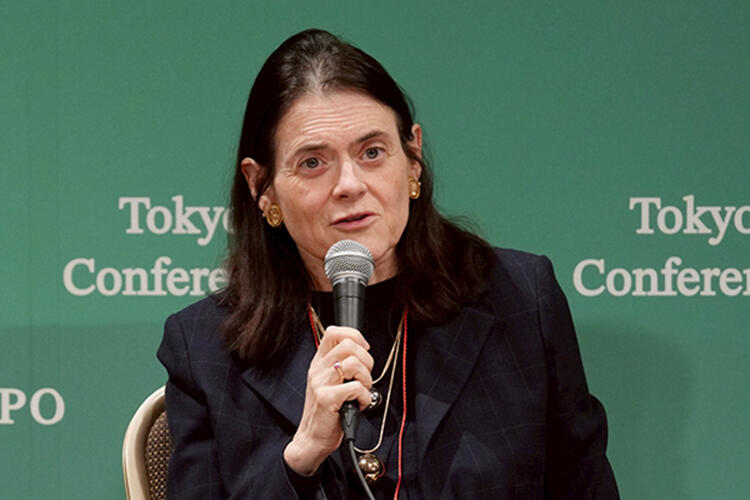
Sunjoy Joshi provided an Indian perspective of the issue at hand and argued that the premise of the discussion itself may be inappropriate.
"I don't like using the words broken or ruptured for the international order of multilateralism. It is not broken or ruptured. The rules-based order has lost legitimacy, but that is not the fault of the institutions," he said. "Some of the institutions within their frameworks worked very well until they weren't allowed to work anymore, but the problems were structural, and structural problems needed structural solutions."
Joshi said that the current structure has created an issue of legitimacy arising from the structure of the multilateral order, and the fact of the P5 being "continually at each other's throats" and having veto powers.
"This is a crisis of legitimacy which has been created by member states," he argued, adding that all those states will have to be at the table to achieve anything.
"If reforms have to take place, they have to be on board, but as everyone knows, they will not be on board. Therefore, you have a structural problem for which there are no structural solutions. So, we need to discuss where we go from here."
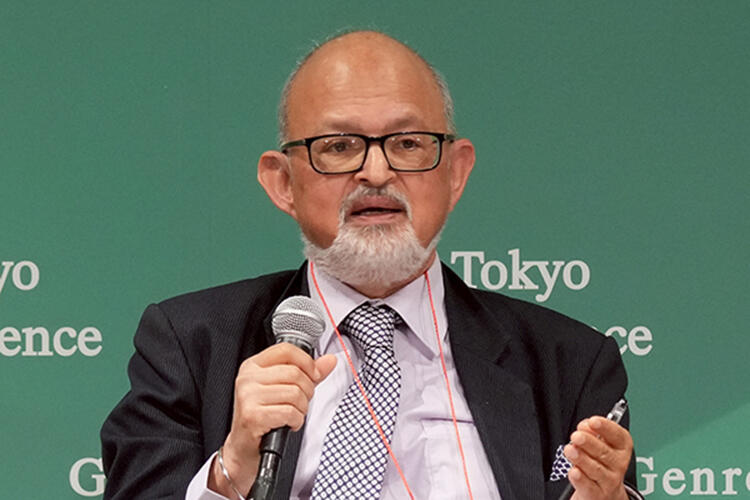
Volker Perthes agreed with Joshi's assertion that the multilateral framework is not broken, but that for multilateralism to function, it requires an order to be built upon.
"Legally, we still have an order. The UN Charter exists. And I think for the majority of the world, the UN system still works. Many of the UN agencies do work. Many of the multilateral cooperative structures do work. The majority of states, which are not big states, major states, not even middle powers, still see the UN Charter as the rule book for their international relations."
The common understanding, according to Perthes, is that the rules are "good", but their legitimacy is being challenged because the major powers are unable to accommodate change. However, he also said that people's understanding of the current order is not entirely accurate.
"From the perspective of a From a European power, it's fine. Everybody loves multilateralism because it has worked for us, right?" he said. "But let's be clear. It hasn't worked for everybody and legitimacy is fading. We need to rebuild it. The UN is not just some organization in a tower in New York. It's all of us."
Thomas Gomart followed up by questioning whether people's view of the history of the multilateral order has not been to some extent embellished.
"If we go back to the collapse of the USSR, we have a period of...a unipolar moment."
At that time in the 1990s, while things seemed to be working well, there were several crises that were not resolved through the multilateral order or through the intervention of the UN in particular.
"We had a huge genocide in Rwanda. We had a war in Balkans, which was not terminated thanks to the United Nations, but thanks to NATO, which was not following international law," he said, "And remember the war in Iraq, the war in Libya...and I could list also things done by Russia, by China, and others."
"I think we should not see multilateralism as being so beautiful, because to some extent, it was not ever really efficient," Gomart concluded.
Paul Samson was asked to provide a glimpse into how multilateralism is viewed in Canada.
"In Canada, multilateralism has pretty good support. It was seen as essential to have an open economy and open society," he said, that the current situation may be difficult to resolve.
"For trade, once subsidies are in place, once restrictions are in place, politically they're very difficult to roll back. So, I think this is going to be a medium-term work in progress. Maybe regional trade organizations will matter here, but it's not going to be easy to roll back to a zone that is more free."
However, Samson's view was not entirely pessimistic.
"The UN Charter and international law are taking a moment of semi-hibernation, but I don't think they're dead."
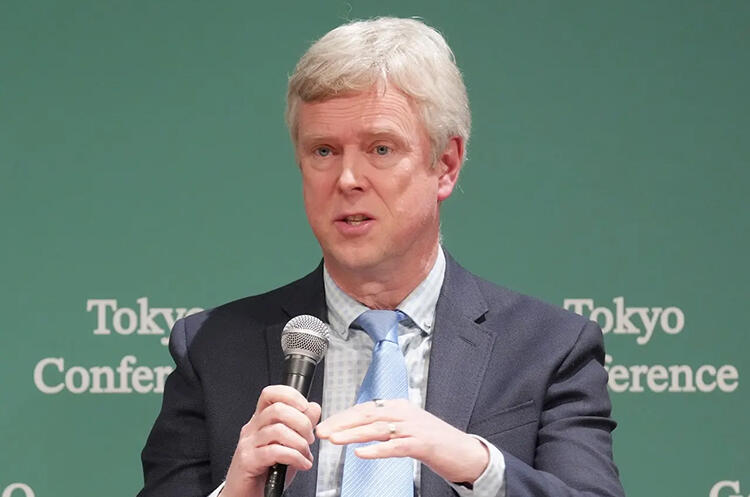
Rizal Sukma believes that multilateralism still has high levels of support in Indonesia, but stressed that the rules are important.
"A lot of people believe that multilateralism functions only if all countries subscribe to one particular set of rules that they believe in," he said, and warned that the new challenge will be in determining how to restrain the major powers within the multilateral framework.
"So that's what we need to get it working: the middle powers and the small powers (working together.)"
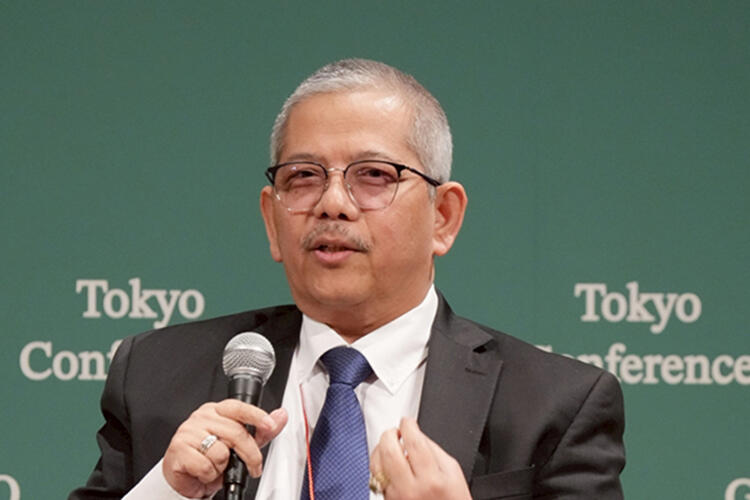
Carlos Ivan Simonsen Leal was asked his opinion about how much influence the middle powers, the Global South, the UN, and other international organizations and institutions actually have in the world today.
"At this moment, I think very little, because you have to change the structure of the economy in many regions of the world and that is going to be very painful," Leal responded.
Differing levels of innovation and unjustifiable trade imbalances will also make resolution of these issues more difficult, Leal explained.
"This will take time. I don't know if that will entail a war, and I hope not. But this will surely be painful."
Sukma expressed some skepticism regarding the ability of middle powers to shape the global order, but did point out possible opportunities.
"I think we should work on the region-focused initiatives...and issue-based coalitions," he said. "It doesn't have to involve, big, countries."
He pointed out the overall agreement regarding the continued efficacy of "single purpose international organizations," and suggested that this offers some hope for multilateralism as a whole.
"We need to focus on those practical organizations that are doable instead of thinking about how we are going to structure the international order for the middle or smaller powers. That's beyond our pay grade, I think."
Lindsay offered his own perspective in reference to the major powers and the extent of their influence.
"I do not see a capacity for China and the United States to divvy up the world and decide how it is run, because while other countries may be smaller and less powerful, they are not powerless. And I think it would be a mistake to think otherwise."
The latter half of the second session saw the panelists answering questions from the audience, after which Yasushi Kudo returned to the podium to present the Chair's Statement and bring the Public Forum to a close.
Post a comment