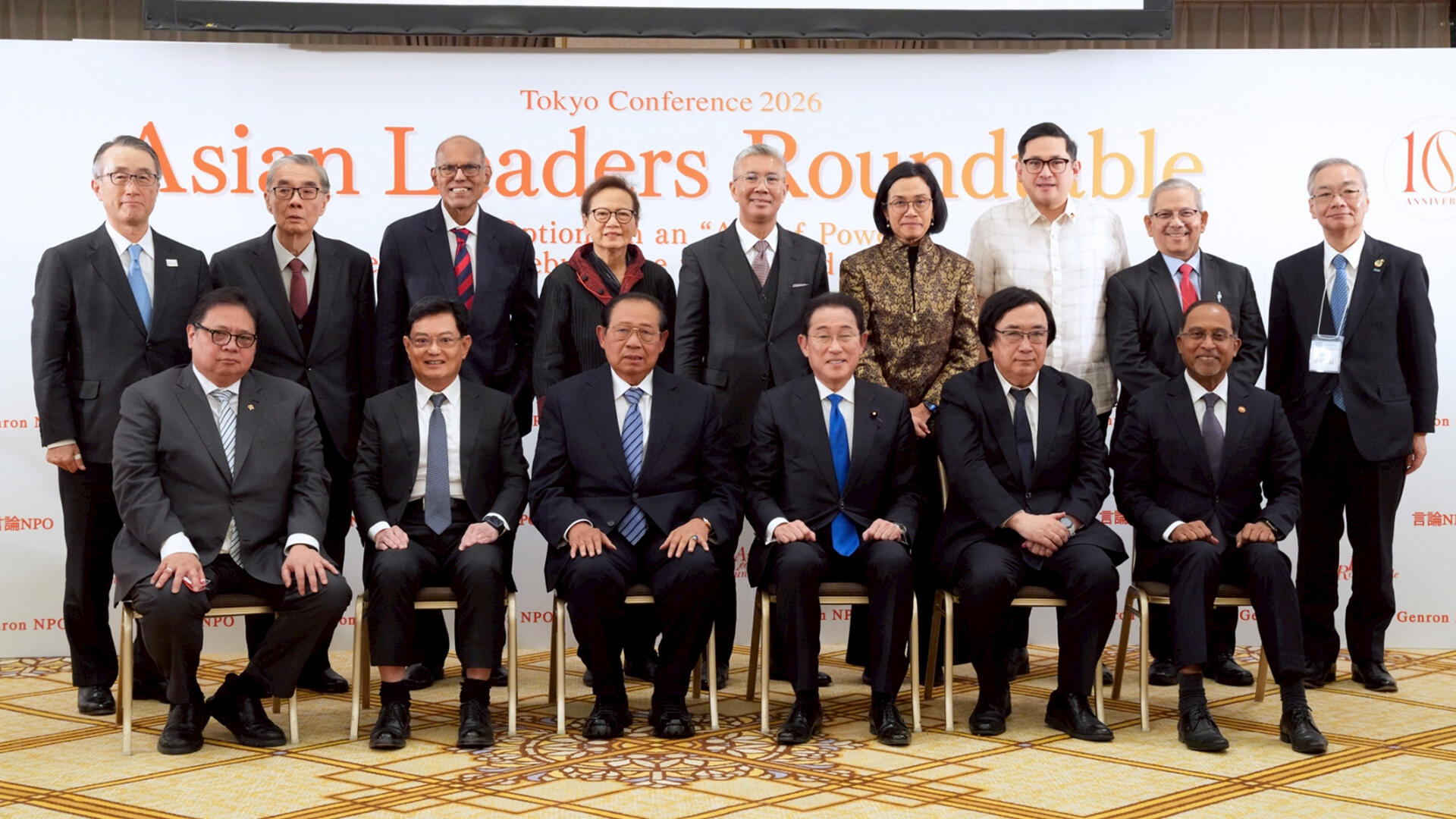
On March 10, 2026, The Genron NPO welcomed leaders from around Asia to the Asian Leaders Roundtable, a new initiative launched to coincide with the tenth anniversary of Tokyo Conference 2026, an annual gathering of experts and leaders from around the world.
As Genron president Yasushi Kudo explained in his remarks opening the forum, the aim of the Asian Leaders Roundtable is not to gather opinions, but to bring together the leaders of many of the most important countries in Asia - Japan, Indonesia, Singapore, the Philippines, Malaysia, India, and more - to discuss what needs to be done to protect the rules-based multilateral order currently threatened by the actions of the major powers, and to discuss what needs to be done to update it for the modern day.
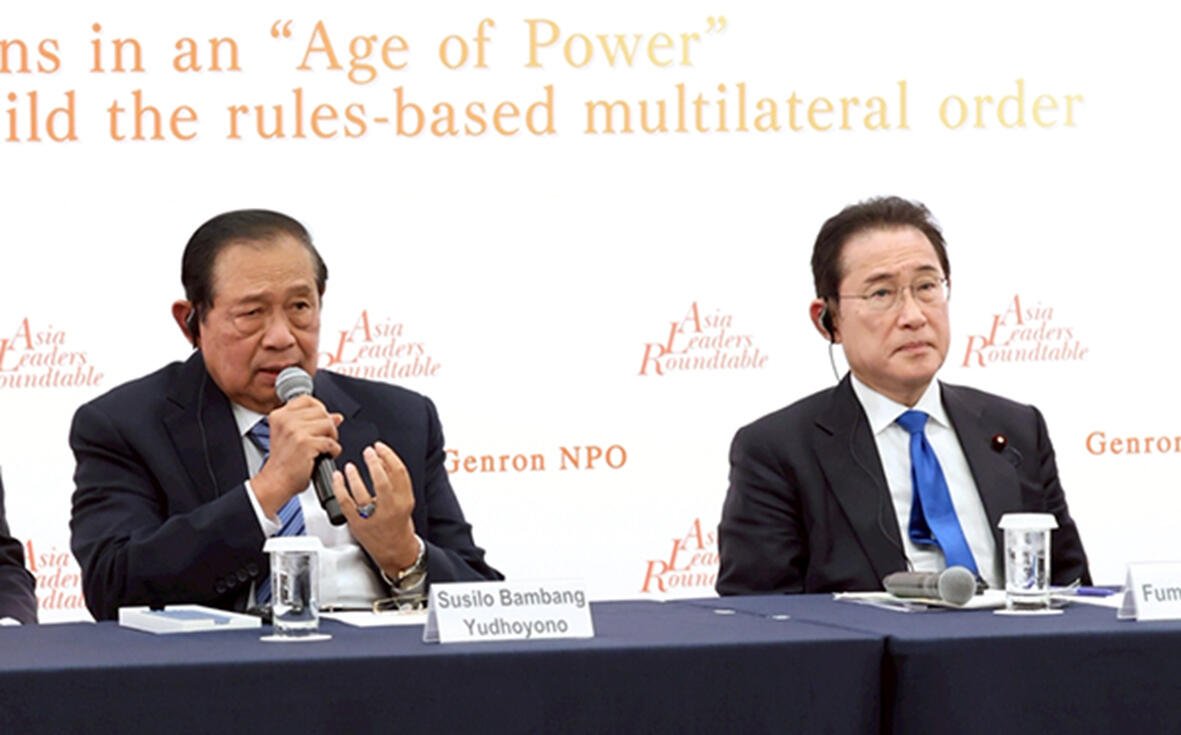
Serving as co-chairs were former Japanese Prime Minister Fumio Kishida and former Indonesian President Susilo Bambang Yudhoyono. Former Prime Minister Kishida kicked off the discussions by explaining why holding the Asian Leaders Roundtable is particularly important today.
"The world is becoming more uncertain," he began. "The very foundation of the international order is quietly but steadily changing."
"Over the years that have passed since the end of the Cold War, we presumed that the world order is underpinned by consensus based on rules, institutions, and multilateral cooperation. However, more recently, the major powers have used force and coercion to achieve their aims rather than engaging in coordination within the existing institutional frameworks, and they are unapologetic about their behavior."
Kishida went on to describe this transformation as being multifaceted, spanning the realms of politics, security, economy, and technology, and also expressed his concern that this change is not a temporary one. He then turned to the effect on Asia.
"In the midst of such a reality," he continued. "One of the regions most heavily impacted is Asia. Asia stands at the heart of global economic growth and stability, and is simultaneously the region is most directly impacted by the behavior of and confrontation between the major powers."
Kishida asked those gathered to consider how the countries of Asia should interpret the changes being seen, and to discuss where the "red line" should be drawn regarding what is and what is not acceptable. He also explained that coordinating an approach to the current situation requires a forum like the Asian Leaders Roundtable.
"Asia is diverse. There are political differences between the countries of Asia, and differences in level of development, history, culture, religion, and national interest.
The objective of this round table is neither to align our positions nor to release a joint statement: what is important is for us to observe what is occurring around the world from an Asian perspective and identify the principles we can never afford to lose."
Kishida closed by encouraging the countries of Asia to take a stand.
"Reticence is not neutrality," he said. "Silence will result in acceptance of a world run solely by the decisions of the major powers. This roundtable is not a place to deliver conclusions. It is a place to demonstrate to the world what Asia is beginning to contemplate."
Next to take the podium was the Roundtable's second co-chair, former Indonesian President Sushiro Bambang Yudhoyono, who lent his own voice to the importance of the gathering.
"Allow me to begin with a simple statement: This forum truly matters. It matters because we are living in a time when the international order is undergoing a profound transformation. The world we knew based on rules, institutions, and multilateral cooperation is increasingly challenged by a new reality served by power politics, geopolitical rivalry, and transactional diplomacy."
Yudhoyono pointed to the rising tensions in the Middle East between Israel, the United States, and Iran, describing the conflict as having become "a regional war," and using it as an example of how quickly the effects of a regional crisis can propagate outwards to "resonate across the global system."
"In times like these, dialogue across nations and societies becomes not just useful, but essential," Yudhoyono said. "This is why I believe that this forum is very valuable. It offers us a space to reflect, to exchange ideas, and to consider what role Asia should play in shaping the future international order. Ladies and gentlemen, in facing global change, humanity always has a choice, and the choice before us is simple: we either care and contribute, or we do nothing. I believe that everyone gathered here today has made the first choice: we care and we are ready to contribute. As the saying goes, if you are not at the table, you will be on the menu."
Yudhoyono explained that history has an important lesson to teach those of us in the modern day about how power must never go unchecked.
"Checks and balances are not only necessary in domestic governance; they are equally important in international relations. Yet we are witnessing a situation where great powers driven by rivalry and national interests sometimes act unilaterally, sometimes competitively, and sometimes unpredictably."
He also described how existing institutions are finding it difficult to address the current situation, but that a potential solution exists.
"International institutions, including the United Nations, often struggle to respond effectively to these dynamics. As a result, many global challenges, from conflicts to economic disruptions, remain unresolved or inadequately addressed. This reality calls for new thinking. Perhaps this very dialogue can be the beginning of what we might call an alliance of global middle powers. These are countries that may not dominate global politics individually, but collectively possess significant economic weight, diplomatic influence, and moral authority. They can defend multilateralism. They can encourage restraint among major powers and they can help prevent the international system from sliding into this order."
Yudhoyono went on to echo Kishida's assertion that Asia is "the central engine of global economic growth" and warned that, if a situation similar to that occurring now in the Middle East arose in Asia, it could have a profound impact on the world.
"Asia is...home to some of the most sensitive geopolitical (hotspots) in the world. If instability were to erupt in this region, especially in the form of military conflict, the consequences would be severe not only for Asia, but also for the entire global economy. Supply chains would be disrupted, economic growth would slow dramatically, and millions of people could suffer. Therefore, Asia has both a strong interest and strong responsibility to preserve sustainability, maintain peace, and sustainable economic growth."
Yudhoyono closed his remarks by reminding the forum how the Asian Leaders Roundtable can contribute to finding answers to the question of what Asia can and should do to safeguard the rules-based international order, and to maintain stability, security, and economic prosperity for the many peoples of Asia.
"The future of our order will not be determined by one country alone, nor by one region alone. It will be saved by the collective wisdom, responsibility, and leadership of many," he concluded. "I believe that Asia, working together with partners across the world, can help ensure that this new era remains one of stability, cooperation, and shared prosperity."
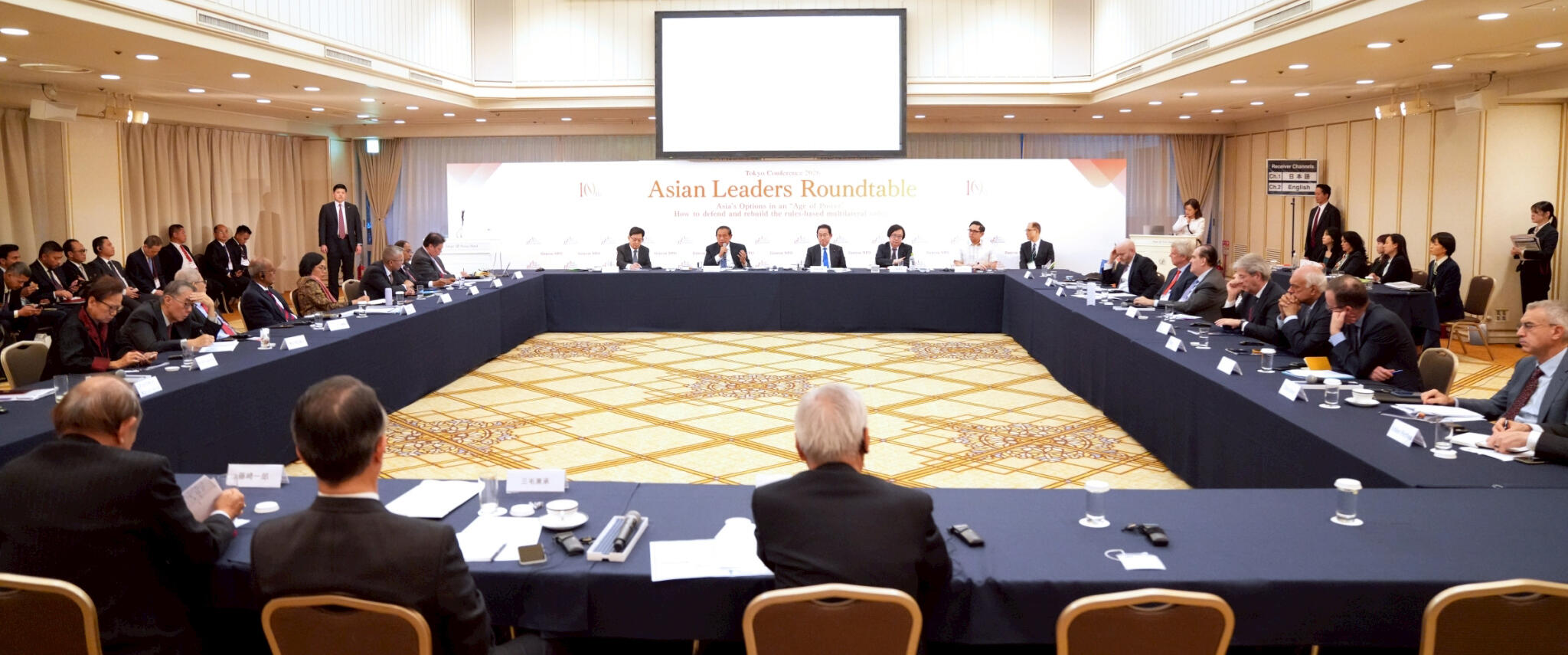
Upon completion of the opening addresses by the co-chairs, Genron president Yasushi Kudo moderated the subsequent discussions, which revolved around three guiding questions.
First, with the continued expansion of power-driven politics and transactional approaches by the major powers, how does Asia perceive the current global order? What principles or values must be protected?
Second, participants were asked to consider what actions should Asia take at the national level, at the regional level, and in cooperation with the rest of the world in light of the current global situation.
Finally, what global role should Asia aspire to realize by 2050, and how should it position itself within the global community?
The Asian Leaders Roundtable holds that Asia should not stand idly by, passively accepting the impact of changes occurring around the world. The region is an integral part of global growth and stability, and it is becoming increasingly important for the countries of Asia to demonstrate to the world the sort of international order they aim to support and defend.
The Asian Leaders Roundtable will serve as a platform through which the countries of Asia can share their visions for the future, discuss the options available, and present those ideas to the world. The plan is for the Asian Leaders Roundtable to become a regular event and to invite representatives from more countries and regions in the years to come. More articles will be posted in the coming days.
Post a comment