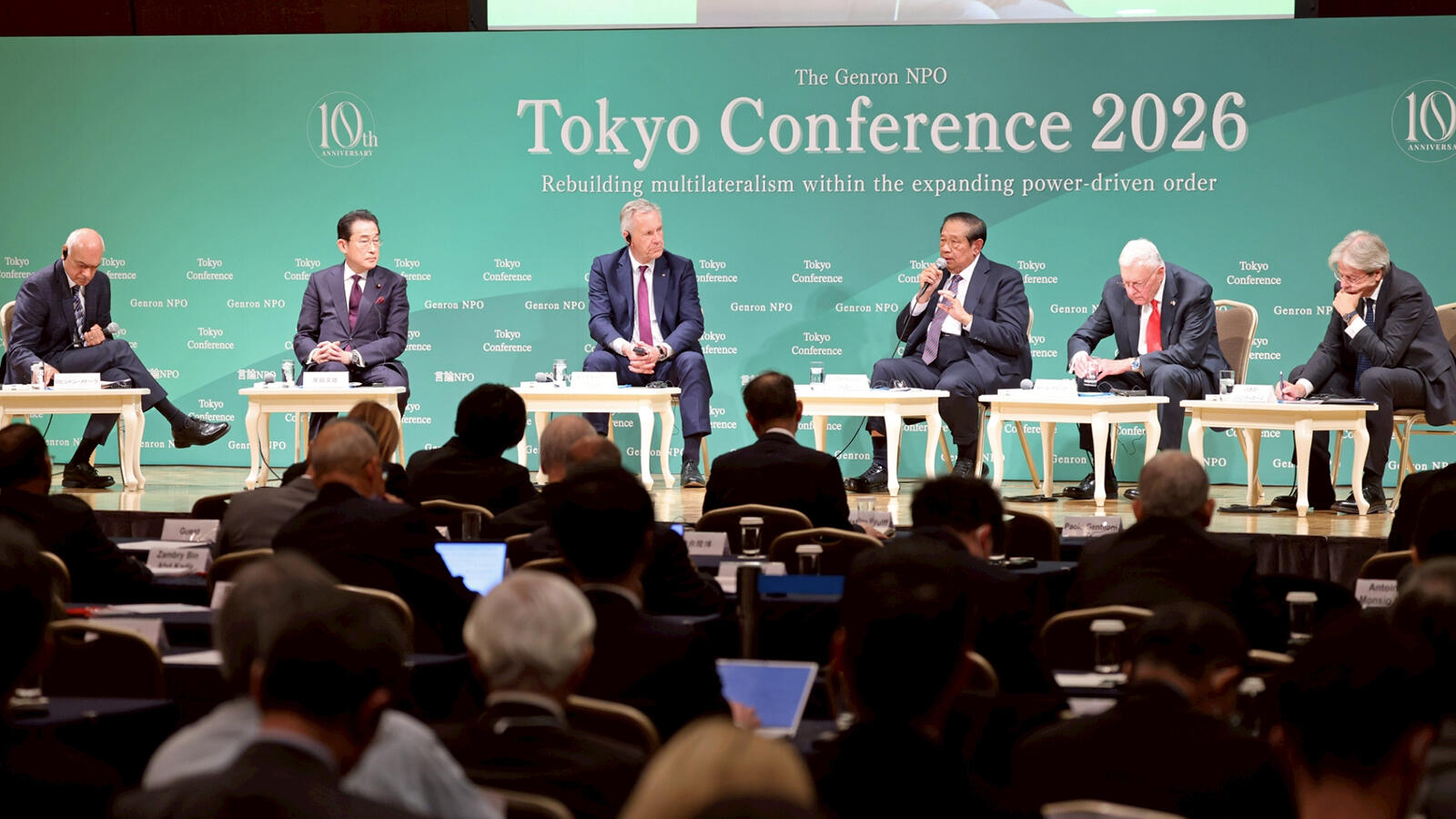
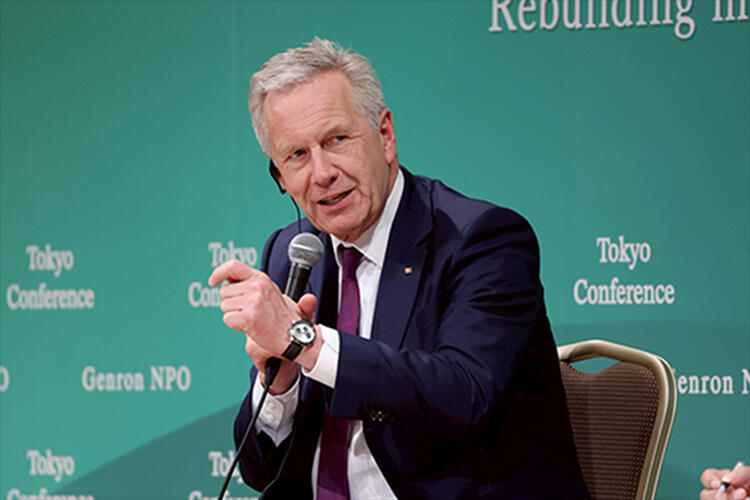
Medhora kicked off the discussion with a question aimed at Christian Wulff and Paolo Gentiloni, who he asked for their opinions on Europe's role in a potential future global order, and where the "red lines" should be drawn to prevent the current situation becoming worse.
Wulff responded first by arguing that building strength will prevent countries from becoming pawns, and emphasized that Europe is in a much better position than many believe ? including Europeans.
"Europe must not be underestimated. We have over 500 million consumers. We have lower debt than many other countries, a smaller income gap, and access to education and healthcare for all, regardless of social status. We are making progress on climate protection and are highly innovative. So, Europe will remain an important partner in the world."
He also noted that the European Union can serve as a model for the rest of the world to follow in moving towards a new future.
"In our system, every country has a commissioner in the European Commission, and every country is treated as an equal, regardless of its size. That is something Europe brings to the table ? mutual respect and appreciation ? and that can also be applied to the world."
Trust is another key for Wulff, and he explained why Japan and Germany enjoy a relatively high standing in other countries.
"They are reliable because they are trustworthy partners in development cooperation, for example," he said. "We are partners, and we must remain so. We value our partners. I believe that must be our approach, our strategy, for navigating the world."
Regarding the red lines, Wulff had a simple and clear response.
"The red lines are when someone wants to shift boundaries, when someone does not respect human dignity, when someone does not accept freedom of expression or freedom of the press. I believe we must continually discuss these red lines to ensure they do not shift, so that we do not change how we deal with others."
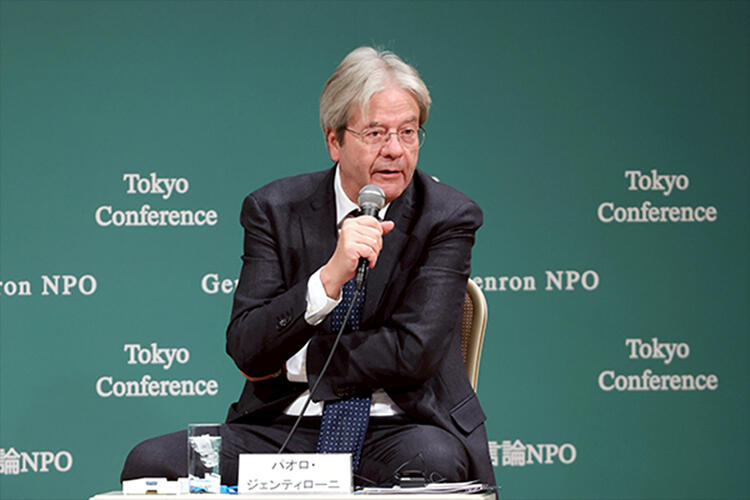
Gentiloni echoed many of Wulff's comments regarding the strengths of the European Union, but pointed out that even the EU is facing new challenges.
"Europeans had three optimistic ideas that proved to be illusions. First, the fact that we could have cheap gas from Russia. Second, that we could have an enormous Chinese market open to our manufacture without any problems. And third, that our American allies will continue to provide, themselves, the burden of European security. In these last 20 years, these three strong ideas proved to be three illusions."
Europe must now address those illusions, Gentiloni explained, and key to this is the concept of strategic autonomy
"How (do we) build our autonomy in terms of trade, of technological innovation and competitiveness, and of defense?" he asked.
While such a goal is easy to explain, he explained, it is made more difficult in the case of Europe because it is not a single state but a union of member states.
"It is predictable and safe, but very slow. And the world is changing very fast. These advantages of Europe risk becoming a liability if we are too slow."
He concluded that the current situation has had at least one silver lining.
"Paradoxically, we should thank President Trump because he has been a wake-up call for Europe. Europe (must work towards) stronger autonomy. We can't be the only herbivores in the world of carnivores."
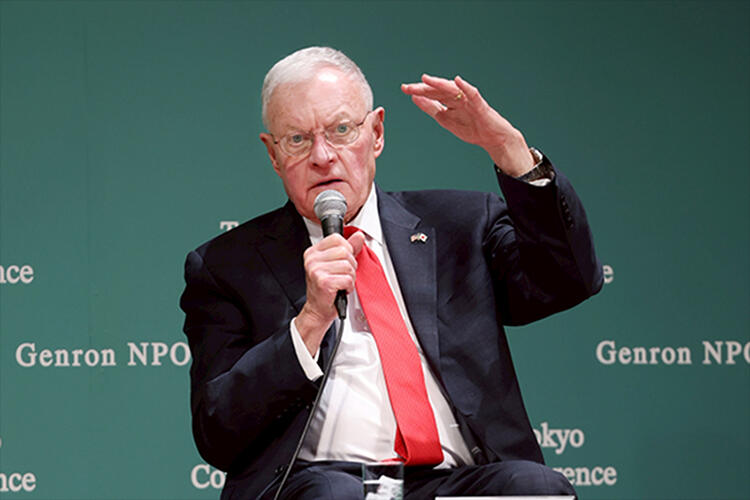
Medhora turned next to Keith Kellogg for some insight on where the relationship between the United States and China may be going.
"In the first Trump administration, we kept (those countries) we considered adversaries apart. You kept the Chinese over in this corner, the North Koreans in this corner, the Iranians in this corner, and the Russians in this corner. You got that separation between them all," Kellogg said.
He argued that it was the Biden administration, which turned away from this strategy, that caused the current situation in which "they actually joined together," and stated that the current dilemma is how to break those relationships apart again.
"Because you can attack each pretty well," he said. "When I say attack, I don't mean a kinetic attack; it's economic features first. How do you break them apart so you can actually approach them in detail?"
Kellogg then explained where the drive towards an "America First" policy came from.
"In the past we've said that America was gonna be sort of like the shield that was out there. Well, we've realized that by doing that, it was really incumbent upon the American people. So, (we knew that) we have to rely on our alliances. Buying time and building insulation. We have to make sure we can build up our own structures, primarily in the economic field, so we can compete well against the Chinese into the future."
The ultimate goal, Kellogg said, is to separate China and Russia and reduce the strength of the partnership they have entered into.
"If we do that, we figure we can work with the Chinese. We can work with the Russians. You can see what's happening in Iran right now in the Middle East, and we hope that there's some type of accommodation we can develop with China and well in the future. But again, it's not a military race, even though they are building militaries. We realize it's economic."
Medhora followed up on Kellogg's keynote, asking if there is "room for a deal" if both the United States and China are following a "Our Nation First" policy, and Kellogg stated that any deal between Russia and the US will need to include China. He also pointed out that Trump's relationships with both Russian President Vladimir Putin and Chinese President Xi Jinping will make dialogue easier.
Next, Medhora asked Susilo Bambang Yudhoyono to expand on what he sees as Asia's role in the future.
"I think countries in Asia have the opportunity to play more roles in the future. It's not only how we could maintain our stability and security in this region, or how we could continue growing our economies. We could do many things to accomplish the global agenda in saving our planet and reducing poverty across the globe."
Yudhoyono pointed to regional architecture such as ASEAN as an example of how Asia could contribute.
"If we could empower these regional architectures, I think there will be many options. There will be many solutions to existing problems that we are facing together."
Yudhoyono also stated that Asia has a limited ability to intervene directly in moderating the friction between China and the United States, but it may be possible to guide them in a positive direction.
"I don't think that any country can stop the rivalry between the two great powers, but we could appeal to both sides," he explained. "There must be another agenda on which two countries can cooperate and serve as an example to this region for a better Asia: economically, politically, and in terms of security."
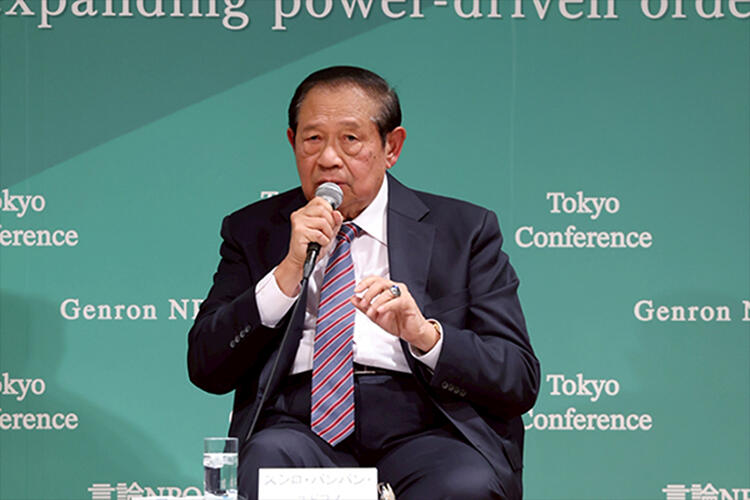
Medhora praised Fumio Kishida's support of multilateralism and asked what role he sees Japan playing in a reconstructed world order.
"That is why we started the Asian Leaders Roundtable, so that Asian stakeholders can think together multilateralism and its future," Kishida answered. "The objective is to engage in dialogue, and our first roundtable (held March 10) went well."
He suggested that the Asian focus on economic multilateralism in the past could be adjusted in the future to account for other issues, including decarbonization and security, but ultimately, Asia has to think about its own future, and this is where Japan has a role to play.
"We feel that it is our responsibility. The direction we take going forward should be determined precisely through a multilateral approach by steadily engaging in dialogue with many countries across Asia. The first step was taken yesterday, and we hope to continue engaging in dialogue with other countries around Asia, with Japan stepping up to offer a venue for us to gather and think about our mutual future."
Medhora returned to Wulff at this point and asked him to describe why empathy is so important and what governments can do to promote it. Wulff began by reminding attendees how the current global order had been built in the first place.
"After the two world wars of the 20th century, together we founded the United Nations. And everyone said: no more war, no more fighting against minorities, no more persecution of minorities, no more backroom diplomacy. But now forgetting is winning out over remembering. We must clearly remember why we founded the United Nations."
However, he also pointed out that the United Nations does not reflect the world as it is today.
"The veto countries have held veto rights since World War II, but India has 1.4 billion people and Indonesia has 300 million people. They are not permanently represented on the Security Council, and certainly haven't got veto power."
Wulff then shifted the spotlight to Africa.
"Africa as a continent has a huge number of young people, a great deal of innovation, significant growth, a lot of spirit, and a great deal of initiative, none of which is reflected in the United Nations. As representatives of different continents here, we must work together to listen more and be more responsive to one another," he said.
This, to Wulff, is both where empathy comes from and why it is so important to have.
"That is empathy. Not just seeing with your own two eyes, but also through the eyes of the other person. That is why I am so focused on Indonesia, because there we see a vast country, a democracy with diverse religions enshrined in its constitution as 'unity in diversity.' In Jakarta, there's a tunnel between the Muslim mosque and the Catholic cathedral, the Tunnel of Friendship. Young Muslims and young Christians who are interested in one another can spend a whole weekend learning about the other religion," Wulff said. "To me, these are the heroes, not the people who only see their own interests."
Wrapping up his point, Wulff pointed a finger at another issue he sees as vital: the lack of representation.
"Most problems are caused by old men who are afraid of no longer being taken seriously. We need to put more women and more young people in positions of responsibility and approach everything with more empathy. Then we'd have fewer problems."
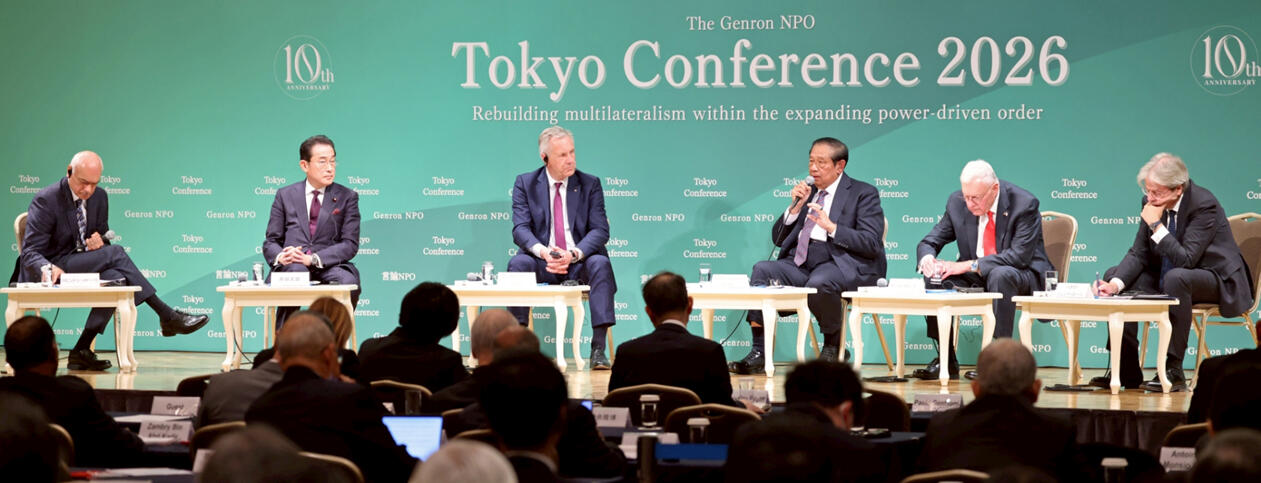
Finally, Medhora asked the panelists about how the rule of law has been handled thus far, and what is in store for the future.
"The 'Rule of law' is not only international rules themselves, but the respect for the rule of law as part of a democratic system," Gentiloni said, before acceding a point made by Kellogg that disregard for the rule of law is not recent. However, Gentiloni believes that what is happening now differs from what was experienced in the past, and that it is very dangerous.
"The second war of the Gulf was when the US made an enormous effort to try to convince (the United Nations that the invasion of) Iraq was justified on the basis of international rules," he said. "We can say that the rules were forgotten at the time, but the effort was enormous. If we compare that effort to the situation now, nothing similar is happening."
Gentiloni then predicted that the next decade will see the start of a new nuclear arms race, "Because non-proliferation treaties will be considered insignificant. Many countries will try to build their own nuclear capacity. I don't think that we can accept a world of this kind."
"We all know the weaknesses of the UN, WTO, you name it," he concluded. "But if we don't work to strengthen them, we are working against peace and prosperity."
In contrast, Kellogg criticized the way rule of law has been handled thus far as being the result of "cowardice."
"Why do countries vote against UN resolutions that condemn the war in Ukraine?" he asked. "They talk about the rule of law. People hide behind the rule of law when you have to aggressively stop what happened."
Kellogg pointed to Neville Chamberlain's appeasement policy regarding German expansionism in 1938 as an example of when aggression was needed.
"You have to draw a line, and sometimes that line is hard. I prefer my sons and their sons and daughters don't go to war next time. It sounds harsh, but too many times nations have hidden behind the term 'rule of law.'"
Yudhoyono added his thoughts regarding rule of law, calling it the "child of justice."
"Rule of law is an important element of democracy," he continued. "We fight for democracy by using rule of law to say no to authoritarianism."
Yudhoyono stressed that rule of law is useful in constraining the powers of leaders and countries that violate the norms of international relations.
"Power must be checked by other powers, because as everybody knows, power tends to corrupt, and absolute power tends to corrupt absolutely."
Yudhoyono believes a safe first step would be for the world to return to the fundamental principle underlying the rule of law; namely, that of respecting international laws regarding warfare and humanitarian conventions.
Wulff added to this, paraphrasing Aristotle by stressing that improving the world is simple.
"When many people work toward a better world, it gets better. And if many people don't work toward it, or if they hold back, or if they work toward something bad, then it gets worse," he said.
Wulff also believes that advocating for rules and ensuring everyone follows them is an inherently positive thing, but admitted that this is a qualified statement.
"How to deal with the dilemma in which people are refusing to abide by law and order, in which people murdering and tyrannizing their own people as in Iran, well, that is another question. In cases where there is such disregard for the law, I can understand why people would resort to violence. But the fundamental principle must be that people create rules and follow them."
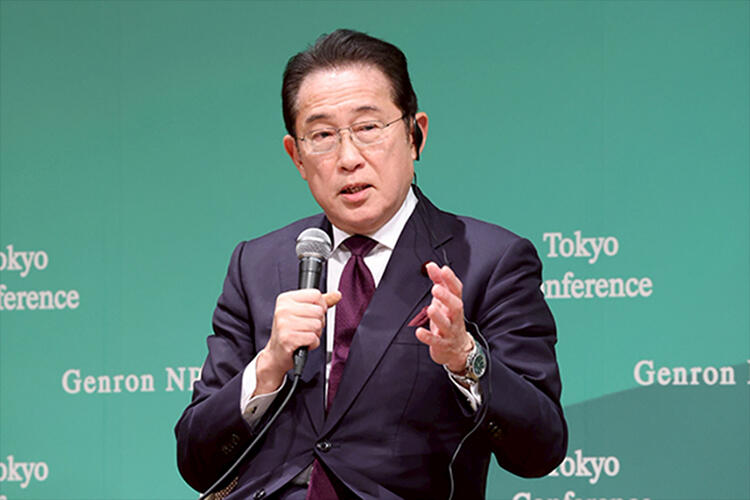
Last to speak was Fumio Kishida, who expressed concern that attempts to change the status quo by force or coercion will continue to be an issue in the future, but added that discussing those rules and how to follow them remains essential.
"I fully recognize that there have been times in the past when (the rule of law) was not thoroughly implemented, but believe that continuing to discuss this ideal of rule of law will send a valuable message to many countries. Russia's invasion of Ukraine began when I was Prime Minister, and I attended the NATO Summit to argue that today's Ukraine could be tomorrow's East Asia, and that such attempts to change the status quo by force must not be tolerated," Kishida explained.
"If the rule of law is not upheld on a sustained basis, there is a risk that other governments will come to believe that they too can change the status quo by force, which will lead to further instability. The international community must continue to make every effort to uphold the principle of the rule of law."
This brought the panel discussion to an end, and after a brief intermission the first session of the Public Forum began. (See other article for details.)
Post a comment